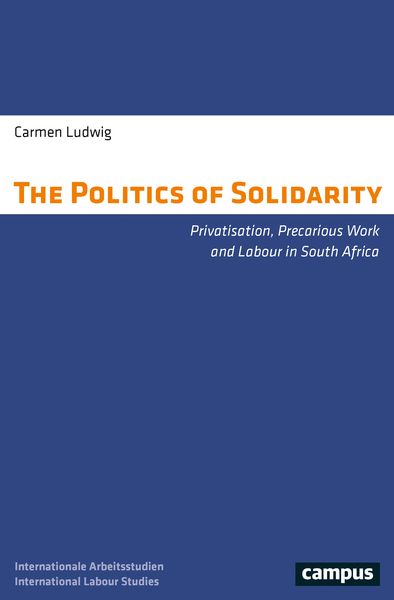
Produktbild: The Politics of Solidarity
Band 22

The Politics of Solidarity Privatisation, Precarious Work and Labour in South Africa

Aus der Reihe Labour Studies

46,60 €

inkl. gesetzl. MwSt., Versandkostenfrei


Beschreibung

Produktdetails

Einband

Taschenbuch

Erscheinungsdatum

19.06.2019

Verlag

Campus

Seitenzahl

379

Maße (L/B/H)

21,3/14,1/2,5 cm

Gewicht

473 g

Auflage

1

Sprache

Englisch

ISBN

978-3-593-51047-7

Beschreibung

Produktdetails

Einband

Taschenbuch

Erscheinungsdatum

19.06.2019

Verlag

Campus

Seitenzahl

379

Maße (L/B/H)

21,3/14,1/2,5 cm

Gewicht

473 g

Auflage

1

Sprache

Englisch

ISBN

978-3-593-51047-7

Herstelleradresse

Beltz Verlagsgruppe GmbH & Co. KG
Werderstr. 10
69469 Weinheim
DE
info@campus.de

Kundinnen und Kunden meinen

0 Bewertungen

Informationen zu Bewertungen

Zur Abgabe einer Bewertung ist eine Anmeldung im Konto notwendig. Die Authentizität der Bewertungen wird von uns nicht überprüft. Wir behalten uns vor, Bewertungstexte, die unseren Richtlinien widersprechen, entsprechend zu kürzen oder zu löschen.

Die Bewertungen sind nach Format, Anzahl Sterne und Datum sortiert.

Verfassen Sie die erste Bewertung zu diesem Artikel

Helfen Sie anderen Kund*innen durch Ihre Meinung

Kundinnen und Kunden meinen

0 Bewertungen filtern

Die Leseprobe wird geladen.
  • Produktbild: The Politics of Solidarity
  • Table of Contents
    Acknowledgements 9
    1 Introduction 13
    1.1 Central Research Question and Aims of Research 16
    1.2 Overview of the Book 18
    2 Theoretical Framework: Solidarity and Trade Union Power Resources 21
    2.1 Scales of Power: Conceptualising Workers’ Power Resources 21
    2.2 Power through Organisation 31
    2.3 The Power to Disrupt Within and Outside the Workplace 35
    2.4 Society as an Ally 37
    2.5 The Dual Character of Institutional Power 40
    2.6 Trade Union Strategies between Inclusive and Exclusive Solidarity 42
    2.7 Interim Conclusion and Stages of Inquiry 44
    3 Methodology and Research Design 47
    3.1 Setting the Stage: The Selection of the Three Research Sites 48
    3.2 Participant Observation and Problem-centred Interviews 51
    3.3 Analysing the Field with the Extended Case Method 61
    3.4 Conducting Research in a Contested Field 64
    4 From Apartheid to Post-Apartheid: Labour in a Contested Terrain 69
    4.1 Contesting the Labour Regime, Building Associational Power: A Brief History of the South African Labour Movement 69
    4.2 From the Freedom Charter to GEAR: Conflicts within the Alliance on Macroeconomic Policy 78
    4.3 Privatising Local Government: The Legislative Framework 83
    4.4 The Fragmentation of the South African Labour Market: Core, Non-core, Periphery 89
    4.5 The South African Labour Movement at a Crossroads 96
    5 Privatisation and the Commodification of Public Services in Johannesburg and Cape Town 105
    5.1 The Post-Apartheid Challenge: Restructuring Johannesburg 106
    5.2 Hollowing out the local state: iGoli 2002 110
    5.3 The SAMWU Response to iGoli 2002 116
    5.4 Restructuring and Privatisation in Cape Town 127
    5.5 The SAMWU Response to Privatisation 136
    6 A Partial Inclusive Union Strategy: Organising a Fragmented Municipal Workforce in Johannesburg 141
    6.1 Facing the Divide: The increasing Fragmentation of the Workforce in Pikitup 141
    6.2 Contesting what a Labour Broker is: The Triangular Employment Relationship in Pikitup 153
    6.3 The Manufacturing of Insecurity in the Workplace 160
    6.4 The Pikitup Strike of 2011 166
    6.5 Failing Interactions between Contract Workers and SAMWU 195
    6.6 A Sense of Belonging: CWP Workers seeking Union Representation 209
    6.7 Interim Conclusion: A Partial Inclusive Strategy of Union Representation 218
    7 An Inclusive Union Strategy: Organising a Fragmented Municipal Workforce in Cape Town 221
    7.1 Confronting the Effects of Privatisation in Cape Town 221
    7.2 Experiences in Organising Workers in Private Waste Companies 237
    7.3 The Campaign against Labour Broking in Cape Town 245
    7.4 An Uphill Battle: Taking up the Struggle of EPWP Workers 256
    7.5 Mobilising Power Resources: Extending the Core 288
    7.6 Logistical Power and the Contested Post-Apartheid Order 290
    7.7 Discursive Power and the Legitimacy of Claims 294
    7.8 Labour and Community Alliances in Cape Town 296
    7.9 Interim Conclusion: An Inclusive Union Strategy 302
    8 An Exclusive Union Strategy: Organising a Fragmented Municipal Workforce in Ekurhuleni 305
    8.1 Conditions and Effects of Outsourcing in the Ekurhuleni Metropolitan Municipality 305
    8.2 “SAMWU we need our jobs back”: Cleaning Workers in Ekurhuleni 311
    8.3 Alternative Forms of Organisation: The Casual Workers Advice Office in Germiston 318
    8.4 Exclusive Solidarity: SAMWU’s Strategy towards Non-core Workers 320
    9 Conclusion 325
    Figures 335
    Tables 337
    Abbreviations 339
    References 342
    Index 377