Gutscheinbedingungen

**Gültig bis 14.09.2026 auf Spielzeug, Schreibwaren, Filme, Geschenke & Trends, Musik, tolino eReader & Zubehör, Hörbücher, nicht preisgebundene Bücher und Kalender in der Thalia App. Einzelne Artikel können ausgeschlossen sein. Aufgrund der Buchpreisbindung sind deutschsprachige Bücher und eBooks ausgenommen. Zusätzlich ausgenommen sind Abos & Flatrates, Games, Geschenkkarten/-boxen, Shelfies, Software, Zeitschriften sowie einzelne Artikel von tonies®. Pro Einkauf einmal einlösbar. Nur gültig mit im Onlineshop hinterlegter Bonuscard. Click & Collect nur bei Onlinevorabzahlung möglich. Keine Barauszahlung. Nicht kombinierbar mit anderen Aktionen und Gutscheinen. Gutschein wird auf max. 500€ Bestellwert angerechnet. Nicht gültig für Versandkosten und Services.

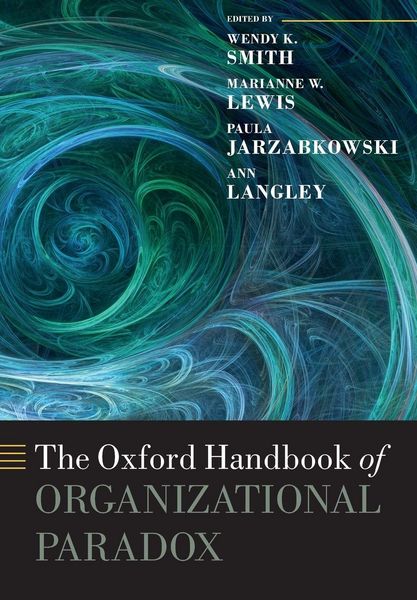
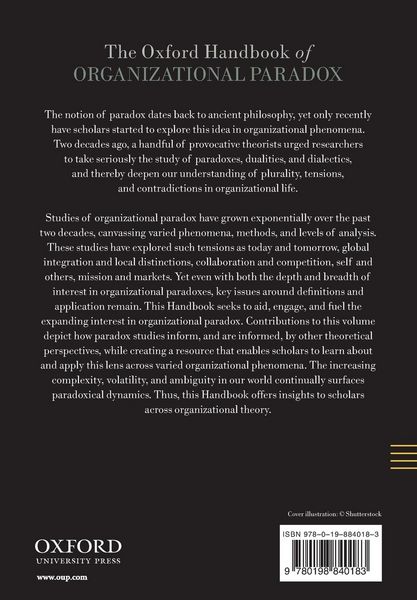
  • Produktbild: The Oxford Handbook of Organizational Paradox
  • Produktbild: The Oxford Handbook of Organizational Paradox

The Oxford Handbook of Organizational Paradox

82,99 €

inkl. gesetzl. MwSt., Versandkostenfrei


Beschreibung

Produktdetails

Einband

Taschenbuch

Erscheinungsdatum

14.03.2019

Herausgeber

Wendy K. Smith + weitere

Verlag

Oxford University Press

Seitenzahl

622

Maße (L/B/H)

24,4/17/3,4 cm

Gewicht

1057 g

Sprache

Englisch

ISBN

978-0-19-884018-3

Beschreibung

Produktdetails

Einband

Taschenbuch

Erscheinungsdatum

14.03.2019

Herausgeber

Verlag

Oxford University Press

Seitenzahl

622

Maße (L/B/H)

24,4/17/3,4 cm

Gewicht

1057 g

Sprache

Englisch

ISBN

978-0-19-884018-3

Herstelleradresse

Libri GmbH
Europaallee 1
36244 Bad Hersfeld
DE

Email: gpsr@libri.de

Noch keine Bewertungen vorhanden

Verfassen Sie die erste Bewertung zu diesem Artikel

Helfen Sie anderen Kundinnen und Kunden durch Ihre Meinung.

Kundinnen und Kunden meinen

Bewertungen (0)

Die Leseprobe wird geladen.
  • Produktbild: The Oxford Handbook of Organizational Paradox
  • Produktbild: The Oxford Handbook of Organizational Paradox
    • Foreword

    • Introduction

    • Part I: Foundations and Approaches

    • 1: Jonathan Schad: Ad Fontes: Philosophical Foundations of Paradox Research

    • 2: Michael Jarrett and Russ Vince: Psychoanalytic Theory, Emotion and Organizational Paradox

    • 3: Josh Keller and Erica Wen Chen: A Roadmap of the Paradoxical Mind: Expanding Cognitive Theories on Organizational Paradox

    • 4: Robin Holt and Mike Zundel: What Paradox?: Developing a Process Syntax for Organizational Research

    • 5: Stewart Clegg and Miguel Pinha de Cuhna: Organizational Dialectics

    • 6: Robert Chia and Ajit Nayak: Cultural: Eastern vs. Circumventing the Logic and Limits of Representation: Otherness in East-West Approaches to ParadoxApproaches

    • Part II: Paradoxical Phenomena in and Beyond Organizations

    • 7: Koen van Bommel and Andre Spicer: Critical Management Studies and Paradox

    • 8: Paul Tracey and Doug Creed: Beyond Managerial Dilemmas: The Study of Institutional Paradoxes in Organization Theory

    • 9: Marya Besharov and Garima Sharma: Paradoxes of Organizational Identity

    • 10: Mariline Comeau-Vallée, Jean-Louis Denis, Julie-Maude Normandin, and Marie-Christine Therrien: Alternate Prisms for Pluralism and Paradox in Organizations

    • 11: Kim Cameron: Paradox in Positive Organizational Scholarship

    • 12: Jean-Pascal Gond, Christiane Demers, and Valerie Michaud: Managing Normative Tensions Within and Across Organizations: What can the Economies of Worth and Paradox Frameworks Learn From Each Other?

    • 13: John Sillince and Ben Golant: The Role of Irony and Metaphor in Working through Paradox During Organizational Change

    • 14: Richard Badham: Reflections on the Paradoxes of Modernity: A Conversation with James March

    • 15: Maria Bengtsson and Tatbeeq Raza-Ullah: Paradox at an Inter-firm Level: A Coopetition Lens

    • 16: Sebastian Raisch and Alexander Zimmermann: Pathways to Ambidexterity: A Process Perspective on the Exploration-Exploitation Paradox

    • 17: Linda L. Putnam and Karen L. Ashcraft: Gender and Organizational Paradox

    • 18: Jason Jay, Sara Soderstrom, and Gabriel Grant: Navigating the Paradoxes of Sustainability

    • 19: Natalie Slawinski and Tima Bansal: The Paradoxes of Time in Organizations

    • 20: Hari Tsoukas and Miguel Pinha de Cuhna: On Organizational Circularity: Vicious and Virtuous Circles in Organizing

    • 21: Ina Aust and Julia Brandl: Tensions in Managing Human Resources: Introducing a Paradox Framework and Research Agenda

    • 22: Ella Miron-Spektor and Miriam Erez: Looking at Creativity Through a Paradox Lens: Deeper Understanding and New Insights

    • 23: Matthew Sheep, Glen Kreiner, and Gail Fairhurst: "I am...I said": Paradoxical Tensions of Individual Identity

    • 24: Eliana Crosina and Jean Bartunek: The Paradoxical Mystery of the Missing Differences Between Academics and Practitioners

    • 25: Jane Le and Rebecca Bednarek: Paradox in Everyday Practice: Applying Practice-Theoretical Principles to Paradox

    • Part III: Engaging Paradoxes

    • 26: Costas Andriopoulos and Manto Gotsi: Methods of Paradox

    • 27: Eric Knight and Sotirios Paroutis: Expanding Paradox-Pedagogy Links: Paradox as a Threshold Concept in Management Education

    • 28: Cliff Kayser, Margaret Seidler, and Barry Johnson: Paradox and Polarities: Finding Common Ground and Moving Forward Together: A Case Study of Polarity Thinking and Action in Charleston, South Carolina