KI-Beratung Beta

Gutscheinbedingungen

**Gültig am 27.11.2026 auf Spielzeug, Schreibwaren, Filme, Geschenke & Trends, Musik, tolino eReader & Zubehör, Hörbücher und Hörbuch-Downloads, nicht preisgebundene Bücher und Kalender online auf thalia.at und in der Thalia App. Einzelne Artikel können ausgeschlossen sein. Aufgrund der Buchpreisbindung sind deutschsprachige Bücher und eBooks ausgenommen. Zusätzlich ausgenommen sind Abos & Flatrates, Games, Geschenkkarten/-boxen, Shelfies, Software, Zeitschriften sowie einzelne Artikel von tonies®. Pro Einkauf einmal einlösbar. Click & Collect nur bei Onlinevorabzahlung möglich. Keine Barauszahlung. Nicht kombinierbar mit anderen Aktionen und Gutscheinen. Gutschein wird auf max. 500€ Bestellwert angerechnet. Nicht gültig für Versandkosten und Services.

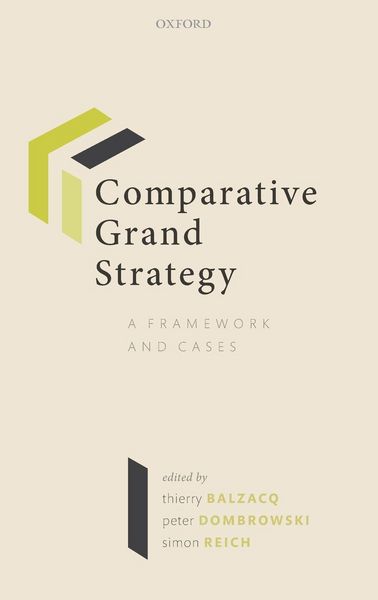
Produktbild: Comparative Grand Strategy

Comparative Grand Strategy A Framework and Cases

194,99 €

inkl. gesetzl. MwSt., Versandkostenfrei


Beschreibung

This book develops a new approach in explaining how a nation's Grand Strategy is constituted, how to assess its merits, and how grand strategies may be comparatively evaluated within a broader framework. The volume responds to three key problems common to both academia and policymaking. First, the literature...

Beschreibung

This book develops a new approach in explaining how a nation's Grand Strategy is constituted, how to assess its merits, and how grand strategies may be comparatively evaluated within a broader framework. The volume responds to three key problems common to both academia and policymaking. First, the literature on the concept of grand strategy generally focuses on the United States, offering no framework for comparative analysis. Indeed, many proponents of US grand strategy suggest that the concept can only be applied, at most, to a very few great powers such as China and Russia. Second, characteristically it remains prescriptive rather than explanatory, ignoring the central conundrum of why differing countries respond in contrasting ways to similar pressures. Third, it often understates the significance of domestic politics and policymaking in the formulation of grand strategies - emphasizing mainly systemic pressures. This book addresses these problems. It seeks to analyze and explain grand strategies through the intersection of domestic and international politics in ten countries grouped distinctively as great powers (The G5), regional powers (Brazil and India) and pivotal powers hostile to each other who are able to destabilize the global system (Iran, Israel, and Saudi Arabia). The book thus employs a comparative framework that describes and explains why and how domestic actors and mechanisms, coupled with external pressures, create specific national strategies. Overall, the book aims to fashion a valid, cross-contextual framework for an emerging research program on grand strategic analysis.

Produktdetails

Einband

Gebundene Ausgabe

Erscheinungsdatum

28.07.2019

Herausgeber Thierry Balzacq + weitere
Verlag Oxford University Press

Produktdetails

Einband

Gebundene Ausgabe

Erscheinungsdatum

28.07.2019

Herausgeber
Verlag Oxford University Press
Seitenzahl

368

Maße (L/B/H)

24/16,1/2,4 cm

Gewicht

666 g

Sprache

Englisch

ISBN

978-0-19-884084-8

Herstelleradresse

Libri GmbH
Europaallee 1
36244 Bad Hersfeld
DE

Email: gpsr@libri.de

Noch keine Bewertungen vorhanden

Verfassen Sie die erste Bewertung zu diesem Artikel

Helfen Sie anderen Kundinnen und Kunden durch Ihre Meinung.

Kundinnen und Kunden meinen

Bewertungen (0)

Die Leseprobe wird geladen.
  • Produktbild: Comparative Grand Strategy
    • 1: Thierry Balzacq, Peter Dombrowski, and Simon Reich: Introduction: Comparing Grand Strategies in the Modern World
    • Part I - Major Powers
    • 2: Peter Dombrowski and Simon Reich: United States
    • 3: Céline Marangé: Russia
    • 4: Andrew S. Erickson: China
    • 5: Thierry Balzacq: France
    • 6: Robert Johnson: Great Britain
    • Part II - Pivotal Powers
    • 7: Carlos R. S. Milani and Tiago Nery: Brazil
    • 8: C. Christine Fair: India
    • 9: Thierry Balzacq and Wendy Ramadan-Alban: Iran
    • 10: Eitan Shamir: Israel
    • 11: Ghaidaa Hetou: Saudi Arabia
    • 12: Daniel Fiott and Luis Simon: European Union
    • 13: Norrin Ripsman: Conclusion: The Emerging Sub-field of Comparative Grand Strategy