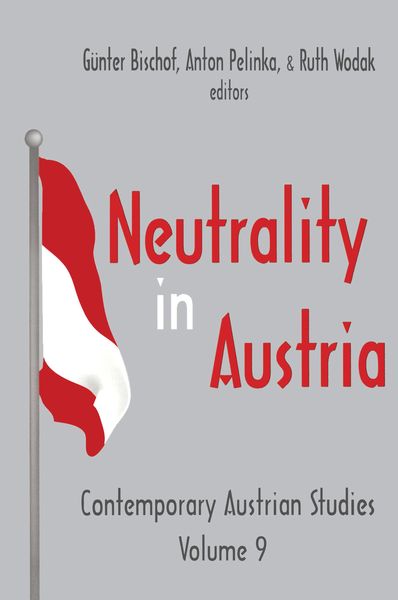
Neutrality in Austria
-
Form:Einzelkauf Download
-
Sprache:Englisch
-
eBook Format:PDF
- ePUB 3 72,00 €
- PDF 72,00 € ausgewählt
72,00 €
inkl. gesetzl. MwSt.Beschreibung
Produktdetails
Format
Kopierschutz
Ja
Family Sharing
Nein
Text-to-Speech
Nein
Erscheinungsdatum
17.04.2018
Herausgeber
Gunter Bischof + weitereVerlag
Taylor & Francis eBooksSeitenzahl
752 (Printausgabe)
Dateigröße
22324 KB
Auflage
1. Auflage
Sprache
Englisch
EAN
9781351308830
After Stalin's death, during a respite in Cold War tensions in 1955, Austria managed to rid itself of a quadripartite occupation regime and become a neutral state. As the Cold War continued, Austria's policy of neutrality helped make this small country into an important mediator of East-West differences, and neutrality became a crucial part of Austria's postwar identity. In the post-Cold War era Austrian neutrality seems to demand redefinition. The work addresses such issues as what neutrality means when Austria's neighbors are joining NATO? What is the difference between Austrian neutrality in 1955 and 2000? In remaining apart from NATO, do Austrian elites risk their nation's national security? Is Austria a "free rider," too stingy to contribute to Western defense? Has the neutralist mentalit become such a crucial part of Austrian postwar identity that its abandonment will threaten civil society? These questions are addressed in this latest in the prestigious Contemporary Austrian Studies series.
The volume emerged from the Wittgenstein Research Center project on "Discourse, Politics, and Identity," an interdisciplinary investigation of the meaning of Austrian neutrality. The first two chapters analyze the current meaning of Austrian neutrality. Karin Liebhart records narrative interviews with former presidents Rudolf Kirchschlger and Kurt Waldheim, both central political actors present at the creation and implementation of Austria's postwar neutrality. Gertraud Benke and Ruth Wodak provide in-depth analysis of a debate on Austrian National Television on "NATO and Neutrality," a microcosm of Austrian popular opinion that exposed all positions and ideological preferences on neutrality. The historian Oliver Rathkolb surveys international perceptions of Austrian neutrality over the past half-century. For comparative contrast David Irwin and John Wilson apply Foucault's theoretical framework to the history and debates on neutrality in Ireland. Political scientists Heinz Grtner and Paul Luif provide examples of how Austrian neutrality has been handled in the past and today. Michael Gehler analyzes Austria's response to the Hungarian crisis of 1956 and Klaus Eisterer reviews the Austrian legation's handling of the 1968 Czechoslovak crisis.
Gnter Bischof is professor of history and executive director of Center Austria at the University of New Orleans. Anton Pelinka is professor of political science at the University of Innsbruck and director of the Institute of Conflict Research in Vienna. Ruth Wodak is professor in the linguistics department at the University of Vienna and director of the research center "Discourse, Politics, Identity" at the Austrian Academy of Science.
Kundinnen und Kunden meinen
Verfassen Sie die erste Bewertung zu diesem Artikel
Helfen Sie anderen Kund*innen durch Ihre Meinung
Kurze Frage zu unserer Seite
Vielen Dank für Ihr Feedback
Wir nutzen Ihr Feedback, um unsere Produktseiten zu verbessern. Bitte haben Sie Verständnis, dass wir Ihnen keine Rückmeldung geben können. Falls Sie Kontakt mit uns aufnehmen möchten, können Sie sich aber gerne an unseren Kund*innenservice wenden.
zum Kundenservice