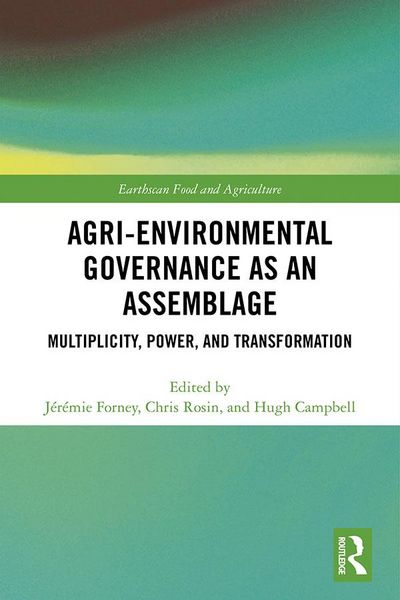
Agri-environmental Governance as an Assemblage Multiplicity, Power, and Transformation
-
- Hardcover
- Taschenbuch
- eBook ausgewählt
-
Form:Einzelkauf Download
-
Sprache:Englisch
64,30 €
inkl. gesetzl. MwSt.Beschreibung
Produktdetails
Format
Kopierschutz
Ja
Family Sharing
Nein
Text-to-Speech
Nein
Erscheinungsdatum
28.03.2018
Herausgeber
Jérémie Forney + weitereVerlag
Taylor & Francis eBooksSeitenzahl
246 (Printausgabe)
Dateigröße
5122 KB
Auflage
1. Auflage
Sprache
Englisch
EAN
9781351629201
In recent decades, the governance of the environment in agri-food systems has emerged as a crucial challenge. A multiplicity of actors have been enrolled in this process, with the private sector and civil society progressively becoming key components in a global context often described as neoliberalization. Agri-environmental governance (AEG) thus gathers a highly complex assemblage of actors and instruments, with multiple interrelations.
This book addresses this complexity, challenging traditional modes of research and explanation in social science and agri-food studies. To do so, it draws on multiple theoretical and methodological insights, applied to case studies from Asia, Europe, Africa, and the Americas. It elaborates an emergent approach to AEG practices as assemblages, looking at the coming-together of multiple actors with diverse trajectories and objectives. The book lays the foundations for an encompassing theoretical framework that transcends pre-existing categories, as well as promoting innovative methodologies, which integrate the role of social actors - including scientists - in the construction of new assemblages. The chapters define, first, the multiplicities and agencies inherent to AEG assemblages. A second set tackles the question of the politics in AEG assemblages, where political hierarchies interweave with economic power and the search for more democratic and participative approaches. Finally, these insights are developed in the form of assemblage practice and methodology. The book challenges social scientists to confront the shortcomings of existing approaches and consider alternative answers to questions about environmental governance of agri-food systems.
Noch keine Bewertungen vorhanden
Verfassen Sie die erste Bewertung zu diesem Artikel
Helfen Sie anderen Kundinnen und Kunden durch Ihre Meinung.
Kurze Frage zu unserer Seite
Vielen Dank für Ihr Feedback
Wir nutzen Ihr Feedback, um unsere Produktseiten zu verbessern. Bitte haben Sie Verständnis, dass wir Ihnen keine Rückmeldung geben können. Falls Sie Kontakt mit uns aufnehmen möchten, können Sie sich aber gerne an unseren Kund*innenservice wenden.
zum Kundenservice