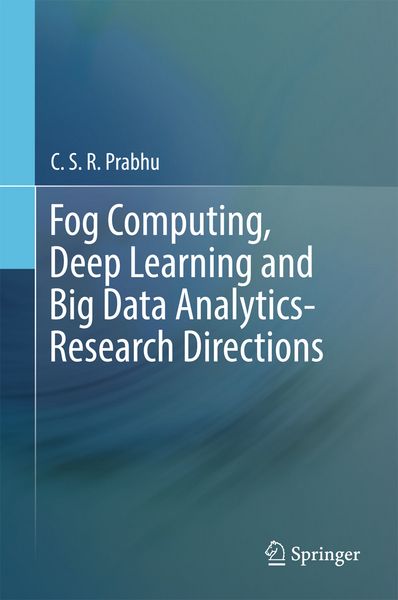
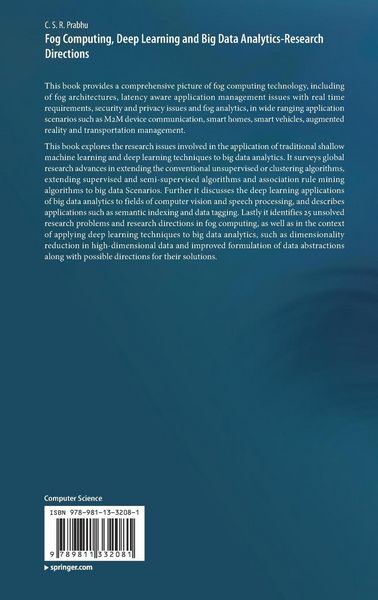
• Produktbild: Fog Computing, Deep Learning and Big Data Analytics-Research Directions
  • Produktbild: Fog Computing, Deep Learning and Big Data Analytics-Research Directions
- 12%

Fog Computing, Deep Learning and Big Data Analytics-Research Directions

12% sparen

134,99 € UVP 153,99 €

inkl. gesetzl. MwSt., Versandkostenfrei


Beschreibung

Produktdetails

Einband

Gebundene Ausgabe

Erscheinungsdatum

16.01.2019

Abbildungen

XIII, 5 illus., 1 illus. in color., schwarz-weiss Illustrationen, farbige Illustrationen

Verlag

Springer Singapore

Seitenzahl

71

Maße (L/B/H)

24,1/16/1,1 cm

Gewicht

307 g

Auflage

1st edition 2019

Sprache

Englisch

ISBN

978-981-13-3208-1

Beschreibung

Produktdetails

Einband

Gebundene Ausgabe

Erscheinungsdatum

16.01.2019

Abbildungen

XIII, 5 illus., 1 illus. in color., schwarz-weiss Illustrationen, farbige Illustrationen

Verlag

Springer Singapore

Seitenzahl

71

Maße (L/B/H)

24,1/16/1,1 cm

Gewicht

307 g

Auflage

1st edition 2019

Sprache

Englisch

ISBN

978-981-13-3208-1

Herstelleradresse

Springer-Verlag GmbH
Tiergartenstr. 17
69121 Heidelberg
DE

Email: ProductSafety@springernature.com

Noch keine Bewertungen vorhanden

Verfassen Sie die erste Bewertung zu diesem Artikel

Helfen Sie anderen Kundinnen und Kunden durch Ihre Meinung.

Kundinnen und Kunden meinen

Bewertungen (0)

  • Produktbild: Fog Computing, Deep Learning and Big Data Analytics-Research Directions
  • Produktbild: Fog Computing, Deep Learning and Big Data Analytics-Research Directions
  • 1 Introduction
    1.1. A new economy based on IOT emerging by 2015
    1.1.1 Emergence of IOT
    1.1.2 Smart Cities and IOT
    1.1.3 Stages of IOT and Stakeholders
    1.1.3.1 Stages of IOT
    1.1.3.2 Stakeholders
    1.1.3.3 Practical Down Scaling
    1.1.4 Analytics
    1.1.5 Analytics from the Edge to Cloud [179]
    1.1.6 Security and Privacy Issues and Challenges in Internet of Things (IOT)
    1.1.7 Access
    1.1.8 Cost Reduction
    1.1.9 Opportunities and Business Model
    1.1.10 Content and Semantics
    1.1.11 Data based Business models coming out of IOT
    1.1.12 Future of IOT
    1.1.12.1 Technology Drivers
    1.1.12.2 Future possibilities
    1.1.12.3 Challenges and Concerns
    1.1.13 Big Data Analytics and IOT
    1.1.13.1 Infrastructure for integration of Big Date with IOT
    1.2 The Technological challenges of an IOT driven Economy
    1.3 Fog Computing Paradigm as a solution
    1.4 Definitions of Fog Computing
    1.5 Characteristics of Fog computing
    1.6 Architectures of Fog computing
    1.6.1 Cloudlet Architecture
    1.6.2 IoX Architecture
    1.6.3 Local Grid’s Fog Computing platform
    1.6.4 Parstream
    1.6.5 Para Drop
    1.6.6 Prismatic Vortex
    1.7 Designing a robust Fog computing platform

    1.8 Present challenges in designing Fog Computing Platform
    1.9 Platform and Applications
    1.9.1 Components of Fog Computing Platform
    1.9.2 Applications and case studies
    1.9.2.1 Health data management and Health care
    1.9.2.2 Smart village health care
    1.9.2.3 Smart home
    1.9.2.4 Smart vehicle and vehicular fog computing
    1.9.2.5 Augmented Reality applications
    2. Fog Application management
    2.1 Introduction
    2.2 Application Management Approaches
    2.3 Performance
    2.4 Latency Aware Application Management
    2.5 Distributed Application Development in Fog
    2.6 Distributed Data flow approach
    2.7 Resource Coordination Approaches
    3 Fog Analytics
    3.1 Introduction
    3.2 Fog Computing
    3.3 Stream data processing
    3.4 Stream Data Analytics and Fog computing
    3.4.1 Machine Learning for Big Data Stream data and Fog Analytics
    3.4.1.1 Supervised Learning
    3.4.1.2 Distributed Decision Trees
    3.5.1.3 Clustering Methods for Big Data
    3.4.1.4 Distributed Parallel Association Rule Mining Techniques for Big Data Scenario
    3.4.1.5 Dynamic Association Mining
    3.4.2 Deep Learning Techniques
    3.4.3 Applications of Deep Learning in Big Data Analytics
    3.4.3.1 Semantic Indexing
    3.4.3.2 Discriminative Tasks and Semantic Tagging
    3.4.4. Deep Learning Challenges in Big Data Analytics
    3.4.4.1 Incremental Learning for Non-Stationary Data
    3.4.4.2 High-Dimensional Data
    3.4.4.3 Large-Scale Models
    3.5 Different Approaches of Fog Analytics
    3.6 Comparision

    3.7 Cloud Solutions for the Edge Analytics
    4 Fog Security and Privary
    4.1 Introduction
    4.2 Secure Communications in Fog Computing
    4.3 Authentication
    4.4 Privacy Issues
    4.5 User Behaviour Profiling
    4.6 Dynamic Fog Nodes and EUs
    4.7 Malicious Attacks
    4.8 Malicious Insider in the Cloud
    4.9 Man in the Middle Attack
    4.10 Secured Multi-Tenancy
    4.11 Backup and Recovery
    5 Research Directions
    6 CONCLUSION
    References