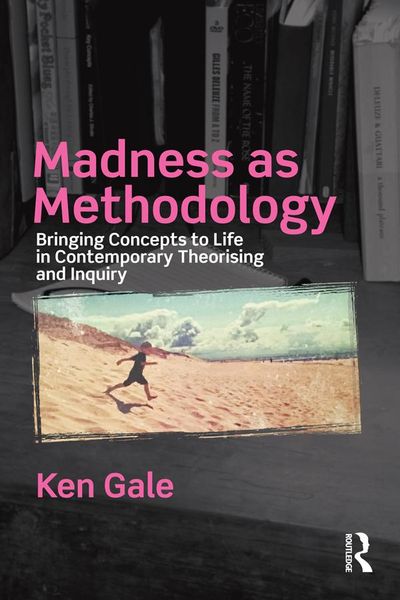
Madness as Methodology Bringing Concepts to Life in Contemporary Theorising and Inquiry
-
- Hardcover
- Taschenbuch
- eBook ausgewählt
-
Form:Einzelkauf Download
-
Sprache:Englisch
-
eBook Format:ePUB 3
- ePUB 3 60,70 € ausgewählt
- PDF 60,70 €
60,70 €
inkl. gesetzl. MwSt.Beschreibung
Produktdetails
Format
ePUB 3
Kopierschutz
Ja
Family Sharing
Nein
Text-to-Speech
Ja
Erscheinungsdatum
23.03.2018
Verlag
Taylor & Francis eBooksSeitenzahl
208 (Printausgabe)
Dateigröße
1288 KB
Sprache
Englisch
EAN
9781351659277
Madness as Methodology begins with the following quotation from Deleuze and Guattari, 'Madness need not be all breakdown. It may also be breakthrough.' This quotation firmly expresses the book's intention to provide readers with radical and innovative approaches to methodology and research in the arts, humanities and education practices. It conceptualises madness, not as a condition of an individual or particular being, but rather as a process that does things differently in terms of creativity and world making.
Through a posthuman theorising as practice, the book emphasises forms of becoming and differentiation that sees all bodies, human and nonhuman, as acting in constant, fluid, relational play. The book offers a means of breaking through and challenging the constraints and limitations of Positivist approaches to established research practice. Therefore, experimentation, concept making as event and a going off the rails are offered as necessary means of inquiry into worlds that are considered to be always not yet known.
Rather than using a linear chapter structure, the book is constructed around Deleuze and Guattari's use of an assemblage of plateaus, providing the reader with a freedom of movement via multiple entry and exit points to the text. These plateaus are processually interconnected providing a focal emphasis upon topics apposite to this madness as methodology. Therefore, as well as offering a challenge to the constraining rigours of conventional research practices, these plateaus engage with topics to do with posthuman thinking, relationality, affect theory, collaboration, subjectivity, friendship, performance and the use of writing as a method of inquiry.
Noch keine Bewertungen vorhanden
Verfassen Sie die erste Bewertung zu diesem Artikel
Helfen Sie anderen Kundinnen und Kunden durch Ihre Meinung.
Kurze Frage zu unserer Seite
Vielen Dank für Ihr Feedback
Wir nutzen Ihr Feedback, um unsere Produktseiten zu verbessern. Bitte haben Sie Verständnis, dass wir Ihnen keine Rückmeldung geben können. Falls Sie Kontakt mit uns aufnehmen möchten, können Sie sich aber gerne an unseren Kund*innenservice wenden.
zum Kundenservice