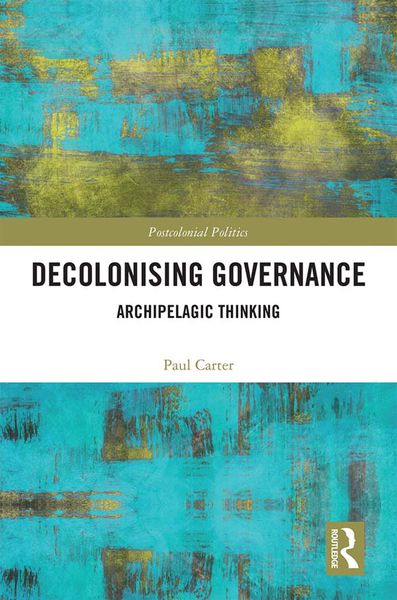
Decolonising Governance Archipelagic Thinking
-
- Taschenbuch
- eBook ausgewählt
-
Form:Einzelkauf Download
-
Sprache:Englisch
-
eBook Format:PDF
- PDF 64,30 € ausgewählt
- ePUB 64,30 €
64,30 €
inkl. gesetzl. MwSt.Beschreibung
Produktdetails
Format
Kopierschutz
Ja
Family Sharing
Nein
Text-to-Speech
Nein
Erscheinungsdatum
19.09.2018
Verlag
Taylor & Francis eBooksSeitenzahl
252 (Printausgabe)
Dateigröße
6521 KB
Auflage
1. Auflage
Sprache
Englisch
EAN
9781351213028
Power may be globalized, but Westphalian notions of sovereignty continue to determine political and legal arrangements domestically and internationally: global issues - the legacy of colonialism expressed in continuing human displacement and environmental destruction - are thus treated 'parochially' and ineffectually. Not designed for dealing with situations of interdependence, democratic institutions find themselves in crisis. Reform in this case is not simply operational but conceptual: political relationships need to be drawn differently; the cultural illiteracy that prevents the local knowledge invested in places made after their stories needs to be recognised as a major obstacle to decolonising governance.
Archipelagic thinking refers to neglected dimensions of the earth's human geography but also to a geo-politics of relationality, where governance is understood performatively as the continuous establishment of exchange rates. Insisting on the poetic literacy that must inform a decolonising politics, Carter suggests a way out of the incommensurability impasse that dogs assertions of indigenous sovereignty. Discussing bicultural areal management strategies located in south-west Victoria, Maluco (Indonesia) and inter-regionally across the Arafura and Timor Seas, Carter argues for the existence of creative regions constituted archipelagically that can intervene to rewrite the theory and practice of decolonisation.
A book of great stylistic elegance and deftness of analysis, Decolonising Governance is an important intervention in the related fields of ecological, ecocritical and environmental humanities. Methodologically innovative in its foregrounding of relationality as the nexus between poetics and politics, it will also be of great interest to scholars in a range of areas, including communicational praxis, land/sea biodiversity design, bicultural resource management, and the constitution of post-Westphalian regional jurisdictions.
Noch keine Bewertungen vorhanden
Verfassen Sie die erste Bewertung zu diesem Artikel
Helfen Sie anderen Kundinnen und Kunden durch Ihre Meinung.
Kurze Frage zu unserer Seite
Vielen Dank für Ihr Feedback
Wir nutzen Ihr Feedback, um unsere Produktseiten zu verbessern. Bitte haben Sie Verständnis, dass wir Ihnen keine Rückmeldung geben können. Falls Sie Kontakt mit uns aufnehmen möchten, können Sie sich aber gerne an unseren Kund*innenservice wenden.
zum Kundenservice