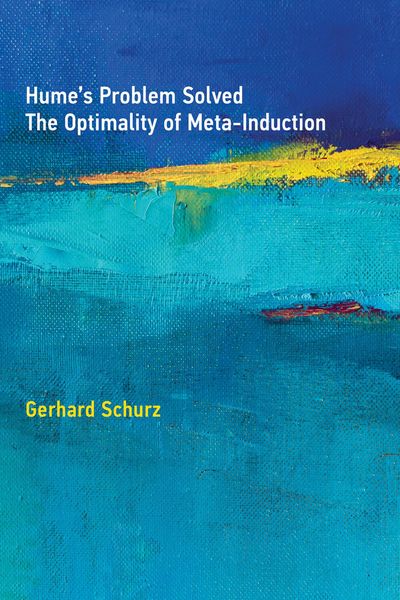
Hume's Problem Solved The Optimality of Meta-Induction
68,99 €
inkl. gesetzl. MwSt.,
Beschreibung
Produktdetails
Einband
Gebundene Ausgabe
Erscheinungsdatum
07.05.2019
Abbildungen
38 b&w illus., Illustrationen, nicht spezifiziert
Verlag
MIT PressSeitenzahl
400
Maße (L/B/H)
23,6/16,2/2,7 cm
Gewicht
676 g
Sprache
Englisch
ISBN
978-0-262-03972-7
Hume's problem of justifying induction has been among epistemology's greatest challenges for centuries. In this book, Gerhard Schurz proposes a new approach to Hume's problem. Acknowledging the force of Hume's arguments against the possibility of a noncircular justification of the reliability of induction, Schurz demonstrates instead the possibility of a noncircular justification of the optimality of induction, or, more precisely, of meta-induction (the application of induction to competing prediction models). Drawing on discoveries in computational learning theory, Schurz demonstrates that a regret-based learning strategy, attractivity-weighted meta-induction, is predictively optimal in all possible worlds among all prediction methods accessible to the epistemic agent. Moreover, the a priori justification of meta-induction generates a noncircular a posteriori justification of object induction. Taken together, these two results provide a noncircular solution to Hume's problem.
Schurz discusses the philosophical debate on the problem of induction, addressing all major attempts at a solution to Hume's problem and describing their shortcomings; presents a series of theorems, accompanied by a description of computer simulations illustrating the content of these theorems (with proofs presented in a mathematical appendix); and defends, refines, and applies core insights regarding the optimality of meta-induction, explaining applications in neighboring disciplines including forecasting sciences, cognitive science, social epistemology, and generalized evolution theory. Finally, Schurz generalizes the method of optimality-based justification to a new strategy of justification in epistemology, arguing that optimality justifications can avoid the problems of justificatory circularity and regress.
Noch keine Bewertungen vorhanden
Verfassen Sie die erste Bewertung zu diesem Artikel
Helfen Sie anderen Kundinnen und Kunden durch Ihre Meinung.
Kurze Frage zu unserer Seite
Vielen Dank für Ihr Feedback
Wir nutzen Ihr Feedback, um unsere Produktseiten zu verbessern. Bitte haben Sie Verständnis, dass wir Ihnen keine Rückmeldung geben können. Falls Sie Kontakt mit uns aufnehmen möchten, können Sie sich aber gerne an unseren Kund*innenservice wenden.
zum Kundenservice