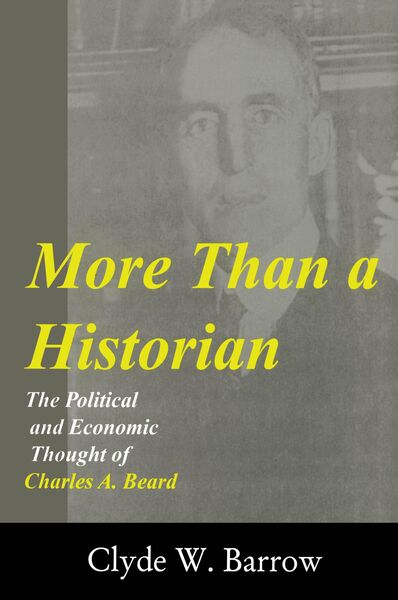
More than a Historian The Political and Economic Thought of Charles A.Beard
-
- Taschenbuch
- eBook ausgewählt
-
Form:Einzelkauf Download
-
Sprache:Englisch
72,00 €
inkl. gesetzl. MwSt.Beschreibung
Produktdetails
Format
Kopierschutz
Ja
Family Sharing
Nein
Text-to-Speech
Nein
Erscheinungsdatum
17.04.2018
Verlag
Taylor & Francis eBooksSeitenzahl
578 (Printausgabe)
Dateigröße
18674 KB
Auflage
1. Auflage
Sprache
Englisch
EAN
9781351326711
Charles A. Beard (1874-1948) was one of America's most influential historians and political scientists. He played a major role in founding the disciplines of history and political science, helped shape the teaching of social studies in the nation's public schools, and was one the nation's most popular public intellectuals. Yet in the second half of the twentieth century, Beard's reputation has been eroded by relentless criticism. Clyde W. Barrow argues that Beard's work has renewed relevance in light of recent theoretical debates about the new institutionalism, the crisis of the welfare state, and American foreign policy messianism. Barrow's takes Beard seriously as a political theorist, while challenging many misconceptions. For example, Beard's method of economic interpretation has been dismissed as Marxist, but Barrow carefully reconstructs the sources of Beard's thinking to demonstrate that his method owes more to historical and institutional economics and that his concept of state-society relations was in fact derived from Madison's Tenth Federalist. Barrow reconstructs Beard's theory of American political development using his concept of realistic dialectics, which viewed the clash between democracy (Jeffersonianism) and capitalism (Hamiltonianism) as the engine of American political development. During the 1930s, Beard suggested that the United States was making the transition to a higher form of social and industrial democracy that would supersede the contradiction of American political development. Notably, Beard was a critic of the New Deal and the liberal welfare state, because they failed to reconstruct the economic relations that reproduce inequalities of income, status, and power.Beard went on to voice his concern that at crucial junctures in American history, class struggle is diverted into international conflicts as popular leaders back down from a direct confrontation with the dominant capitalist elite. He analyzes American foreign policy as an extension of domestic economic policy and, in particular, a result of the failures of domestic economic policy. Beard's conception of American history plays itself out in a tragic cycle of imperialism and diversion that left him a disenchanted realist. This incisive study will be of interest to those intrested in the evolution of historical thinking.
Noch keine Bewertungen vorhanden
Verfassen Sie die erste Bewertung zu diesem Artikel
Helfen Sie anderen Kundinnen und Kunden durch Ihre Meinung.
Kurze Frage zu unserer Seite
Vielen Dank für Ihr Feedback
Wir nutzen Ihr Feedback, um unsere Produktseiten zu verbessern. Bitte haben Sie Verständnis, dass wir Ihnen keine Rückmeldung geben können. Falls Sie Kontakt mit uns aufnehmen möchten, können Sie sich aber gerne an unseren Kund*innenservice wenden.
zum Kundenservice