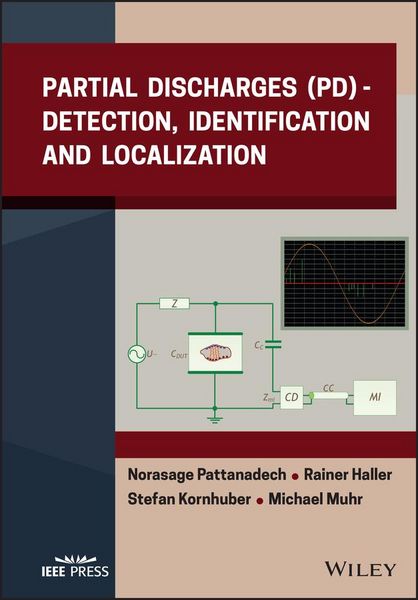
Partial Discharges (PD) Detection, Identification and Localization
-
- Englisch ausgewählt
125,99 €
inkl. gesetzl. MwSt.,
Beschreibung
Produktdetails
Einband
Gebundene Ausgabe
Erscheinungsdatum
01.09.2023
Verlag
John Wiley & SonsSeitenzahl
336
Maße (L/B/H)
24,5/17,6/2,2 cm
Gewicht
802 g
Auflage
1. Auflage
Sprache
Englisch
ISBN
978-1-119-56845-2
Explore state-of-the-art partial discharge measurement techniques
In Partial Discharges (PD) - Detection, Identification and Localization, a team of distinguished electrical engineers delivers a comprehensive treatment of the behavior, modeling, measurement, monitoring, localization, and evaluation of partial discharges. It includes coverage of all major advancements in the field that have occurred over the last few decades. It also discusses partial discharge phenomena, detection methods, and strategies for analyzing and processing collected data.
Mechanisms of insulation failure are explored, as is the denoising of partial discharge measurement data and the localization of partial discharge in large, high-voltage equipment. Non-electric principles and procedures are discussed, and the book offers a variety of tables, figures, and photographs to illustrate the concepts discussed within. Partial Discharges(PD) also provides:
- A thorough introduction to the physical behavior of partial discharges, including their causes and classification
- Comprehensive modeling of partial discharge behavior, including classical and dipole discharges
- Practical discussions of the measurement of partial discharges, including the electrical method, partial discharge decoupling, and pre- and post-processing of partial discharges
- In-depth examinations of the monitoring of partial discharge behavior, including methods and realization
Perfect for electrical engineers engaged in electrical power engineering, Partial Discharges (PD) will also earn a place in the libraries of research and development specialists employed in the manufacturing, quality testing and operation of electrical systems.
Noch keine Bewertungen vorhanden
Verfassen Sie die erste Bewertung zu diesem Artikel
Helfen Sie anderen Kundinnen und Kunden durch Ihre Meinung.
Kurze Frage zu unserer Seite
Vielen Dank für Ihr Feedback
Wir nutzen Ihr Feedback, um unsere Produktseiten zu verbessern. Bitte haben Sie Verständnis, dass wir Ihnen keine Rückmeldung geben können. Falls Sie Kontakt mit uns aufnehmen möchten, können Sie sich aber gerne an unseren Kund*innenservice wenden.
zum Kundenservice