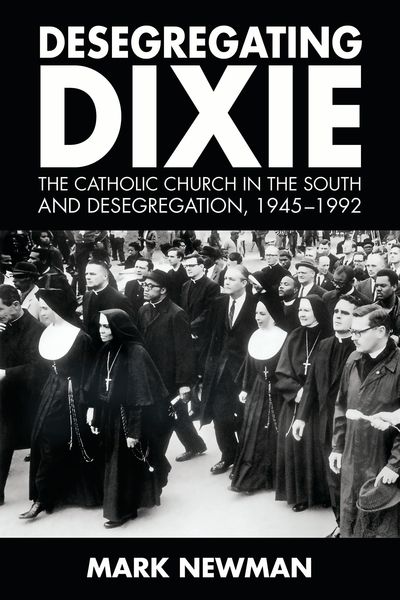
Desegregating Dixie The Catholic Church in the South and Desegregation, 1945-1992
-
- Hardcover
- Taschenbuch
- eBook ausgewählt
-
Form:Einzelkauf Download
-
Sprache:Englisch
31,40 €
inkl. gesetzl. MwSt.Beschreibung
Produktdetails
Format
ePUB
Kopierschutz
Ja
Family Sharing
Nein
Text-to-Speech
Ja
Erscheinungsdatum
04.10.2018
Verlag
Bonnier Books UKSeitenzahl
474 (Printausgabe)
Dateigröße
1708 KB
Sprache
Englisch
EAN
9781496818874
Winner of the 2020 American Studies Network Book Prize from the European Association for American Studies
Mark Newman draws on a vast range of archives and many interviews to uncover for the first time the complex response of African American and white Catholics across the South to desegregation. In the late nineteenth and first half of the twentieth century, the southern Catholic Church contributed to segregation by confining African Americans to the back of white churches and to black-only schools and churches. However, in the twentieth century, papal adoption and dissemination of the doctrine of the Mystical Body of Christ, pressure from some black and white Catholics, and secular change brought by the civil rights movement increasingly led the Church to address racial discrimination both inside and outside its walls.
Far from monolithic, white Catholics in the South split between a moderate segregationist majority and minorities of hard-line segregationists and progressive racial egalitarians. While some bishops felt no discomfort with segregation, prelates appointed from the late 1940s onward tended to be more supportive of religious and secular change. Some bishops in the peripheral South began desegregation before or in anticipation of secular change while elsewhere, especially in the Deep South, they often tied changes in the Catholic churches to secular desegregation.
African American Catholics were diverse and more active in the civil rights movement than has often been assumed. While some black Catholics challenged racism in the Church, many were conflicted about the manner of Catholic desegregation generally imposed by closing valued black institutions. Tracing its impact through the early 1990s, Newman reveals how desegregation shook congregations but seldom brought about genuine integration.
Mark Newman draws on a vast range of archives and many interviews to uncover for the first time the complex response of African American and white Catholics across the South to desegregation. In the late nineteenth and first half of the twentieth century, the southern Catholic Church contributed to segregation by confining African Americans to the back of white churches and to black-only schools and churches. However, in the twentieth century, papal adoption and dissemination of the doctrine of the Mystical Body of Christ, pressure from some black and white Catholics, and secular change brought by the civil rights movement increasingly led the Church to address racial discrimination both inside and outside its walls.
Far from monolithic, white Catholics in the South split between a moderate segregationist majority and minorities of hard-line segregationists and progressive racial egalitarians. While some bishops felt no discomfort with segregation, prelates appointed from the late 1940s onward tended to be more supportive of religious and secular change. Some bishops in the peripheral South began desegregation before or in anticipation of secular change while elsewhere, especially in the Deep South, they often tied changes in the Catholic churches to secular desegregation.
African American Catholics were diverse and more active in the civil rights movement than has often been assumed. While some black Catholics challenged racism in the Church, many were conflicted about the manner of Catholic desegregation generally imposed by closing valued black institutions. Tracing its impact through the early 1990s, Newman reveals how desegregation shook congregations but seldom brought about genuine integration.
Noch keine Bewertungen vorhanden
Verfassen Sie die erste Bewertung zu diesem Artikel
Helfen Sie anderen Kundinnen und Kunden durch Ihre Meinung.
Kurze Frage zu unserer Seite
Vielen Dank für Ihr Feedback
Wir nutzen Ihr Feedback, um unsere Produktseiten zu verbessern. Bitte haben Sie Verständnis, dass wir Ihnen keine Rückmeldung geben können. Falls Sie Kontakt mit uns aufnehmen möchten, können Sie sich aber gerne an unseren Kund*innenservice wenden.
zum Kundenservice