KI-Beratung Beta

Gutscheinbedingungen

**Gültig bis 18.11.2026 auf englischsprachige Klassiker (klassiker-32728) online auf thalia.at und in der Thalia App. Einzelne Artikel können ausgeschlossen sein. Ausgenommen sind preisgebundene Artikel & eBooks. Pro Einkauf einmal einlösbar. Click & Collect nur bei Onlinevorabzahlung möglich. Keine Barauszahlung. Nicht kombinierbar mit anderen Aktionen und Gutscheinen. Gutschein wird auf max. 500€ Bestellwert angerechnet. Nicht gültig für Geschenkkarten, Versandkosten und Services.

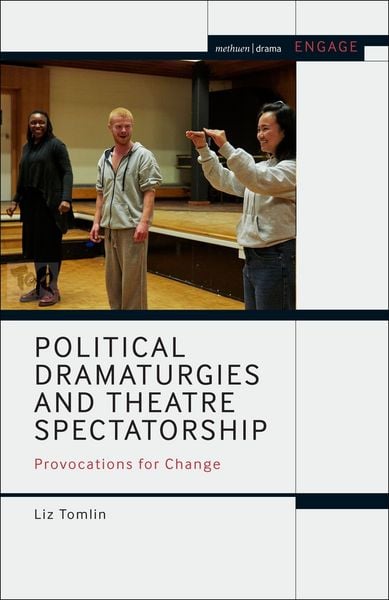
Produktbild: Political Dramaturgies and Theatre Spectatorship

Political Dramaturgies and Theatre Spectatorship Provocations for Change

Aus der Reihe Methuen Drama Engage

159,99 €

inkl. gesetzl. MwSt., Versandkostenfrei


Beschreibung

What do we mean when we describe theatre as political today? How might theatre-makers' provocations for change need to be differently designed when addressing the precarious spectator-subject of twenty- first century neoliberalism? In this important study Liz Tomlin interrogates the influential theories...

Beschreibung

What do we mean when we describe theatre as political today? How might theatre-makers' provocations for change need to be differently designed when addressing the precarious spectator-subject of twenty- first century neoliberalism? In this important study Liz Tomlin interrogates the influential theories of Jacques Rancière to propose a new framework of analysis through which contemporary political dramaturgies can be investigated. Drawing, in particular, on Ernesto Laclau and Chantal Mouffe, Lilie Chouliaraki and Judith Butler, Tomlin argues that the capacities of the contemporary and future spectator to be 'effected' or 'affected' by politically-engaged theatre need to be urgently re-evaluated. Central to this study is Tomlin's theorized figuration of the neoliberal spectator-subject as precarious, individualized and ironic, with a reduced capacity for empathy, agency and the ability to imagine better futures. This, in turn, leads to a predilection for a response to injustice that is driven by a concern for the feelings of the subject-self, rather than concern for the suffering other. These characteristics are argued to shape even those spectator-subjects towards the left of the political spectrum, thus necessitating a careful reconsideration of new and long-standing dramaturgies of political provocation. Dramaturgies examined include the ironic invitations of Made in China and Martin Crimp, the exploration of affect in Kieran Hurley's Heads Up, the new sincerity that characterizes the work of Andy Smith, the turn to the staging of the spectators' 'other' in Developing Artists' Queens of Syria and Chris Thorpe and Rachel Chavkin's Confirmation, and the community activism of Common Wealth's The Deal Versus the People.

Produktdetails

Einband

Gebundene Ausgabe

Erscheinungsdatum

13.06.2019

Herausgeber Enoch Brater + weitere
Verlag Bloomsbury Academic

Produktdetails

Einband

Gebundene Ausgabe

Erscheinungsdatum

13.06.2019

Herausgeber
Verlag Bloomsbury Academic
Seitenzahl

214

Maße (L/B/H)

22,2/14,5/1,5 cm

Gewicht

407 g

Sprache

Englisch

ISBN

978-1-4742-9560-4

Herstelleradresse

Libri GmbH
Europaallee 1
36244 Bad Hersfeld
DE

Email: gpsr@libri.de

Noch keine Bewertungen vorhanden

Verfassen Sie die erste Bewertung zu diesem Artikel

Helfen Sie anderen Kundinnen und Kunden durch Ihre Meinung.

Kundinnen und Kunden meinen

Bewertungen (0)

Die Leseprobe wird geladen.
  • Produktbild: Political Dramaturgies and Theatre Spectatorship
  • Acknowledgements
    Introduction
    Part One: Configuring the Spectator-Subject
    Chapter One: Real and Imagined Spectators
    Chapter Two: The Autonomous Spectator
    Chapter Three: Precarious Spectators
    Part Two: Contemporary Political Dramaturgies
    Chapter Four: Political Logics and Contemporary Dramaturgies
    Chapter Five: Questions of Irony and Interpellation
    Chapter Six: Questions of Autonomy and Affect
    Chapter Seven: Questions of Empathy and Agonism
    Chapter Eight: Questions of Antagonism and Agency
    Epilogue
    References
    Index