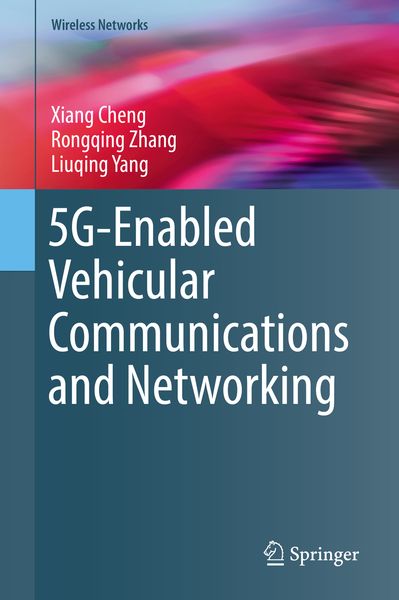
5G-Enabled Vehicular Communications and Networking
119,99 €
inkl. gesetzl. MwSt.,
Beschreibung
Produktdetails
Einband
Gebundene Ausgabe
Erscheinungsdatum
20.11.2018
Abbildungen
IX, 177 p. 71 illus., 65 illus. in color.
Verlag
SpringerSeitenzahl
177
Maße (L/B/H)
24,1/16/1,6 cm
Gewicht
453 g
Sprache
Englisch
ISBN
978-3-030-02175-7
This book investigates and reviews recent advanced techniques and important applications in vehicular communications and networking (VCN) from a novel perspective of the combination and integration of VCN and connected vehicles, which provides a significant scientific and technical support for future 5G-based VCN.
5G-Enabled Vehicular Communications and Networking
introduces vehicular channel characteristics, reviews current channel modeling approaches, and then provides a new generic geometry-based stochastic modeling approach for vehicle-to-everything (V2X) communications. The investigation of vehicular channel measurements and modeling provides fundamental supports for the VCN system design. Then, this book investigates VCN-vehicle combination from PHY and MAC layers, respectively. As for the PHY layer, many advanced techniques that can be effectively applied in VCN to counter the PHY challenges are introduced, including novel ICI cancellation methods, index modulated OFDM, differential spatial modulation, and energy harvesting relaying.
As for the MAC layer, distributed and centralized MAC designs are analyzed and compared in terms of feasibility and availability. Specifically, distributed congestion control, D2D-enabled vehicular communications, and centralized data dissemination scheduling are elaborated, which can significantly improve the network performance in vehicular networks. Finally, considering VCN-vehicle integration, this book introduces several hot-topic applications in vehicular networks, including electric vehicles, distributed data storage, unmanned aerial vehicles, and security and privacy, which indicates the significance and development value of VCN-vehicle integration in future vehicular networks and our daily life.
The primary audience for this book includes professionals and researchers working in the field of vehicular communications, intelligent transportation systems (ITS), and Internet of vehicles (IoV). Advanced level students studying electrical engineering will also find this book useful as a secondary textbook for related courses.
Noch keine Bewertungen vorhanden
Verfassen Sie die erste Bewertung zu diesem Artikel
Helfen Sie anderen Kundinnen und Kunden durch Ihre Meinung.
Kurze Frage zu unserer Seite
Vielen Dank für Ihr Feedback
Wir nutzen Ihr Feedback, um unsere Produktseiten zu verbessern. Bitte haben Sie Verständnis, dass wir Ihnen keine Rückmeldung geben können. Falls Sie Kontakt mit uns aufnehmen möchten, können Sie sich aber gerne an unseren Kund*innenservice wenden.
zum Kundenservice