
The Letters of the Younger Pliny
-
- Hardcover
- Taschenbuch ausgewählt
- eBook
-
Sprache:Englisch
-
Verlag:Indoeuropeanpublishing.Com
23,99 €
inkl. gesetzl. MwSt.,
- Kostenlose Lieferung ab 30 € Einkaufswert
- Versandkostenfrei für Bonuscard-Kund*innen
Beschreibung
Produktdetails
Einband
Taschenbuch
Erscheinungsdatum
15.01.2019
Herausgeber
F. C. T. BosanquetVerlag
Indoeuropeanpublishing.ComSeitenzahl
220
Maße (L/B/H)
22,9/15,2/1,3 cm
Gewicht
365 g
Sprache
Englisch
ISBN
978-1-64439-084-9
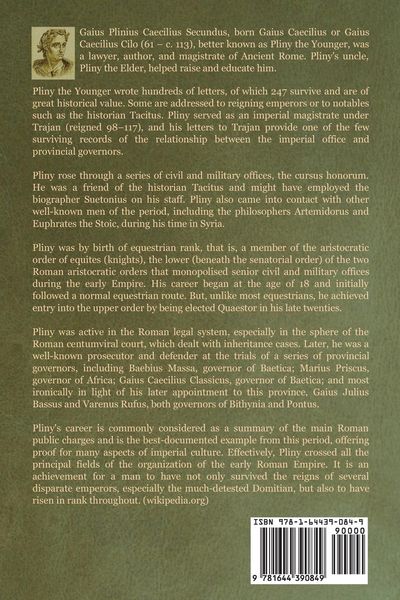
Gaius Plinius Caecilius Secundus, born Gaius Caecilius or Gaius Caecilius Cilo (61 – c. 113), better known as Pliny the Younger, was a lawyer, author, and magistrate of Ancient Rome. Pliny's uncle, Pliny the Elder, helped raise and educate him. Pliny the Younger wrote hundreds of letters, of which 247 survive and are of great historical value. Some are addressed to reigning emperors or to notables such as the historian Tacitus. Pliny served as an imperial magistrate under Trajan (reigned 98–117), and his letters to Trajan provide one of the few surviving records of the relationship between the imperial office and provincial governors. Pliny rose through a series of civil and military offices, the cursus honorum. He was a friend of the historian Tacitus and might have employed the biographer Suetonius on his staff. Pliny also came into contact with other well-known men of the period, including the philosophers Artemidorus and Euphrates the Stoic, during his time in Syria. Pliny was by birth of equestrian rank, that is, a member of the aristocratic order of equites (knights), the lower (beneath the senatorial order) of the two Roman aristocratic orders that monopolised senior civil and military offices during the early Empire. His career began at the age of 18 and initially followed a normal equestrian route. But, unlike most equestrians, he achieved entry into the upper order by being elected Quaestor in his late twenties. Pliny was active in the Roman legal system, especially in the sphere of the Roman centumviral court, which dealt with inheritance cases. Later, he was a well-known prosecutor and defender at the trials of a series of provincial governors, including Baebius Massa, governor of Baetica; Marius Priscus, governor of Africa; Gaius Caecilius Classicus, governor of Baetica; and most ironically in light of his later appointment to this province, Gaius Julius Bassus and Varenus Rufus, both governors of Bithynia and Pontus. Pliny's career is commonly considered as a summary of the main Roman public charges and is the best-documented example from this period, offering proof for many aspects of imperial culture. Effectively, Pliny crossed all the principal fields of the organization of the early Roman Empire.
Noch keine Bewertungen vorhanden
Verfassen Sie die erste Bewertung zu diesem Artikel
Helfen Sie anderen Kundinnen und Kunden durch Ihre Meinung.
Kurze Frage zu unserer Seite
Vielen Dank für Ihr Feedback
Wir nutzen Ihr Feedback, um unsere Produktseiten zu verbessern. Bitte haben Sie Verständnis, dass wir Ihnen keine Rückmeldung geben können. Falls Sie Kontakt mit uns aufnehmen möchten, können Sie sich aber gerne an unseren Kund*innenservice wenden.
zum Kundenservice