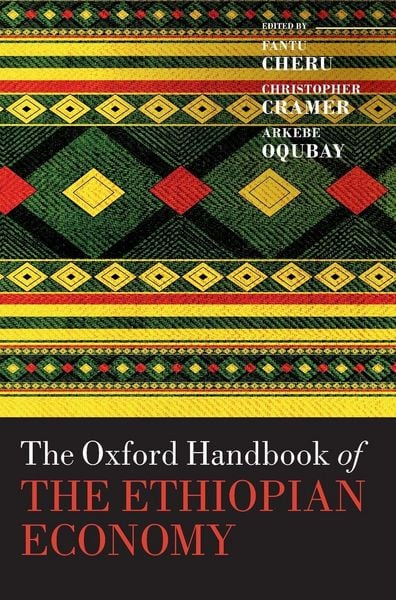
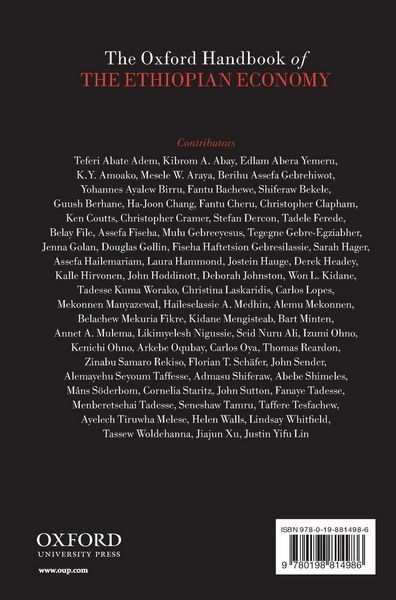
• Produktbild: The Oxford Handbook of the Ethiopian Economy
  • Produktbild: The Oxford Handbook of the Ethiopian Economy

The Oxford Handbook of the Ethiopian Economy

Aus der Reihe Oxford Handbooks

192,99 €

inkl. gesetzl. MwSt., Versandkostenfrei


Beschreibung

Produktdetails

Einband

Gebundene Ausgabe

Erscheinungsdatum

24.01.2019

Herausgeber

Cheru Fantu + weitere

Verlag

Oxford University Press

Seitenzahl

1008

Maße (L/B/H)

25/17,5/5,8 cm

Gewicht

1880 g

Sprache

Englisch

ISBN

978-0-19-881498-6

Beschreibung

Rezension

The editors of this massive volume on the Ethiopian economy have commendably sought to include as many viewpoints as possible while emphasizing empirical approaches. The book covers the major issues, including macroeconomic policy, the development of the social welfare system, agriculture, and industrial policy. Foreign Affairs

Produktdetails

Einband

Gebundene Ausgabe

Erscheinungsdatum

24.01.2019

Herausgeber

Verlag

Oxford University Press

Seitenzahl

1008

Maße (L/B/H)

25/17,5/5,8 cm

Gewicht

1880 g

Sprache

Englisch

ISBN

978-0-19-881498-6

Herstelleradresse

Libri GmbH
Europaallee 1
36244 Bad Hersfeld
DE

Email: gpsr@libri.de

Noch keine Bewertungen vorhanden

Verfassen Sie die erste Bewertung zu diesem Artikel

Helfen Sie anderen Kundinnen und Kunden durch Ihre Meinung.

Kundinnen und Kunden meinen

Bewertungen (0)

Die Leseprobe wird geladen.
  • Produktbild: The Oxford Handbook of the Ethiopian Economy
  • Produktbild: The Oxford Handbook of the Ethiopian Economy

    • Part I: Context, Concepts, and History


    • 1: Fantu Cheru, Christopher Cramer, and Arkebe Oqubay: Introduction


    • 2: Shiferaw Bekele: Ethiopia's transition from a traditional to a developing economy (1890s-1960s)


    • 3: Christopher Clapham: Ethiopia's political economy from the imperial period to the present


    • 4: Teferi Abate Adem: Land tenure and land policy in Ethiopia (1950-2000)


    • 5: Kidane Mengisteab: Federalism in Ethiopia's transformation


    • 6: Assefa Fiseha and Fiseha Haftetsion Gebresilassie: The interface between federalism and development in Ethiopia


    • 7: Menberetsehai Tadesse and Belachew M. Fikre: Ethiopia's constitutional framework and legal institutions for development


    • 8: Fantu Cheru and Zinabu S. Rekisa: Ethiopia's 'economic diplomacy' and regional integration


    • Part II: Economic Development


    • 9: Mekonnen Manyazewal and Admasu Shiferaw: Economic policy and structural transformation in Ethiopia


    • 10: Yohannes Ayalew Birru: Ethiopian financial sector development


    • 11: Mekonnen Manyazewal: Financing Ethiopia's development


    • 12: Seid Nuru Ali: Infrastructure and economic transformation in Ethiopia


    • 13: Ken Coutts and Christina Laskaridis: Financial balances and the development of the Ethiopian economy


    • 14: Berihu Assefa Gebrehiwot: Trade policy in Ethiopia (1991-2016)


    • 15: Christopher Cramer and John Sender: Policy, political economy, and performance in Ethiopia's coffee sector


    • 16: Laura Hammond: Livelihoods and mobility in the border regions of Ethiopia


    • 17: Haileselassie A. Medhin and Alemu Mekonnen: Green and climate-resilient transformation in Ethiopia


    • 18: John Sender: Assessing poverty trends in Ethiopia (1990-2015)


    • Part III: Social Policy and Development


    • 19: Tassew Woldehanna and Mesele W. Araya: Poverty and inequality in Ethiopia (1995/96-2015/16)


    • 20: Abebe Shimeles: Growth, poverty, and distribution in Ethiopia


    • 21: Assefa Hailemariam: Ethiopia's changing demography


    • 22: Deborah Johnston and Helen Walls: Economic policy and food security in Ethiopia


    • 23: Kalle Hirvonen, Derek Headey, Jenna Golan, and John Hoddinott: Changes in child undernutrition in Ethiopia (2000-2016)


    • 24: John Hoddinott and Alemayehu Seyoum Taffesse: Social protection in Ethiopia


    • 25: Zinabu Samaro Rekiso: Education and economic development in Ethiopia (1991-2017)


    • Part IV: Agriculture and Rural Transformation


    • 26: Stefan Dercon and Douglas Gollin: Agriculture's changing role in Ethiopia's economic transformation


    • 27: Alemayehu Seyoum Taffesse: The transformation of smallholder crop production in Ethiopia (1994-2016)


    • 28: Guush Berhane and Kibrom A. Abay: Rural finance and smallholder farming in Ethiopia


    • 29: Florian T. Schÿfer, Tadesse Kuma Workako, and Bart Minten: Performance and institutions of the Ethiopian coffee sector


    • 30: Florian T. Schÿfer: Private coffee plantations in Ethiopia


    • 31: Ayelech Tiruwha Melese: Constraints on the Ethiopian Floriculture Industry


    • 32: Bart Minten, Seneshaw Tamru, and Thomas Reardon: Agricultural markets in Ethiopia


    • 33: Fantu Nisrane Bachewe and Fanaye Tadesse: Livestock production in Ethiopia


    • 34: Likimyelesh Nigussie and Annet A. Mulema: Women's empowerment in rural Ethiopia


    • Part V: Industrialization and Urban Development


    • 35: Arkebe Oqubay: Industrial policy and late industrialisation in Ethiopia


    • 36: Arkebe Oqubay: Structure and performance of the Ethiopian manufacturing sector


    • 37: Admasu Shiferaw and Måns Söderbom: The Ethiopian manufacturing sector: Productivity, export, and competitiveness


    • 38: Carlos Oya: Building an industrial workforce in Ethiopia


    • 39: Mulu Gebreeyesus: The private sector in Ethiopia's transformation


    • 40: Lindsay Whitfield and Cornelia Staritz: Light manufacturing in Ethiopia: The apparel export industry


    • 41: Tesfachew Taffere: Technological learning and industrialisation in Ethiopia


    • 42: Won L. Kidane: The legal framework for the protection of foreign direct investment in Ethiopia


    • 43: Tadele Ferede and Belay File: Rural-urban linkages in Ethiopia


    • 44: Tegegne Gebre-Egziabher and Edlam Abera Yemeru: Urbanisation and industrial development in Ethiopia


    • Part VI: Structural Transformation and the African Continent


    • 45: Justin Yifu Lin, Jiajun Xu, and Sarah Hager: A New Structural Economics perspective on Special Economic Zones in Ethiopia


    • 46: Ha-Joon Chang and Jostein Hauge: The concept of a 'developmental state' in Ethiopia


    • 47: Kenichi Ohno and Izumi Ohno: A Japanese perspective on Ethiopia's transformation


    • 48: John Sutton: Institution building for industrialisation: The Ethiopian Investment Commission


    • 49: Carlos Lopes: Three sectoral policies in Ethiopia's structural transformation


    • 50: K.Y. Amoako: Growing with depth: What African countries can learn from the Ethiopian experience