KI-Beratung Beta

  • Produktbild: Fourier Analysis of Economic Phenomena
  • Produktbild: Fourier Analysis of Economic Phenomena
Band 2 - 11%

Fourier Analysis of Economic Phenomena

11% sparen

125,99 € UVP 142,99 €

inkl. gesetzl. MwSt., Versandkostenfrei


Beschreibung

This is the first monograph that discusses in detail the interactions between Fourier analysis and dynamic economic theories, in particular, business cycles.Many economic theories have analyzed cyclical behaviors of economic variables. In this book, the focus is on a couple of trials: (1) the Kaldor...

Beschreibung

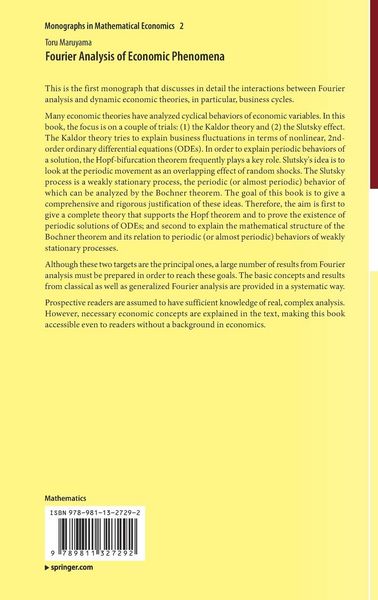
This is the first monograph that discusses in detail the interactions between Fourier analysis and dynamic economic theories, in particular, business cycles.Many economic theories have analyzed cyclical behaviors of economic variables. In this book, the focus is on a couple of trials: (1) the Kaldor theory and (2) the Slutsky effect. The Kaldor theory tries to explain business fluctuations in terms of nonlinear, 2nd-order ordinary differential equations (ODEs). In order to explain periodic behaviors of a solution, the Hopf-bifurcation theorem frequently plays a key role. Slutsky's idea is to look at the periodic movement as an overlapping effect of random shocks. The Slutsky process is a weakly stationary process, the periodic (or almost periodic) behavior of which can be analyzed by the Bochner theorem. The goal of this book is to give a comprehensive and rigorous justification of these ideas. Therefore, the aim is first to give a complete theory that supports the Hopftheorem and to prove the existence of periodic solutions of ODEs; and second to explain the mathematical structure of the Bochner theorem and its relation to periodic (or almost periodic) behaviors of weakly stationary processes.Although these two targets are the principal ones, a large number of results from Fourier analysis must be prepared in order to reach these goals. The basic concepts and results from classical as well as generalized Fourier analysis are provided in a systematic way.Prospective readers are assumed to have sufficient knowledge of real, complex analysis. However, necessary economic concepts are explained in the text, making this book accessible even to readers without a background in economics.

Rezension

“The manuscript is a well balanced collection of economic applications and systematic and carefully constructed mathematical theories.  Among the various economic theories on business, the fluctuations model is considered the most typical and influential. The manuscript includes fluctuations from both theoretical and empirical viewpoints. … The manuscript ‘Fourier analysis of economic phenomena’ is a very good auxiliary text book for graduate finance, business, and administrative sciences, graduate mathematical modeling, and applied mathematics.” (Haydar Akca, zbMATH 1473.42001, 2021)

“This book is of interest to researchers in various fields who use mathematical models that require the use of Fourier analysis.” (Ants Aasma, Mathematical Reviews, August, 2020)

Produktdetails

Einband

Gebundene Ausgabe

Erscheinungsdatum

15.07.2019

Abbildungen

XI, 410 p. 64 illus.

Verlag Springer Singapore

Produktdetails

Einband

Gebundene Ausgabe

Erscheinungsdatum

15.07.2019

Abbildungen

XI, 410 p. 64 illus.

Verlag Springer Singapore
Seitenzahl

410

Maße (L/B/H)

24,1/16/2,9 cm

Gewicht

747 g

Auflage

19001 Auflage 1st edition 2018

Sprache

Englisch

ISBN

978-981-13-2729-2

Herstelleradresse

Springer-Verlag KG
Sachsenplatz 4-6
1201 Wien
AT

Email: ProductSafety@springernature.com

Noch keine Bewertungen vorhanden

Verfassen Sie die erste Bewertung zu diesem Artikel

Helfen Sie anderen Kundinnen und Kunden durch Ihre Meinung.

Kundinnen und Kunden meinen

Bewertungen (0)

  • Produktbild: Fourier Analysis of Economic Phenomena
  • Produktbild: Fourier Analysis of Economic Phenomena
  • 1. Fourier series on a Hilbert space.- 2. Convergence of classical Fourier series.- 3. Fourier transforms (1).- 4. Fourier transforms (2).- 5. Summation kernels and spectral syntheses.- 6. Fourier transforms of Radon measures.- 7. Spectral representations of unitary operators.- 8. Fourier analysis of weakly stationary stochastic processes.- 9. Almost periodic functions and weakly stationary stochastic processes.- 10. Fredholm Operators.- 11. Hopf bifurcations.