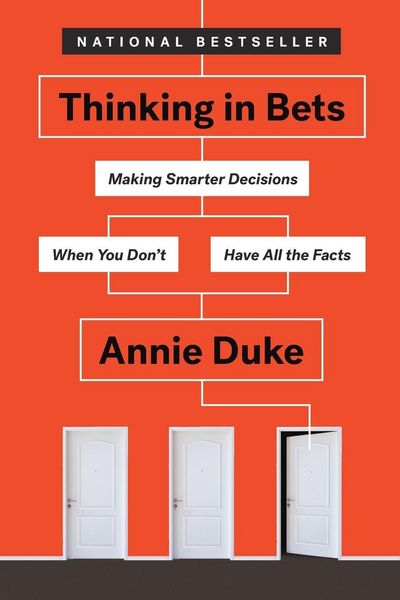
Thinking in Bets Making Smarter Decisions When You Don't Have All the Facts
-
- Hardcover
- Taschenbuch ausgewählt
- eBook
- Hörbuch
-
Sprache:Englisch
21,99 €
inkl. gesetzl. MwSt.,
- Kostenlose Lieferung ab 30 € Einkaufswert
- Versandkostenfrei für Bonuscard-Kund*innen
Beschreibung
Produktdetails
Verkaufsrang
439
Einband
Taschenbuch
Erscheinungsdatum
07.05.2019
Verlag
Penguin USSeitenzahl
290
Maße (L/B/H)
21/14/1,6 cm
Gewicht
358 g
Farbe
Rot / Lichtgrau
Sprache
Englisch
ISBN
978-0-7352-1637-2
A big favorite among investors these days. The New York Times
Outstanding. Jason Zweig, The Wall Street Journal
In Super Bowl XLIX, Seahawks coach Pete Carroll made one of the most controversial calls in football history: With 26 seconds remaining, and trailing by four at the Patriots' one-yard line, he called for a pass instead of a hand off to his star running back. The pass was intercepted and the Seahawks lost. Critics called it the dumbest play in history. But was the call really that bad? Or did Carroll actually make a great move that was ruined by bad luck?
Even the best decision doesn't yield the best outcome every time. There's always an element of luck that you can't control, and there is always information that is hidden from view. So the key to long-term success (and avoiding worrying yourself to death) is to think in bets: How sure am I? What are the possible ways things could turn out? What decision has the highest odds of success? Did I land in the unlucky 10% on the strategy that works 90% of the time? Or is my success attributable to dumb luck rather than great decision making?
Annie Duke, a former World Series of Poker champion turned business consultant, draws on examples from business, sports, politics, and (of course) poker to share tools anyone can use to embrace uncertainty and make better decisions. For most people, it's difficult to say "I'm not sure" in a world that values and, even, rewards the appearance of certainty. But professional poker players are comfortable with the fact that great decisions don't always lead to great outcomes and bad decisions don't always lead to bad outcomes.
By shifting your thinking from a need for certainty to a goal of accurately assessing what you know and what you don't, you'll be less vulnerable to reactive emotions, knee-jerk biases, and destructive habits in your decision making. You'll become more confident, calm, compassionate and successful in the long run.
Noch keine Bewertungen vorhanden
Verfassen Sie die erste Bewertung zu diesem Artikel
Helfen Sie anderen Kundinnen und Kunden durch Ihre Meinung.
Kurze Frage zu unserer Seite
Vielen Dank für Ihr Feedback
Wir nutzen Ihr Feedback, um unsere Produktseiten zu verbessern. Bitte haben Sie Verständnis, dass wir Ihnen keine Rückmeldung geben können. Falls Sie Kontakt mit uns aufnehmen möchten, können Sie sich aber gerne an unseren Kund*innenservice wenden.
zum Kundenservice