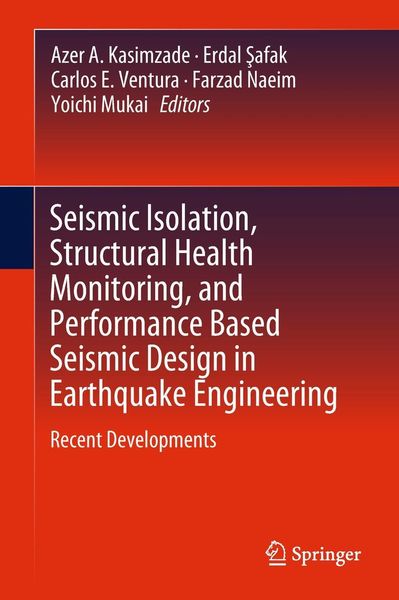
Seismic Isolation, Structural Health Monitoring, and Performance Based Seismic Design in Earthquake Engineering Recent Developments
-
- Hardcover
- Taschenbuch
- eBook ausgewählt
-
Form:Einzelkauf Download
-
Sprache:Englisch
120,99 €
inkl. gesetzl. MwSt.Beschreibung
Produktdetails
Format
Kopierschutz
Nein
Family Sharing
Nein
Text-to-Speech
Nein
Erscheinungsdatum
13.08.2018
Herausgeber
Azer A. Kasimzade + weitereVerlag
SpringerSeitenzahl
364 (Printausgabe)
Dateigröße
21013 KB
Sprache
Englisch
EAN
9783319931579
This book features chapters based on selected presentations from the International Congress on Advanced Earthquake Resistance of Structures, AERS2016, held in Samsun, Turkey, from 24 to 28 October 2016.
It covers the latest advances in three widely popular research areas in Earthquake Engineering: Performance-Based Seismic Design, Seismic Isolation Systems, and Structural Health Monitoring.
The book shows the vulnerability of high-rise and seismically isolated buildings to long periods of strong ground motions, and proposes new passive and semi-active structural seismic isolation systems to protect against such effects. These systems are validated through real-time hybrid tests on shaking tables.
Structural health monitoring systems provide rapid assessment of structural safety after an earthquake and allow preventive measures to be taken, such as shutting down the elevators and gas lines, before damage occurs. Using the vibration data from instrumented tall buildings, the book demonstrates that large, distant earthquakes and surface waves, which are not accounted for in most attenuation equations, can cause long-duration shaking and damage in tall buildings.
The overview of the current performance-based design methodologies includes discussions on the design of tall buildings and the reasons common prescriptive code provisions are not sufficient to address the requirements of tall-building design. In addition, the book explains the modelling and acceptance criteria associated with various performance-based design guidelines, and discusses issues such as selection and scaling of ground motion records, soil-foundation-structure interaction, and seismic instrumentation and peer review needs.
The book is of interest to a wide range of professionals in earthquake engineering, including designers, researchers, and graduate students.
Noch keine Bewertungen vorhanden
Verfassen Sie die erste Bewertung zu diesem Artikel
Helfen Sie anderen Kundinnen und Kunden durch Ihre Meinung.
Kurze Frage zu unserer Seite
Vielen Dank für Ihr Feedback
Wir nutzen Ihr Feedback, um unsere Produktseiten zu verbessern. Bitte haben Sie Verständnis, dass wir Ihnen keine Rückmeldung geben können. Falls Sie Kontakt mit uns aufnehmen möchten, können Sie sich aber gerne an unseren Kund*innenservice wenden.
zum Kundenservice