Gutscheinbedingungen

**Gültig am 26.09.2026 auf fremdsprachige Mangas (mangas-29438) online auf thalia.at und in der Thalia App. Einzelne Artikel können ausgeschlossen sein. Ausgenommen sind preisgebundene Artikel & eBooks. Pro Einkauf einmal einlösbar. Click & Collect nur bei Onlinevorabzahlung möglich. Keine Barauszahlung. Nicht kombinierbar mit anderen Aktionen und Gutscheinen. Gutschein wird auf max. 500€ Bestellwert angerechnet. Nicht gültig für Geschenkkarten, Versandkosten und Services.

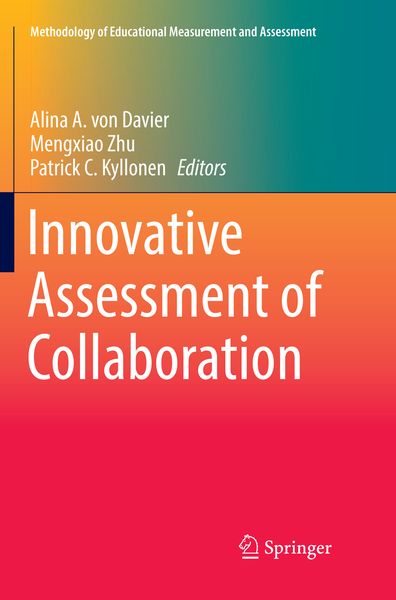
Produktbild: Innovative Assessment of Collaboration

Innovative Assessment of Collaboration

138,99 €

inkl. gesetzl. MwSt., Versandkostenfrei


Beschreibung

Produktdetails

Einband

Taschenbuch

Erscheinungsdatum

17.07.2018

Abbildungen

XIX, 330 p. 72 illus., 42 illus. in color.

Herausgeber

Alina A. Davier + weitere

Verlag

Springer

Seitenzahl

330

Maße (L/B/H)

23,5/15,5/1,8 cm

Gewicht

608 g

Auflage

Softcover reprint of the original 1st ed. 2017

Sprache

Englisch

ISBN

978-3-319-81469-8

Beschreibung

Rezension

“The value of this volume is in the cross-disciplinary snapshot of the research on assessment of collaboration. The editors should be applauded for culling ideas from a variety of disciplines that would otherwise not be cross-referenced. … the references inside this volume would be an ideal starting point for anyone working in either education or IO psychology, but who is new to the assessment of collaboration.” (Tyler H. Matta, Psychometrika, Vol. 83, 2018)

Produktdetails

Einband

Taschenbuch

Erscheinungsdatum

17.07.2018

Abbildungen

XIX, 330 p. 72 illus., 42 illus. in color.

Herausgeber

Verlag

Springer

Seitenzahl

330

Maße (L/B/H)

23,5/15,5/1,8 cm

Gewicht

608 g

Auflage

Softcover reprint of the original 1st ed. 2017

Sprache

Englisch

ISBN

978-3-319-81469-8

Herstelleradresse

Springer-Verlag KG
Sachsenplatz 4-6
1201 Wien
AT

Email: ProductSafety@springernature.com

Noch keine Bewertungen vorhanden

Verfassen Sie die erste Bewertung zu diesem Artikel

Helfen Sie anderen Kundinnen und Kunden durch Ihre Meinung.

Kundinnen und Kunden meinen

Bewertungen (0)

Weitere Artikel finden Sie in

  • Produktbild: Innovative Assessment of Collaboration

  • Prologue: Building the Foundation for Innovations in Assessment: Interdisciplinary Measurement of Collaboration and Teamwork.-
    1.
    Introduction: Innovative Assessment of Collaboration.- PART 1: Framework and Methods.-
    2.
    The Assessment of Team Performance: Observation and Needs.-
    3.
    Assessing Collaboration Within and Between Teams: A Multiteam Systems Perspective.-
    4.
    Innovation in Team Interaction: New Methods for Assessing Collaboration between Brains and Bodies Using a Multi-Level Framework.-
    5.
    Assessing Collaborative Problem Solving Through Conversational Agents.-
    6.
    Assessment of Discussion in Learning Contexts.-
    7.
    Collaborative Problem Solving Measures in the Programme for International Students Assessment (PISA).-
    8.
    Assessing and Teaching 21
    st
    Century Skills: Collaborative Problem Solving as a Case Study.-
    9.
    Initial Steps towards a Standardized Assessment for Collaborative Problem Solving (CPS): Practical Challenges and Strategies.-
    10.
    Exploring Dual Eye Tracking as a Tool to Assess Collaboration.-
    11.
    Multimodal Behavioral Analytics in Intelligent Learning and Assessment Systems.-
    12.
    Measuring Collaboration in Cross-Cultural Contexts.-
    13.
    Inclusive Design of Collaborative Problem-Solving Tasks.- PART 2: Modeling and Analysis.-
    14.
    Understanding and Assessing Collaborative Processes through Relational Events.-
    15.
    Modeling Collaboration Using Point Processes.-
    16.
    Dynamic Bayesian Network Models for Peer Tutoring Interactions.-
    17.
    Representing Self-Organization and Nonstationarities in Dyadic Interaction Processes Using Dynamic Systems Modeling Techniques.-
    18.
    Modeling Collaboration with Social Network Models.-
    19.
    Network Models for Teams with Overlapping Membership.-
    20.
    Linking Team Neurodynamic Organizations with Observational Rating of Team Performance.