Gutscheinbedingungen

**Gültig bis 06.07.2026 auf fremdsprachige Bücher online auf thalia.at, in der Thalia App ab einem Mindestbestellwert von 30€ und in allen Thalia Buchhandlungen in Österreich. In den Buchhandlungen nur gültig auf lagernde Ware. Einzelne Artikel können ausgeschlossen sein. Ausgenommen sind preisgebundene Artikel & eBooks. Pro Einkauf einmal einlösbar. Nur gültig gegen Vorlage oder im Onlineshop hinterlegter Bonuscard. Infos zur Einlösung in der Buchhandlung sind auf der Bonuscard-Vorteilspreisseite zu finden. Click & Collect nur bei Onlinevorabzahlung möglich. Keine Einlösung bei Scan & Go-Bezahlung. Keine Barauszahlung. Nicht kombinierbar mit anderen Aktionen und Gutscheinen. Gutschein wird auf max. 500€ Bestellwert angerechnet. Nicht gültig für Versandkosten und Services.

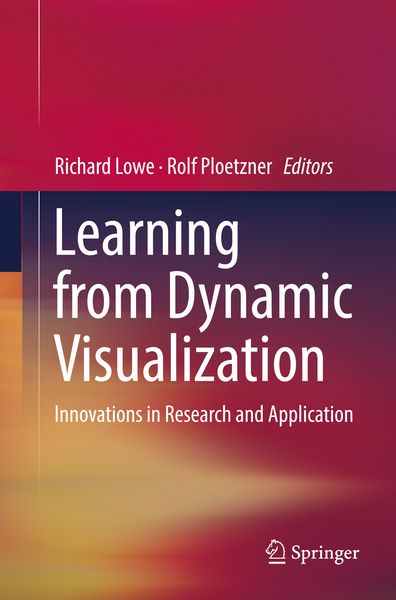
  • Produktbild: Learning from Dynamic Visualization
  • Produktbild: Learning from Dynamic Visualization

Learning from Dynamic Visualization Innovations in Research and Application

99,99 €

inkl. gesetzl. MwSt., Versandkostenfrei


Beschreibung

Produktdetails

Einband

Taschenbuch

Erscheinungsdatum

09.06.2018

Abbildungen

XVII, 81 illus., schwarz-weiss Illustrationen

Herausgeber

Richard Lowe + weitere

Verlag

Springer

Seitenzahl

386

Maße (L/B/H)

23,5/15,5/2,2 cm

Gewicht

610 g

Auflage

Softcover reprint of the original 1st edition 2017

Sprache

Englisch

ISBN

978-3-319-85852-4

Beschreibung

Portrait

Richard Lowe is Professor of Learning Technologies at Curtin University, Australia. After undergraduate studies in science, he worked as an industrial chemist, science educator and textbook writer then completed a Ph.D. in Educational Psychology at Murdoch University, Australia. His research focuses on the effectiveness of explanatory graphics with a particular emphasis on learner processing of complex technical animations. He has a special interest in how the findings from such research can be applied to improving the design of dynamic graphics used not only within educational settings, but also across society more generally.

Rolf Ploetzner received a Ph.D. in Psychology from the University of Freiburg, Germany, where he specialized in cognitive and educational psychology. Across his research career, he has participated in various research projects at the University of Freiburg, the Learning Research and Development Center (LRDC) at the University of Pittsburgh (U.S.A), and the Knowledge Media Research Center (KMRC) in Tübingen, Germany. Since 2002 he has been a Full Professor of Media in Education at the University of Education in Freiburg. In his current research he focuses on strategies for learning from dynamic and interactive media.

Produktdetails

Einband

Taschenbuch

Erscheinungsdatum

09.06.2018

Abbildungen

XVII, 81 illus., schwarz-weiss Illustrationen

Herausgeber

Verlag

Springer

Seitenzahl

386

Maße (L/B/H)

23,5/15,5/2,2 cm

Gewicht

610 g

Auflage

Softcover reprint of the original 1st edition 2017

Sprache

Englisch

ISBN

978-3-319-85852-4

Herstelleradresse

Springer-Verlag KG
Sachsenplatz 4-6
1201 Wien
AT

Email: GPSR Kontakt

Noch keine Bewertungen vorhanden

Verfassen Sie die erste Bewertung zu diesem Artikel

Helfen Sie anderen Kundinnen und Kunden durch Ihre Meinung.

Kundinnen und Kunden meinen

Bewertungen (0)

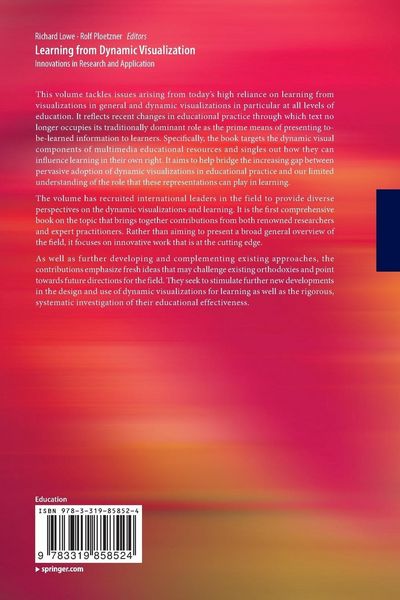
  • Produktbild: Learning from Dynamic Visualization
  • Produktbild: Learning from Dynamic Visualization
  • Introduction.- Section I. Innovations in Representation and Design.- A Composition Approach to Design of Educational Animations, Richard Lowe and Jean-Michel Boucheix.- Learning from Animations: From 2d to 3d? Stephan Schwan and Frank Papenmeier.- Looking Across Instead of Back and Forth: How the Simultaneous, Presentation of Multiple Animation Episodes Facilitates Learning, Rolf Ploetzner and Richard Lowe.- Learning from Static and Dynamic Visualizations: What Kind of Questions Should We Ask? Inga Wagner and Wolfgang Schnotz.- The Role of Craft-Based Knowledge in the Design of Dynamic Visualizations, Jodie Jenkinson.- Designing Instructional Science Visualizations in the Trenches: Where Research Meets Production Reality, Gaël G. McGill.- Section II. Innovations in Assessment.- Dynamic Visuospatial Ability and Learning from Dynamic Visualizations, Christopher A. Sanchez and Jennifer Wiley.- Demonstration Tasks for Assessment, Richard Lowe, Jean-Michel Boucheix and Benjamin Fillisch.- Assessing Science Inquiry and Reasoning Using Dynamic Visualizations and Interactive Simulations, Jodi Davenport and Edys Quellmalz.- Design of Effective Dynamic Visualizations - A Struggle between the Beauty and the Beast?.- Commentary on Sections I and II, Katharina Scheiter.- Section III. Innovations in Scaffolding.- Attention Guidance Strategies for Supporting Learning from Dynamic Visualizations, Björn De Koning and Halska Jarodzka.- Learning Three-Dimensional Anatomical Structures with Animation: Effects of Orientation References and Learners' Spatial Ability, Sandra Berney and Mireille Bétrancourt.- Section IV. Innovations in Learner Engagement.- Self-Generated Drawing: A Help or Hindrance to Learning from Animation? Richard Lowe and Lucia Mason.- Drawing for Promoting Learning and Engagement with Dynamic Visualizations, Mike Stieff.- Strategies for Learning from Animation With and Without Narration, Rolf Ploetzner and Bianka Breyer.- Guiding Cognitive Processing During Learning with Animations - Commentary on Sections III and IV, Richard E. Mayer.- About the Editors.- About the Contributors.- Index.