Gutscheinbedingungen

**Gültig bis 24.09.2026 ab einem Mindestbestellwert von 30€ auf Spielzeug, Schreibwaren, Filme, Geschenke & Trends, Musik, tolino eReader & Zubehör, Hörbücher und Hörbuch-Downloads, nicht preisgebundene Bücher und Kalender online auf thalia.at und in der Thalia App. Einzelne Artikel können ausgeschlossen sein. Aufgrund der Buchpreisbindung sind deutschsprachige Bücher und eBooks ausgenommen. Zusätzlich ausgenommen sind Abos & Flatrates, Games, Geschenkkarten/-boxen, Shelfies, Software, Zeitschriften sowie einzelne Artikel von tonies®. Pro Einkauf einmal einlösbar. Click & Collect nur bei Onlinevorabzahlung möglich. Keine Barauszahlung. Nicht kombinierbar mit anderen Aktionen und Gutscheinen. Gutschein wird auf max. 500€ Bestellwert angerechnet. Nicht gültig für Versandkosten und Services. Preisgebundene Artikel sind vom Mindestbestellwert ausgeschlossen.

Produktbild: Phytoremediation

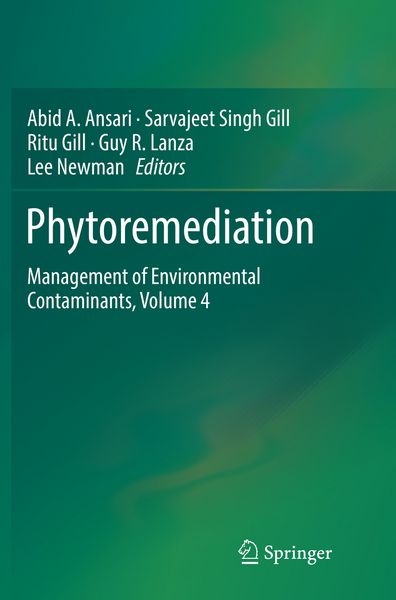
Phytoremediation Management of Environmental Contaminants, Volume 4

151,99 €

inkl. gesetzl. MwSt., Versandkostenfrei


Beschreibung

Produktdetails

Einband

Taschenbuch

Erscheinungsdatum

07.07.2018

Abbildungen

XV, 409 p. 59 illus., 31 illus. in color.

Herausgeber

Abid A. Ansari + weitere

Verlag

Springer

Seitenzahl

409

Maße (L/B/H)

23,5/15,5/2,4 cm

Gewicht

645 g

Auflage

1oftcover reprint of the original 1st ed. 2016

Sprache

Englisch

ISBN

978-3-319-82436-9

Beschreibung

Portrait

Dr. Abid A Ansari, M.Sc., Ph.DDepartment of Biology, University of TabukTabuk, Kingdom of Saudi Arabia

Dr. Sarvajeet Singh Gill, M.Sc. (Gold medal), M.Phil., Ph.D 

Dr. Ritu Gill, Ph.DStress Physiology and Molecular Biology Lab, Centre for Biotechnology,MD University, Rohtak 124 001, Haryana, India

Dr. Guy R. Lanza, Ph.D.College of Environmental Science and ForestryState University of New York (SUNY)Syracuse, NY 13210-2778USA

Dr. Lee Newman, Ph.DCollege of Environmental Science and ForestryState University of New York (SUNY) Syracuse, NY 13210-2778USA

Produktdetails

Einband

Taschenbuch

Erscheinungsdatum

07.07.2018

Abbildungen

XV, 409 p. 59 illus., 31 illus. in color.

Herausgeber

Verlag

Springer

Seitenzahl

409

Maße (L/B/H)

23,5/15,5/2,4 cm

Gewicht

645 g

Auflage

1oftcover reprint of the original 1st ed. 2016

Sprache

Englisch

ISBN

978-3-319-82436-9

Herstelleradresse

Springer-Verlag KG
Sachsenplatz 4-6
1201 Wien
AT

Email: ProductSafety@springernature.com

Noch keine Bewertungen vorhanden

Verfassen Sie die erste Bewertung zu diesem Artikel

Helfen Sie anderen Kundinnen und Kunden durch Ihre Meinung.

Kundinnen und Kunden meinen

Bewertungen (0)

  • Produktbild: Phytoremediation
  • Section 1. Phytoremediation of Organic Contaminants.- Phytoremediation of PCBs and PAHs by Grasses: A Critical Perspective.- Organic Soil Amendments in the Phytoremediation Process.- Phytoremediation of Crude Oil Contaminated Soil using Cynodon dactylon (L.) Pers).- A Study on Degradation of Heavy Metals in Crude Oil Contaminated Soil using Cyperus rotundus.- Polycyclic Aromatic Hydrocarbons and Heavy Metal Contaminated Sites: Phytoremediation as a Strategy for Addressing the Complexity of Pollution.- Phytoremediation of Polycyclic Aromatic Hydrocarbons (PAHs) in Urban Atmospheric Deposition Using Bio-retention Systems.- Section 2. Wastewater Engineering and Technology.- Plant Growth Promoting Bacteria: A Good Source for Phytoremediation of Metals Contaminated Soil.- Biotechnological Approaches to Remediate Soil and Water using Plant-Microbe Interactions.- Current and Future Opportunities for Forest Land Application Systems of Wastewater.- Bio-retention Systems for Storm water Treatment and Management in Urban Systems.- Fungal Laccase Enzyme Applications in Bioremediation of Polluted Wastewater.- Section 3. Natural and Constructed Wetlands for Phytoremediation.- Phytoremediation Applications for Waste Water and Improved Water Quality.- Plants for Constructed Wetlands as an Ecological Engineering Alternative to Road Runoff Desalination.- Constructed Wetlands for Livestock Wastewater Treatment: Antibiotics Removal and Effects on CWs Performance.- Phytoremediation Potential of Selected Mangrove Plants for Trace Metal Contamination in Indian Sundarban Wetland.- Fate of Phenolic Compounds in Constructed Wetlands Treating Contaminated Water.- Removal of Pathogenic Bacteria in Constructed Wetlands: Mechanisms and Efficiency.- Section 4. Phytoremediation for Reclamation and Restoration.- Low-Tech Alternatives for the Rehabilitation of Aquatic and Riparian Environments.- Proposed Rehabilitation Method of Uncontrolled Landfills in Insular CommunitiesThrough Multi CriteriaAnalysis Decision Tool.- Suitability of Different Mediterranean Plants for Phytoremediation of Mine Soils Affected with Cadmium.