KI-Beratung Beta

Gutscheinbedingungen

**Gültig bis 18.11.2026 auf englischsprachige Klassiker (klassiker-32728) online auf thalia.at und in der Thalia App. Einzelne Artikel können ausgeschlossen sein. Ausgenommen sind preisgebundene Artikel & eBooks. Pro Einkauf einmal einlösbar. Click & Collect nur bei Onlinevorabzahlung möglich. Keine Barauszahlung. Nicht kombinierbar mit anderen Aktionen und Gutscheinen. Gutschein wird auf max. 500€ Bestellwert angerechnet. Nicht gültig für Geschenkkarten, Versandkosten und Services.

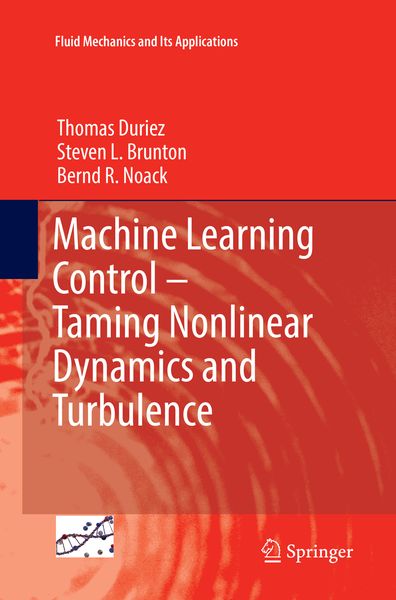
Produktbild: Machine Learning Control – Taming Nonlinear Dynamics and Turbulence
Band 116

Machine Learning Control – Taming Nonlinear Dynamics and Turbulence

98,99 €

inkl. gesetzl. MwSt., Versandkostenfrei


Beschreibung

This is the first textbook on a generally applicable control strategy for turbulence and other complex nonlinear systems. The approach of the book employs powerful methods of machine learning for optimal nonlinear control laws. This machine learning control (MLC) is motivated and detailed in Chapters...

Beschreibung

This is the first textbook on a generally applicable control strategy for turbulence and other complex nonlinear systems. The approach of the book employs powerful methods of machine learning for optimal nonlinear control laws. This machine learning control (MLC) is motivated and detailed in Chapters 1 and 2. In Chapter 3, methods of linear control theory are reviewed. In Chapter 4, MLC is shown to reproduce known optimal control laws for linear dynamics (LQR, LQG). In Chapter 5, MLC detects and exploits a strongly nonlinear actuation mechanism of a low-dimensional dynamical system when linear control methods are shown to fail. Experimental control demonstrations from a laminar shear-layer to turbulent boundary-layers are reviewed in Chapter 6, followed by general good practices for experiments in Chapter 7. The book concludes with an outlook on the vast future applications of MLC in Chapter 8. Matlab codes are provided for easy reproducibility of the presented results. The book includes interviews with leading researchers in turbulence control (S. Bagheri, B. Batten, M. Glauser, D. Williams) and machine learning (M. Schoenauer) for a broader perspective. All chapters have exercises and supplemental videos will be available through YouTube.    

Produktdetails

Einband

Taschenbuch

Erscheinungsdatum

22.04.2018

Abbildungen

XX, 211 p. 73 illus., 58 illus. in color.

Verlag Springer

Produktdetails

Einband

Taschenbuch

Erscheinungsdatum

22.04.2018

Abbildungen

XX, 211 p. 73 illus., 58 illus. in color.

Verlag Springer
Seitenzahl

211

Maße (L/B/H)

23,5/15,5/1,2 cm

Gewicht

408 g

Auflage

Softcover reprint of the original 1st ed. 2017

Sprache

Englisch

ISBN

978-3-319-82140-5

Herstelleradresse

Springer-Verlag KG
Sachsenplatz 4-6
1201 Wien
AT

Email: ProductSafety@springernature.com

Noch keine Bewertungen vorhanden

Verfassen Sie die erste Bewertung zu diesem Artikel

Helfen Sie anderen Kundinnen und Kunden durch Ihre Meinung.

Kundinnen und Kunden meinen

Bewertungen (0)

  • Produktbild: Machine Learning Control – Taming Nonlinear Dynamics and Turbulence
  • Preface.- 1 Introduction.- 1.1 Feedback in engineering and living systems.- 1.2 Benefits of feedback control.- 1.3 Challenges of feedback control.- 1.4 Feedback turbulence control is a grand challenge problem.- 1.5 Nature teaches us the control design.- 1.6 Outline of the book.- 1.7 Exercises.- 2 Machine learning control (MLC).- 2.1 Methods of machine learning.- 2.2 MLC with genetic programming.- 2.3 Examples.- 2.4 Exercises.- 2.5 Suggested reading.- 2.6 Interview with Professor Marc Schoenauer.- 3 Methods of linear control theory.- 3.1 Linear systems.- 3.2 Full-state feedback.- Linear quadratic regulator (LQR).- 3.3 Sensor-based state estimation.- Kalman filtering.- 3.4 Sensor-based feedback.- Linear quadratic Gaussian (LQG).- 3.5 System Identification and Model Reduction.- 3.6 Exercises.- 3.7 Suggested reading.- 4 Benchmarking MLC against linear control.- 4.1 Comparison of MLC with LQR on a linear oscillator.- 4.2 Comparison of MLC with Kalman filter on a noisy linear oscillator.- 4.3 Comparison of MLC with LQG for sensor-based feedback.- 4.4 Modifications for small nonlinearity.- 4.5 Exercises.- 4.6 Interview with Professor Shervin Bagheri.- 5 Taming nonlinear dynamics with MLC.- 5.1 Generalized mean-field system.- 5.2 Machine learning control.- 5.3 Derivation outline for the generalized mean-field model.- 5.4 Alternative control approaches.- 5.5 Exercises.- 5.6 Suggested reading.- 5.7 Interview with Professor Mark N. Glauser.- 6 Taming real world flow control experiments with MLC.- 6.1 Separation control over a backward-facing step.- 6.2 Separation control of turbulent boundary layers.- 6.3 Control of mixing layer growth.- 6.4 Alternative model-based control approaches.- 6.5 Implementation of MLC in experiments.- 6.6 Suggested reading.- 6.7 Interview with Professor David Williams.- 7 MLC tactics and strategy.- 7.1 The ideal flow control experiment.- 7.2 Desiderata of the control problem — from the definition to hardware choices.- 7.3 Time scales of MLC.- 7.4 MLCparameters and convergence.- 7.5 The imperfect experiment.- 8 Future developments.- 8.1 Methodological advances of MLC.- 8.2 System-reduction techniques for MLC — Coping with high-dimensional input and output.- 8.3 Future applications of MLC.- 8.4 Exercises.- 8.5 Interview with Professor Belinda Batten.- Glossary.- Symbols.- Abbreviations.- Matlab® Code: OpenMLC.- Bibliography.- Index.