
Data Mining for Social Robotics Toward Autonomously Social Robots
-
- Hardcover
- Taschenbuch ausgewählt
- eBook
-
Sprache:Englisch
99,99 €
inkl. gesetzl. MwSt.,
Beschreibung
Produktdetails
Einband
Taschenbuch
Erscheinungsdatum
30.03.2018
Abbildungen
XII, 328 p. 74 illus. in color.
Verlag
SpringerSeitenzahl
328
Maße (L/B/H)
23,5/15,5/1,9 cm
Gewicht
517 g
Auflage
Softcover reprint of the original 1st ed. 2015
Sprache
Englisch
ISBN
978-3-319-79755-7
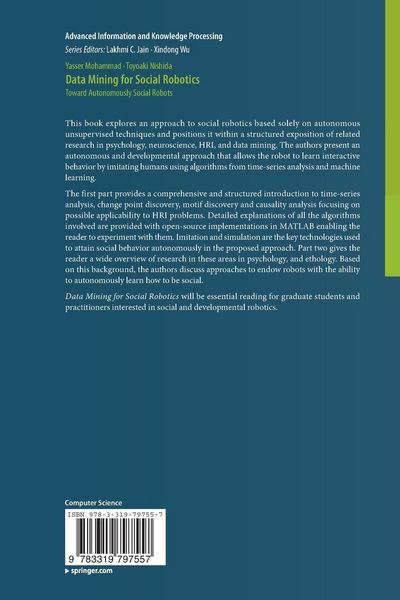
This book explores an approach to social robotics based solely on autonomous unsupervised techniques and positions it within a structured exposition of related research in psychology, neuroscience, HRI, and data mining. The authors present an autonomous and developmental approach that allows the robot to learn interactive behavior by imitating humans using algorithms from time-series analysis and machine learning.
The first part provides a comprehensive and structured introduction to time-series analysis, change point discovery, motif discovery and causality analysis focusing on possible applicability to HRI problems. Detailed explanations of all the algorithms involved are provided with open-source implementations in MATLAB enabling the reader to experiment with them. Imitation and simulation are the key technologies used to attain social behavior autonomously in the proposed approach. Part two gives the reader a wide overview of research in these areas in psychology, and ethology. Based on this background, the authors discuss approaches to endow robots with the ability to autonomously learn how to be social.
Data Mining for Social Robots will be essential reading for graduate students and practitioners interested in social and developmental robotics.
Noch keine Bewertungen vorhanden
Verfassen Sie die erste Bewertung zu diesem Artikel
Helfen Sie anderen Kundinnen und Kunden durch Ihre Meinung.
Kurze Frage zu unserer Seite
Vielen Dank für Ihr Feedback
Wir nutzen Ihr Feedback, um unsere Produktseiten zu verbessern. Bitte haben Sie Verständnis, dass wir Ihnen keine Rückmeldung geben können. Falls Sie Kontakt mit uns aufnehmen möchten, können Sie sich aber gerne an unseren Kund*innenservice wenden.
zum Kundenservice