KI-Beratung Beta

Gutscheinbedingungen

**Gültig am 20.11.2026 ab einem Mindestbestellwert von 30€ auf Spielzeug, Schreibwaren, Filme, Geschenke & Trends, Musik, tolino eReader & Zubehör, Hörbücher und Hörbuch-Downloads, nicht preisgebundene Bücher und Kalender online auf thalia.at und in der Thalia App. Einzelne Artikel können ausgeschlossen sein. Aufgrund der Buchpreisbindung sind deutschsprachige Bücher und eBooks ausgenommen. Zusätzlich ausgenommen sind Abos & Flatrates, Games, Geschenkkarten/-boxen, Shelfies, Software, Zeitschriften sowie einzelne Artikel von tonies®. Pro Einkauf einmal einlösbar. Click & Collect nur bei Onlinevorabzahlung möglich. Keine Barauszahlung. Nicht kombinierbar mit anderen Aktionen und Gutscheinen. Gutschein wird auf max. 500€ Bestellwert angerechnet. Nicht gültig für Versandkosten und Services. Preisgebundene Artikel sind vom Mindestbestellwert ausgeschlossen.

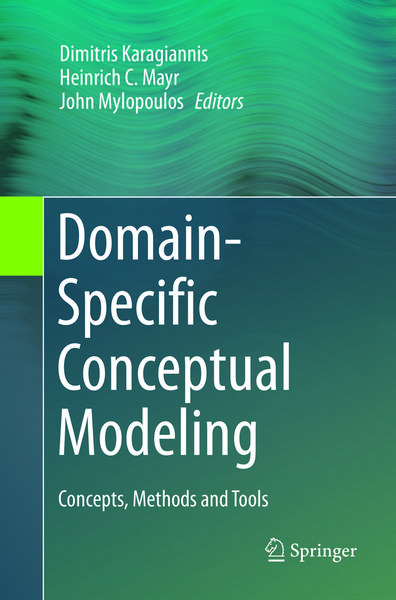
  • Produktbild: Domain-Specific Conceptual Modeling
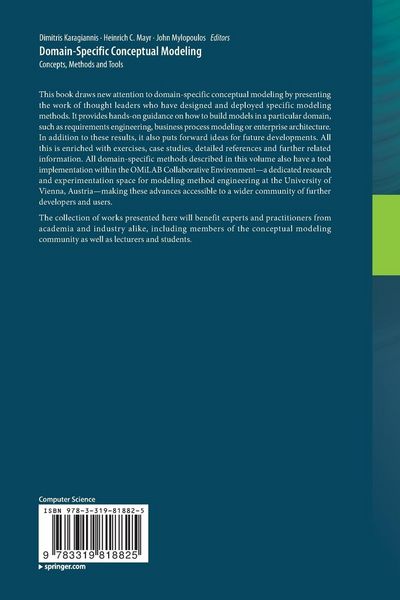
  • Produktbild: Domain-Specific Conceptual Modeling

Domain-Specific Conceptual Modeling Concepts, Methods and Tools

99,99 €

inkl. gesetzl. MwSt., Versandkostenfrei


Beschreibung

This book draws new attention to domain-specific conceptual modeling by presenting the work of thought leaders who have designed and deployed specific modeling methods. It provides hands-on guidance on how to build models in a particular domain, such as requirements engineering, business process modeling...

Beschreibung

This book draws new attention to domain-specific conceptual modeling by presenting the work of thought leaders who have designed and deployed specific modeling methods. It provides hands-on guidance on how to build models in a particular domain, such as requirements engineering, business process modeling or enterprise architecture. In addition to these results, it also puts forward ideas for future developments. All this is enriched with exercises, case studies, detailed references and further related information. All domain-specific methods described in this volume also have a tool implementation within the OMiLAB Collaborative Environment – a dedicated research and experimentation space for modeling method engineering at the University of Vienna, Austria – making these advances accessible to a wider community of further developers and users.


The collection of works presented here will benefit experts and practitioners from academia and industry alike, including members ofthe conceptual modeling community as well as lecturers and students. 

Portrait

Dimitris Karagiannis
holds a full professor position for Business Informatics at the University of Vienna since 1993, leading the Research Group Knowledge Engineering. He earned a PhD degree from the Technical University Berlin in 1987. The same year he joined the Research Institute for Application-oriented Knowledge Processing in Ulm as division head for “Enterprise Information Systems”. Karagiannis holds an honorary professorship from the Babes-Bolyai University in Cluj-Napoca, Romania. His research interests include meta-modelling, knowledge engineering, business process management, enterprise architecture management and artificial intelligence. The industrial application of his meta-modelling research was demonstrated within the BOC Group, a European software- and consulting company.

Heinrich C. Mayr
has been a full professor of Informatics at Universität Klagenfurt since 1990, leading the Application Engineering Research Group. Until then he was an assistant professor at the University of Karlsruhe (today: KIT), visiting professor at several universities, and CEO of a German software company. His research is documented in over 200 publications and includes information system design methodologies, requirements and model engineering, and knowledge management. Amongst other functions, he was President of the Gesellschaft für Informatik (GI), Vice President of the Council of European Professional Informatics Societies (CEPIS), and chairman of the board of trustees of a regional utility company. For 6 years he served as Rector of the University. Currently he is editor in chief of the Lecture Notes in Informatics (LNI), vice-chair of the ER steering committee, chairperson of the council of the Software Internet Cluster SIC, and Member of the TC Wirtschaftsinformatik of the German Accreditation Organisation ASIIN.

John Mylopoulos

holds a professor emeritus position at the Universities of Toronto and Trento. He earned a PhD degree from Princeton University in 1970 and joined the faculty of the Department of Computer Science at the University of Toronto the same year. His research interests include conceptual modelling, requirements engineering, data semantics and knowledge management. Mylopoulos is a fellow of the Association for the Advancement of Artificial Intelligence (AAAI) and the Royal Society of Canada (Academy of Applied Sciences). He has served as programme/general chair of international conferences in Artificial Intelligence, Databases and Software Engineering, including IJCAI (1991), Requirements Engineering (1997, 2011), and VLDB (2004).

Produktdetails

Einband

Taschenbuch

Erscheinungsdatum

31.05.2018

Abbildungen

XII, 594 p. 301 illus.

Herausgeber Dimitris Karagiannis + weitere

Produktdetails

Einband

Taschenbuch

Erscheinungsdatum

31.05.2018

Abbildungen

XII, 594 p. 301 illus.

Herausgeber
Verlag Springer
Seitenzahl

594

Maße (L/B/H)

23,5/15,5/3,3 cm

Gewicht

908 g

Auflage

Softcover reprint of the original 1st ed. 2016

Sprache

Englisch

ISBN

978-3-319-81882-5

Herstelleradresse

Springer-Verlag KG
Sachsenplatz 4-6
1201 Wien
AT

Email: ProductSafety@springernature.com

Noch keine Bewertungen vorhanden

Verfassen Sie die erste Bewertung zu diesem Artikel

Helfen Sie anderen Kundinnen und Kunden durch Ihre Meinung.

Kundinnen und Kunden meinen

Bewertungen (0)

  • Produktbild: Domain-Specific Conceptual Modeling
  • Produktbild: Domain-Specific Conceptual Modeling

  • An Introduction to Modeling Method Conceptualization.- Big Data.- Business Process Management.- Business- and Process Transformation.- Enterprise Information Systems.- Enterprise Strategic Management.- Internet of Things/Future Internet.- Knowledge Engineering.- Production Management Systems.- Requirements Engineering.- Service Science: Social Implications.- Technology Enhanced Learning.