Gutscheinbedingungen

**Gültig bis 02.09.2026 auf fremdsprachige Bücher in der Thalia App. Einzelne Artikel können ausgeschlossen sein. Ausgenommen sind preisgebundene Artikel & eBooks. Pro Einkauf einmal einlösbar. Click & Collect nur bei Onlinevorabzahlung möglich. Keine Barauszahlung. Nicht kombinierbar mit anderen Aktionen und Gutscheinen. Gutschein wird auf max. 500€ Bestellwert angerechnet. Nicht gültig für Geschenkkarten, Versandkosten und Services.

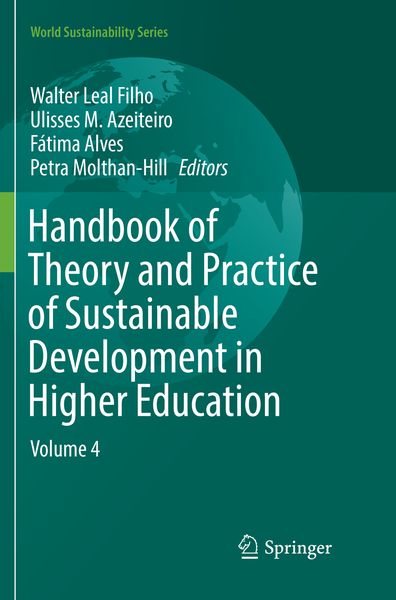
  • Produktbild: Handbook of Theory and Practice of Sustainable Development in Higher Education
  • Produktbild: Handbook of Theory and Practice of Sustainable Development in Higher Education

Handbook of Theory and Practice of Sustainable Development in Higher Education Volume 4

178,99 €

inkl. gesetzl. MwSt., Versandkostenfrei


Beschreibung

Produktdetails

Einband

Taschenbuch

Erscheinungsdatum

20.07.2018

Abbildungen

X, 540 p. 89 illus., 70 illus. in color.

Herausgeber

Walter Leal Filho + weitere

Verlag

Springer

Seitenzahl

540

Maße (L/B/H)

23,5/15,5/3 cm

Gewicht

826 g

Auflage

Softcover reprint of the original 1st ed. 2017

Sprache

Englisch

ISBN

978-3-319-83847-2

Beschreibung

Portrait


Walter Leal Filho (BSc, PhD, DSc, DPhil, DEd, DL, DLitt) is a Senior Professor and Head of the Research and Transfer Centre "Applications of Life Sciences" at Hamburg University of Applied Sciences in Germany, and Chair of Environment and Technology at Manchester Metropolitan University, UK. He is the initiator of the Word Sustainable Development Symposia (WSSD-U) series, and chairs the Inter-University Sustainable Development Research Programme. Professor Leal Filho has written, co-written, edited or co-edited more than 300 publications, including books, book chapters and papers in refereed journals.


Ulisses M. Azeiteiro Associate Professor with Aggregation in the Biology Department and integrated member of the Centre for Environmental and Marine Studies, University of Aveiro. He held a Professor teaching position at the Public Distance Education University in Portugal (Universidade Aberta) until September 2016. At the Centre for Functional Ecology, hosted by the Faculty of Sciences and Technology of the University of Coimbra, he was the Coordinator of the Research Group Social-Economic Governance and Sustainability (from 2010 to 2016). He was the Coordinator of the Research Line Long Term Ecological Response to Global Changes at IMAR-CMA – Marine and Environmental Research Centre of Coimbra University (from 2008 to 2009). His scientific performance and outputs translates to over 200 publications (books, peer-reviewed articles, and book chapters).


Fátima Alves is a Professor at the Department of Social Sciences and Management, Universidade Aberta, and is the Coordinator of the MSc in Intercultural Relations. As a researcher she is integrated in the Centre for Functional Ecology (CEF) atCoimbra University, Coordinator of the CEF extension at the Open University, and Vice-Coordinator of the Social-Economic Governance and Sustainability Research Group, a multidisciplinary group that integrates postgraduate students and researchers from the natural and social sciences. Their scientific production is concerned with the need to articulate different disciplinary perspectives that emphasize the complementary dimensions of socio-environmental phenomena and sustainability. As a researcher she also collaborates at the Centre for Migrations and Intercultural Relations (CEMRI). Her research work has focused on the Sociology of Health; Social Policy; Interculturalities; Environment and Society; Lay Rationalities and Climate Change; and the Governance of Social and Environmental Systems. She has published several books, peer-reviewed articles and papers at international conferences.


ily: 'Courier New'; background-position: initial initial; background-repeat: initial initial;">Petra Molthan-Hill (PFHEA, PhD, MBA, Dipl. Theol.) currently heads the HEA Green Academy 'Food for Thought' Project at Nottingham Trent University, UK. The aim of the project is to develop curricular and extra-curricular activities embedding sustainability into various disciplines, from Business Studies through Medieval History to Astrophysics, including the Sustainability in Practice Certificate, which was shortlisted for the Green Gown Awards 2014. Petra is also the Sustainability Coordinator and a researcher at the Nottingham Business School. Recently, she won the Guardian University Award 2015 in Business Partnership for her Greenhouse Gas Management Project, an innovative project for the core curriculum. Her main research interest has been in experiential learning methods and the integration of sustainability into the curriculum, but also the behavior of managers in cross-cultural comparisons. Petra edited the book ‘The Business Student’s Guide to Sustainable Development’, which has since been adapted to include the Sustainable Development Goals in its second edition. Petra is also Co-Chair of the United Nations-PRME working group on climate change and environment.

Produktdetails

Einband

Taschenbuch

Erscheinungsdatum

20.07.2018

Abbildungen

X, 540 p. 89 illus., 70 illus. in color.

Herausgeber

Verlag

Springer

Seitenzahl

540

Maße (L/B/H)

23,5/15,5/3 cm

Gewicht

826 g

Auflage

Softcover reprint of the original 1st ed. 2017

Sprache

Englisch

ISBN

978-3-319-83847-2

Herstelleradresse

Springer-Verlag KG
Sachsenplatz 4-6
1201 Wien
AT

Email: ProductSafety@springernature.com

Noch keine Bewertungen vorhanden

Verfassen Sie die erste Bewertung zu diesem Artikel

Helfen Sie anderen Kundinnen und Kunden durch Ihre Meinung.

Kundinnen und Kunden meinen

Bewertungen (0)

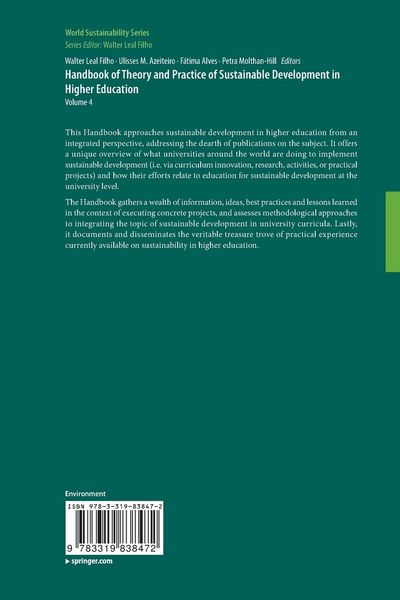
  • Produktbild: Handbook of Theory and Practice of Sustainable Development in Higher Education
  • Produktbild: Handbook of Theory and Practice of Sustainable Development in Higher Education

  • Achieving Resiliency Through Sustainable Literacy.- Learning and Teaching for a Sustainable Future.- Training Sustainability Change Agents: Lessons from International Water Education.- Awareness and Attitudes Towards Sustainable Development Amongst Higher Education Students in Penang, Malaysia.- Interdisciplinary Teamwork on Sustainable Development – The Top Ten Strategies Based on Experience of Student Initiated Projects.- The Will and the Skill in Education for Sustainability. Designing Tomorrow’s Campus: Resiliency, Vulnerability, and Adaptation.- Space for Interdisciplinary Collaboration: One Mode of Achieving Social Sustainability at Universities.- Overcoming Traditional Boundaries in Advancing Education for Sustainable.- Crafting Pedagogical Pathways that Disrupt and Transform Anthropocentric Mindsets of Higher Education Students.- Rethinking Thinking about Sustainable Development Curriculum.