KI-Beratung Beta

Produktbild: Enterprise Interoperability VII
Band 8 - 10%

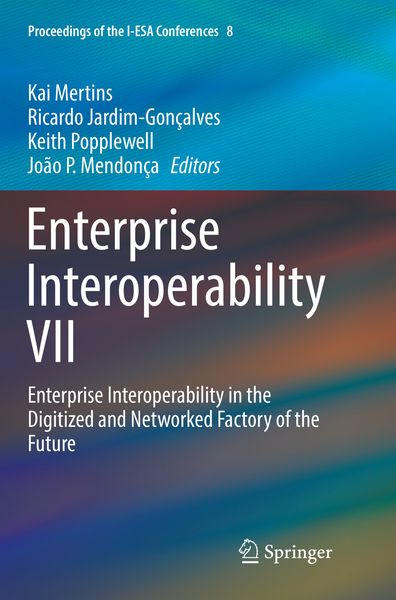
Enterprise Interoperability VII Enterprise Interoperability in the Digitized and Networked Factory of the Future

10% sparen

196,99 € UVP 219,99 €

inkl. gesetzl. MwSt., Versandkostenfrei


Beschreibung

A concise reference to the state of the art in systems interoperability, Enterprise Interoperability VII will be of great value to engineers and computer scientists working in manufacturing and other process industries and to software engineers and electronic and manufacturing engineers working in the...

Beschreibung

A concise reference to the state of the art in systems interoperability, Enterprise Interoperability VII will be of great value to engineers and computer scientists working in manufacturing and other process industries and to software engineers and electronic and manufacturing engineers working in the academic environment. Furthermore, it shows how knowledge of the meaning within information and the use to which it will be put have to be held in common between enterprises for consistent and efficient inter-enterprise networks.

Over 30 papers, ranging from academic research through case studies to industrial and administrative experience of interoperability show how, in a scenario of globalised markets, where the capacity to cooperate with other organizations efficiently is essential in order to remain economically, socially and environmentally cost-effective, the most innovative digitized and networked enterprises ensure that their systems and applications are able to interoperate across heterogeneous collaborative networks of independent organizations. This goal of interoperability is essential, not only from the perspective of the individual enterprise but also in the business structures that are now emerging, such as complex collaborating networks of suppliers and customers, virtual enterprises, interconnected organisations or extended enterprises, as well as in mergers and acquisitions. Establishing efficient and relevant collaborative situations requires the management of interoperability from a dynamic point of view: a relevant and efficient collaboration of organizations may require adaptation to remain in line with changing objectives, evolving resources, unexpected events, etc. Many of the papers contained in this, the eighth volume of Proceedings of the I-ESA Conferences have examples and illustrations calculated to deepen understanding and generate new ideas.

The I-ESA’16 Conference from which this book is drawn was organized by the Escola de Engenharia da Universidade do Minho, on behalf of the European Virtual Laboratory for Enterprise Interoperability (INTEROP-VLab) and Interop VLab Portuguese Pole.

Portrait

Prof.
Dr.-Ing. Kai Mertins was born 1947 in the Federal Republic of Germany. After
studies of Control Theory in Hamburg and of Economy together with Production
Technology at the Technical University of Berlin he was a member of the
scientific staff of the University Institute for Machine Tool and Manufacturing
Technology (IWF). Since 1983 he was head of the department "Production
Control and Manufacturing Systems" at the Fraunhofer-Institute for
Production Systems and Design Technology (IPK), where he is since 1988 Director
for Planning Technology. Since 1998 he is Professor for Production Management
at the Technical University of Berlin, Germany. He has more than 20 years
experience in design, planning, simulation and control of flexible manufacturing
systems, manufacturing control systems, shop floor control systems, computer
integrated manufacturing, business reengineering and enterprise modelling as
well as Intellectual Capital Statement. He was General Project manager in
several international industrial projects and gave lectures and seminars at the
Technical University Berlin and several other universities.

Produktdetails

Einband

Taschenbuch

Erscheinungsdatum

16.06.2018

Abbildungen

XIV, 104 illus., 87 illus. in color., farbige Illustrationen, schwarz-weiss Illustrationen

Herausgeber Kai Mertins + weitere

Produktdetails

Einband

Taschenbuch

Erscheinungsdatum

16.06.2018

Abbildungen

XIV, 104 illus., 87 illus. in color., farbige Illustrationen, schwarz-weiss Illustrationen

Herausgeber
Verlag Springer
Seitenzahl

344

Maße (L/B/H)

23,5/15,5/1,9 cm

Gewicht

742 g

Auflage

Softcover reprint of the original 1st ed. 2016

Sprache

Englisch

ISBN

978-3-319-80928-1

Herstelleradresse

Springer International Publishing AG
Gewerbestr. 11
6330 Cham
Schweiz
Url: www.springer.com

Noch keine Bewertungen vorhanden

Verfassen Sie die erste Bewertung zu diesem Artikel

Helfen Sie anderen Kundinnen und Kunden durch Ihre Meinung.

Kundinnen und Kunden meinen

Bewertungen (0)

  • Produktbild: Enterprise Interoperability VII
  • Part I: Introduction.- An Interoperable Cloud Environment of Manufacturing Control System.- A New Framework for Strategic Risk Analysis in a Global Pump Manufacturing Network.- Cloud and Services Testing Applied in Manufacturing.- A Self Sustainable Approach for IoT Services Provisioning.- Part II: Modelling the Enterprise Interoperability.- Requirement Pattern Elicitation Approach of Massive Customers in Domain Oriented Service Requirement.- Semantic Data Integration Approach for the Vision of a Digital Factory.- Negotiation Coordination Model for Supporting Enterprise Interoperability.- Part III: Semantics for Enterprise Interoperability.- The Systems Development Life Cycle to Facilitate Progression Towards Semantic and Organizational Interoperability for Healthcare System.- Performance Oriented Decision Making to Guide Web Service Lifecycle.- Profiling Based on Music and Physiological State.- Part IV: Architectures and Frameworks for Interoperability.- Automated Process Model Generation for Internet of Things Oriented Enterprise Systems.- Use of Big Data for Continuous Interoperability in Crisis Management.- Weaving Trending, Costing and Recommendations Using Big Data Analytics: An Enterprise Capability Evaluator.- The Industry Cockpit Approach: A Framework for Flexible Real-time Production Monitoring.- Part V: Services for the Enterprise Interoperability.- iFloW: An Integrated Logistics Software System for Inbound Supply Chain Traceability.- Qualitative Evaluation of Manufacturing Software Units Interoperability Using ISO 25000 Quality Mode.- Process Modeling Approach for the Liquid-Sensing Enterprise.- Part VI: Ontologies and Concepts for Enterprise Interoperability.- A MetaMeta Level Formal Manufacturing Ontology for Meta Level Production Methods.- Towards an Interoperable Decision Support Platform for Eco-labeling Process.- Framework of Design Principles and Standards for Enterprise Interoperability Service Utilities.- Part VII: Industrial Implementation of Enterprise Interoperability.- Requirements Engineering Using Serious Games.- Knowledge-based System to Enhance Coordination of Hospital Practitioners: A Case Study.- Towards a Flexible Gamification Model for an Interoperable E-learning BP Simulation Platform.- Part VIII: Collaborative Supply Networks Interoperability.- Towards a Methodology to Support the Strategies Alignment Process in Collaborative Networks.- Meta-modeling of Collaborative Supply Chain.- Seamless Interrelation Between Business Strategies and Tactical Planning.- A Competition Model for the Offer: An Experiment of Management Simulation.