KI-Beratung Beta

Gutscheinbedingungen

**Gültig bis 30.11.2026 auf Spielzeug, Schreibwaren, Filme, Geschenke & Trends, Musik, tolino eReader & Zubehör, Hörbücher und Hörbuch-Downloads, nicht preisgebundene Bücher und Kalender online auf thalia.at und in der Thalia App. Einzelne Artikel können ausgeschlossen sein. Aufgrund der Buchpreisbindung sind deutschsprachige Bücher und eBooks ausgenommen. Zusätzlich ausgenommen sind Abos & Flatrates, Games, Geschenkkarten/-boxen, Shelfies, Software, Zeitschriften sowie einzelne Artikel von tonies®. Pro Einkauf einmal einlösbar. Nur gültig mit im Onlineshop hinterlegter Bonuscard. Click & Collect nur bei Onlinevorabzahlung möglich. Keine Barauszahlung. Nicht kombinierbar mit anderen Aktionen und Gutscheinen. Gutschein wird auf max. 500€ Bestellwert angerechnet. Nicht gültig für Versandkosten und Services.

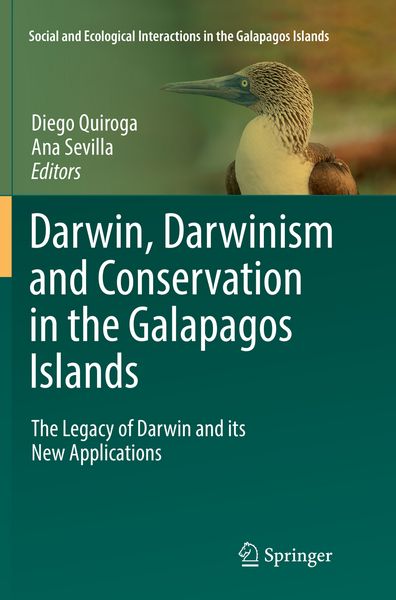
  • Produktbild: Darwin, Darwinism and Conservation in the Galapagos Islands
  • Produktbild: Darwin, Darwinism and Conservation in the Galapagos Islands

Darwin, Darwinism and Conservation in the Galapagos Islands The Legacy of Darwin and its New Applications

131,99 €

inkl. gesetzl. MwSt., Versandkostenfrei


Beschreibung

The book explores how Darwin´s legendary and mythologized visit to the Galapagos affected the socioecosystems of the Islands, as well as the cultural and intellectual traditions of Ecuador and Latin America. It highlights in what way the connection between Darwin and the Galapagos has had real, enduring...

Beschreibung

The book explores how Darwin´s legendary and mythologized visit to the Galapagos affected the socioecosystems of the Islands, as well as the cultural and intellectual traditions of Ecuador and Latin America. It highlights in what way the connection between Darwin and the Galapagos has had real, enduring and paradoxical effects in the Archipelago. This Twenty Century construct of the Galapagos as the cradle of Darwin’s theory and insights triggered not only the definition of the Galapagos as a living natural laboratory but also the production of a series of conservation practices and the reshaping of the Galapagos as a tourism destination with an increasingly important flow of tourists that potentially threaten its fragile ecosystems. The book argues that the idea of a Darwinian living laboratory has been limited by the success of the very same constructs that promote its conservation. It suggests critical interpretations of this paradox by questioning many of the dichotomies that havebeen created to understand nature and its conservation.  We also explore some possible ways in which Darwin's ideas can be used to better understand the social and natural threats facing the Islands and to develop sustainable and successful management practices.

Rezension

“This thought-provoking work will appeal to environmentalists, evolutionists, and historians of natural history. Summing Up: Recommended. Upper-division undergraduates and above; researchers and faculty.” (J. S. Schwartz, Choice, Vol. 54 (9), May, 2017)

Portrait

Diego Quiroga got his B.A. at the University of California Berkeley and his M.A. and Ph.D. at the University of Illinois, Urbana-Champaign in anthropology. He has done research on different areas of Ecuador and has written on diverse topics including medical anthropology, development, conservation and political ecology. Besides researching issues such as fisheries and tourism in the Galapagos, Diego is also studying the amazon forest and examining the changes and transformations that indigenous people in the area are experiencing and their response to these new challenges. He is the cofounder of GAIAS, the Galapagos Academic Institute for the Arts and the Sciences and the current director of the Center which is a branch of the Universidad San Francisco de Quito in San Cristobal, Galapagos.  Diego is also involved in the administration of the program and teaches classes for the local Galapagos students and in for different exchange programs in collaboration with many universities around the world.
Ana Sevilla is a research associate at the Universidad San Francisco de Quito. She completed her Ph.D. at Facultad Latinoamericana de Ciencias Sociales and did her postdoctoral studies at Leiden University. Her research interests lie in the area of the history of science; she studies processes of knowledge production in non-European spaces of modernity. Ana has focused her explorations on the reception of Darwin´s ideas in Ecuador and Latin America. She is also involved in the Galapagos tourism industry. She has worked in one of the most important tourism operators of the Galapagos in the area of research and development of new products.

Produktdetails

Einband

Taschenbuch

Erscheinungsdatum

16.06.2018

Abbildungen

XV, 164 p. 6 illus. in color.

Herausgeber Diego Quiroga + weitere

Produktdetails

Einband

Taschenbuch

Erscheinungsdatum

16.06.2018

Abbildungen

XV, 164 p. 6 illus. in color.

Herausgeber
Verlag Springer
Seitenzahl

164

Maße (L/B/H)

23,5/15,5/1,1 cm

Gewicht

283 g

Auflage

Softcover reprint of the original 1st edition 2017

Sprache

Englisch

ISBN

978-3-319-81665-4

Herstelleradresse

Springer Heidelberg
Tiergartenstr. 17
69121 Heidelberg
DE
buchhandel-buch@springer.com

Noch keine Bewertungen vorhanden

Verfassen Sie die erste Bewertung zu diesem Artikel

Helfen Sie anderen Kundinnen und Kunden durch Ihre Meinung.

Kundinnen und Kunden meinen

Bewertungen (0)

  • Produktbild: Darwin, Darwinism and Conservation in the Galapagos Islands
  • Produktbild: Darwin, Darwinism and Conservation in the Galapagos Islands
  • Foreword.- 1.Darwin’s Galapagos Myth.- 2.On the Origin of Species and the Galapagos Islands.- 3.The Galapagos Islands and the Ecuadorean State: Early Encounters.- 4.Darwinians, Anti-Darwinians and the Galapagos (1835-1935).- 5.Mythologizing Darwin’s Islands.- 6.Mythologizing Darwin’s Islands.- 7.Darwinism in Latin America: Reception and Introduction.- 8.The Charles Darwin Foundation: some critical remarks about its history and trends.- 9.Darwin, Emergent Process and the Conservation of Galapagos Ecosystems.- 10.Darwinian Emergence, Conservation and Restoration: Novel Ecosystems and Hybrid Environments.