Gutscheinbedingungen

**Gültig bis 17.08.2026 auf Schreibwaren & Office-Artikel online auf thalia.at, in der Thalia App und in teilnehmenden Thalia Buchhandlungen in Österreich mit Schulsortiment. In den Buchhandlungen nur gültig auf lagernde Ware. Einzelne Artikel können ausgeschlossen sein. Ausgenommen sind preisgebundene Artikel. Pro Einkauf einmal einlösbar. Nur gültig gegen Vorlage oder im Onlineshop hinterlegter Bonuscard. Infos zur Einlösung in der Buchhandlung sind auf der Bonuscard-Vorteilspreisseite zu finden. Click & Collect nur bei Onlinevorabzahlung möglich. Keine Einlösung bei Scan & Go-Bezahlung. Keine Barauszahlung. Nicht kombinierbar mit anderen Aktionen und Gutscheinen. Gutschein wird auf max. 500€ Bestellwert angerechnet. Nicht gültig für Geschenkkarten, Versandkosten und Services.

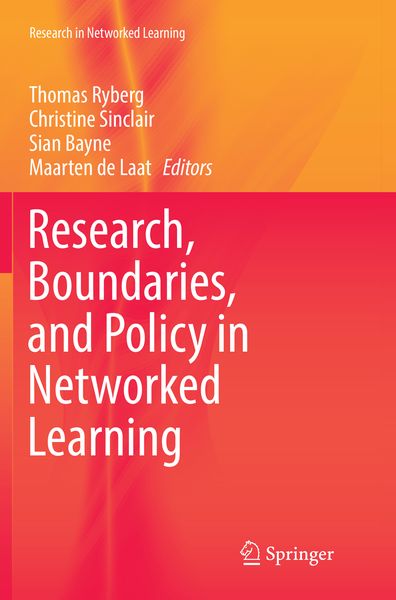
  • Produktbild: Research, Boundaries, and Policy in Networked Learning
  • Produktbild: Research, Boundaries, and Policy in Networked Learning

Research, Boundaries, and Policy in Networked Learning

99,99 €

inkl. gesetzl. MwSt., Versandkostenfrei


Beschreibung

Produktdetails

Einband

Taschenbuch

Erscheinungsdatum

09.06.2018

Abbildungen

VIII, 8 illus., 5 illus. in color., farbige Illustrationen, schwarz-weiss Illustrationen

Herausgeber

Thomas Ryberg + weitere

Verlag

Springer

Seitenzahl

191

Maße (L/B/H)

23,5/15,5/1,2 cm

Gewicht

314 g

Auflage

Softcover reprint of the original 1st ed. 2016

Sprache

Englisch

ISBN

978-3-319-80970-0

Beschreibung

Portrait

Thomas Ryberg  is Professor MSO in the Department of Communication and Psychology at Aalborg University (AAU), Denmark. He is part of the research centre: “E-learning lab - Center for User Driven Innovation, Learning and Design”. His primary research interests are within the fields of Networked Learning, Problem Based Learning (PBL), Computer Supported Collaborative Learning (CSCL) and Technology Enhanced Learning (TEL). He is co-chair of the International Networked Learning Conference and member of the Aalborg PBL Academy Management Board. 

Siân Bayne is a Professor of Digital Education in the School of Education, based in the Digital Cultures and Education research group at the University of Edinburgh. She has been widely published in a variety of peer reviewed journals, such as Research in Learning Technology and E-Learning, and has edited and contributed to several books. 

Maarten de Laat  is full Professor at the Open Universiteit ofthe Netherlands. He is director of the Social and Networked Learning research programme, which concentrates on exploring social learning strategies and networked learning relationships that facilitate professional development in the workplace.  He has published and presented his work extensively in research journals, books and conferences. 

Christine Sinclair is a lecturer in Digital Education at the University of Edinburgh. She has published and presented numerous papers in both journals such as TechTrends and books like Exploring the Theory, Pedagogy, and Practice of Networked Learning published by Springer. Her research interests include the experience of being a student in a variety of fields and online education.

Produktdetails

Einband

Taschenbuch

Erscheinungsdatum

09.06.2018

Abbildungen

VIII, 8 illus., 5 illus. in color., farbige Illustrationen, schwarz-weiss Illustrationen

Herausgeber

Verlag

Springer

Seitenzahl

191

Maße (L/B/H)

23,5/15,5/1,2 cm

Gewicht

314 g

Auflage

Softcover reprint of the original 1st ed. 2016

Sprache

Englisch

ISBN

978-3-319-80970-0

Herstelleradresse

Springer-Verlag GmbH
Tiergartenstr. 17
69121 Heidelberg
DE

Email: ProductSafety@springernature.com

Noch keine Bewertungen vorhanden

Verfassen Sie die erste Bewertung zu diesem Artikel

Helfen Sie anderen Kundinnen und Kunden durch Ihre Meinung.

Kundinnen und Kunden meinen

Bewertungen (0)

Weitere Artikel finden Sie in

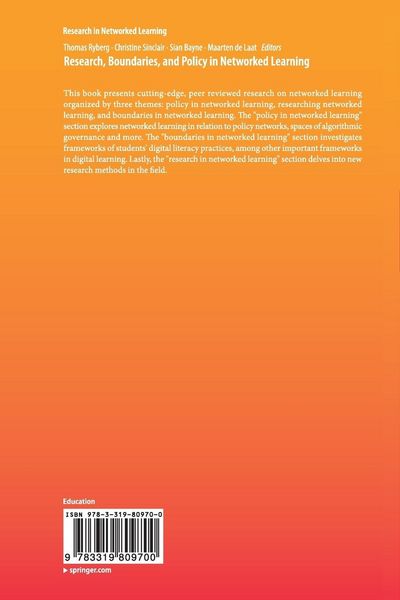
  • Produktbild: Research, Boundaries, and Policy in Networked Learning
  • Produktbild: Research, Boundaries, and Policy in Networked Learning
  • Introduction.- Learning from a Deceptively Spacious Policy Discourse.- Policy networks, database pedagogies, and the new spaces of algorithmic governance in education.- The politics of networked learning in an age of austerity.- It's not all about the learner: a sociomaterial reframing of students' digital literacy practices.- Design for networked learning: framing relations between participants' activities and the physical setting.- Lost in transition?: Making sense of space: time configurations across workplace and educational boundaries.- A practice-grounded approach to 'engagement' and 'motivation' in networked learning.- Research methods are made by questioning: the post-disciplinary challenge of networked learning.- Mobile learning field activity: Pedagogy of simultaneity to support learning in the open.- Conclusion.