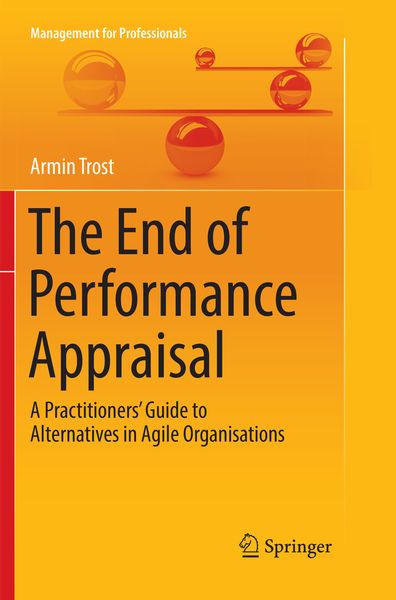
This book demonstrates, in detail, why annual performance appraisals might still work in hierarchical environments, but largely fail in agile ones. The annual performance appraisal is one of the world’s most widely used management tools. For many years, it was indeed seen as a pre-requisite for successful leadership and professional management. While most managers and employees have always been sceptical in this respect, those at a strategic level are now also realising it causes more harm than good, and a growing number of leading companies have similarly abolished this approach. One key reason lies in the changing working world, and the quest for greater organisational agility. Companies are moving away from rigid structuring. The arguments are presented objectively but with practical relevance, coherently illustrating the available alternatives for achieving what annual performance appraisals largely have not.
Kundinnen und Kunden meinen
5.0/5.0
Bewertung
aus Villingen-Schwenningen
5/5
14.06.2017
Buch (Gebundene Ausgabe)
A honest and detailed analysis of the most common tool of human resources
Prof. Dr. Armin Trost, an industrial and organizational German psychologist and a prominent author, speaker and consultant who focuses primarily on talent management, employer branding and the future of work, analyzes and provides clear arguments on the pros and cons of performance appraisals and what could be done in its place.
On his book The End of Performance Appraisal: A Practitioners Guide to Alternatives in Agile Organisations, Dr. Trost not only acknowledges the naivety with which HR managers often approach real challenges that are connected to annual performance appraisals and the damage that a wrongly settled performance appraisal may bring to the growth of healthy working relationships and employee development, but he also rightly shapes alternative approaches in relation to the various benefits that are intended to achieve through a performance appraisal system.
Even though, the book is intended to be a Human Resources Practitioners Guide, Dr. Trost, a university professor on human resources by vocation, displays his lecturing skills by successfully introducing either the novice reader as well as the well-seasoned HR expert into the concept, purposes and possible results of performance appraisals and helps them to better understand the benefits and dynamics associated with annual performance appraisals from a neutral perspective. With a very fresh and easy going writing voice, the author systematically evaluates the performance appraisal´s framework conditions, its possibilities and limits, and provides positive alternatives to its implementation, like allowing the employee or his/her team sets goals for their own guidance or implementing social and collaborative approaches.
As for the importance of the subject, while the author expressly states that what makes this book special is the fact that it examines in detail the desired benefits of annual performance appraisals in relation to different contexts and that the most important reason to read this book lies in the changing working world, the value of his work may not only rest on those facts, as neither on his structured examination of annual performance appraisals in agile and hierarchical working worlds, but also at the humanistic approach with which the author develops such considerations as it can be read through his numerous assertions.
For the writer trust, autonomy and self regulation play a fundamental roll on employee´s development, as well as in working teams and enterprises success. Furthermore, Dr. Trost places the employee as the sole commander of his own achievements, and remarks that in complex and unpredictable working environments, like the ones in which most of us live, only the employees themselves are responsible for their development, just as they are for setting and achieving their goals.
Special attention should be paid to two aspects of Dr. Trost work. First, the No baby-sitting strategy that results in working teams addressing and controlling the low performance of any of its members without the interference of the team leader or manager is indeed necessary and healthy; employees natural response to exercise pressure over an underperforming colleague should be understood and accepted. However, this strategy shall not be confused with allowing mobbing at the workplace, which is hardly the message of the author, whom according to his arguments is a true supporter of human development, team work and mutual respect and trust. On this regard, only two questions stay up in the air: how can managers effectively distinguish teams self-regulation from mobbing? And how can the former be promoted without allowing the latter?
Secondly, some of the ratings systems that the author uses to compare different aspects of performance appraisals in agile and hierarchical worlds like The annual performance appraisal and its prospects of success in a hierarchical and agile world are admittedly, not very detailed, which is true, but this sort of shortcomings should not discourage the reader from its study by any mean, as the rationale behind those ratings is clearly and undoubtedly outlined in detail. On the contrary, the so admitted lacking of detail only reveals a polished analysis and the thought-provoking modesty and openness of the author.
Finally, one last relevant consequence shall be considered while reading Dr. Trost book. It is almost impossible for the reader to go throughout his written lectures without performing a self-reflection and assessment regarding his/her own performance as an employee and/or as manager in terms of responsibility, independence and trust, either he/she grant them to others or others deposit on him/her.
However, just in case that the enthusiastic reader had lost such opportunity of self-reflection while gladly reading the examples of Mick Jager as leader of the Rolling Stones and Sir George Martin as manager of the Beatles among others contained all along the book, Dr. Trost comes one more time to the rescue by suggesting everybody to answer two simple questions for himself/herself at the beginning of each year: What do I want to be proud of in 12 months time? and What areas do I want to improve in over the next 12 months? Plain questions indeed, nevertheless strong enough as to become the beginning of the end of performance appraisal and the beginning of a new self development and human resources management era.
Kurze Frage zu unserer Seite
Vielen Dank für Ihr Feedback
Wir nutzen Ihr Feedback, um unsere Produktseiten zu verbessern. Bitte haben Sie Verständnis, dass wir Ihnen keine Rückmeldung geben können. Falls Sie Kontakt mit uns aufnehmen möchten, können Sie sich aber gerne an unseren Kund*innenservice wenden.