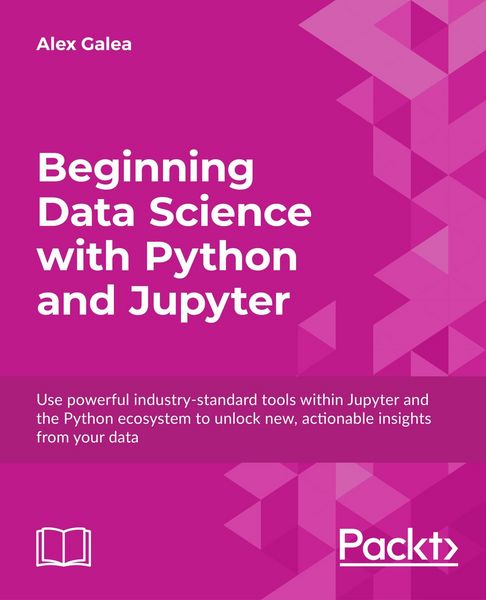
Beginning Data Science with Python and Jupyter Use powerful industry-standard tools within Jupyter and the Python ecosystem to unlock new, actionable insights from your data
-
- Einzelkauf Download ausgewählt
-
Sprache:Englisch
11,30 €
inkl. gesetzl. MwSt.Beschreibung
Produktdetails
Format
ePUB
Kopierschutz
Ja
Family Sharing
Ja
Text-to-Speech
Ja
Erscheinungsdatum
05.06.2018
Verlag
Packt PublishingSeitenzahl
194 (Printausgabe)
Dateigröße
13556 KB
Sprache
Englisch
EAN
9781789534658
Use powerful industry-standard tools to unlock new, actionable insight from your existing data
Key Features- Get up and running with the Jupyter ecosystem and some example datasets
- Learn about key machine learning concepts like SVM, KNN classifiers and Random Forests
- Discover how you can use web scraping to gather and parse your own bespoke datasets
Getting started with data science doesn't have to be an uphill battle. This step-by-step guide is ideal for beginners who know a little Python and are looking for a quick, fast-paced introduction.
Get to grips with the skills you need for entry-level data science in this hands-on Python and Jupyter course. You'll learn about some of the most commonly used libraries that are part of the Anaconda distribution, and then explore machine learning models with real datasets to give you the skills and exposure you need for the real world.
We'll start with understanding the basics of Jupyter and its standard features. You'll be analyzing an example of a data analytics report. After analyzing a data analytics report, next step is to implement multiple classification algorithms. We'll then show you how easy it can be to scrape and gather your own data from the open web, so that you can apply your new skills in an actionable context. Finish up by learning to visualize these data interactively.
What you will learn- Identify potential areas of investigation and perform exploratory data analysis
- Plan a machine learning classification strategy and train classification models
- Use validation curves and dimensionality reduction to tune and enhance your models
- Scrape tabular data from web pages and transform it into Pandas DataFrames
- Create interactive, web-friendly visualizations to clearly communicate your findings
This course is ideal for professionals with a variety of job descriptions across large range of industries, given the rising popularity and accessibility of data science. You'll need some prior experience with Python, with any prior work with libraries like Pandas, Matplotlib and Pandas providing you a useful head start.
Alex Galea has been professionally practicing data analytics since graduating with a Master's degree in Physics from the University of Guelph, Canada. He developed a keen interest in Python while researching quantum gases as part of his graduate studies. Alex is currently doing web data analytics, where Python continues to play a key role in his work. He is a frequent blogger about data-centric projects that involve Python and Jupyter Notebooks.Noch keine Bewertungen vorhanden
Verfassen Sie die erste Bewertung zu diesem Artikel
Helfen Sie anderen Kundinnen und Kunden durch Ihre Meinung.
Kurze Frage zu unserer Seite
Vielen Dank für Ihr Feedback
Wir nutzen Ihr Feedback, um unsere Produktseiten zu verbessern. Bitte haben Sie Verständnis, dass wir Ihnen keine Rückmeldung geben können. Falls Sie Kontakt mit uns aufnehmen möchten, können Sie sich aber gerne an unseren Kund*innenservice wenden.
zum Kundenservice