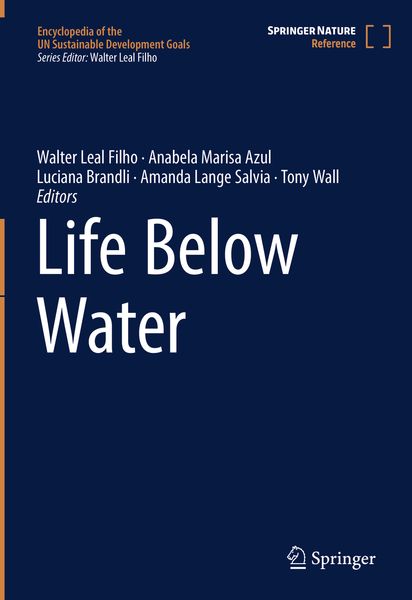
Life Below Water
-
- Englisch ausgewählt
589,99 €
UVP
659,99 €
inkl. gesetzl. MwSt.,
Beschreibung
Produktdetails
Einband
Gebundene Ausgabe
Erscheinungsdatum
27.04.2022
Abbildungen
XXX, 267 illus., 242 illus. in color., farbige Illustrationen, schwarz-weiss Illustrationen
Herausgeber
Walter Leal Filho + weitereVerlag
SpringerSeitenzahl
1110
Maße (L/B/H)
26/18,3/5 cm
Gewicht
2546 g
Auflage
1st edition 2022
Sprache
Englisch
ISBN
978-3-319-98535-0
The problems related to the process of industrialisation such as biodiversity depletion, climate change and a worsening of health and living conditions, especially but not only in developing countries, intensify. Therefore, there is an increasing need to search for integrated solutions to make development more sustainable. The United Nations has acknowledged the problem and approved the “2030 Agenda for Sustainable Development”. On 1st January 2016, the 17 Sustainable Development Goals (SDGs) of the Agenda officially came into force. These goals cover the three dimensions of sustainable development: economic growth, social inclusion and environmental protection.
The Encyclopedia of the UN Sustainable Development Goals comprehensively addresses the SDGs in an integrated way. It encompasses 17 volumes, each one devoted to one of the 17 SDGs. This volume is dedicated to SDG 14 “ Conserve and sustainably use the oceans, seas and marine resources for sustainable development ". Marine and coastal bio-resources, play an essential role in human well-being and social and economic development. This volume addresses this sustainability challenge providing the description of a range of terms, which allows a better understanding and fosters knowledge about it.Concretely, the defined targets are:
- Prevent and significantly reduce marine pollution of all kinds, in particular from land-based activities, including marine debris and nutrient pollution
- Sustainably manage and protect marine and coastal ecosystems to avoid significant adverse impacts, including by strengthening their resilience, and take action for their restoration in order to achieve healthy and productive oceans
- Minimize and address the impacts of ocean acidification, including through enhanced scientific cooperation at all levels
- Effectively regulate harvesting and end overfishing, illegal, unreported and unregulated fishing and destructive fishing practices and implement science-based management plans, in order to restore fish stocks in the shortest time feasible, at least to levels that can produce maximum sustainable yield as determined by their biological characteristics
- Conserve at least 10 per cent of coastal and marine areas, consistent with national and international law and based on the best available scientific information
- Prohibit certain forms of fisheries subsidies which contribute to overcapacity and overfishing, eliminate subsidies that contribute to illegal, unreported and unregulated fishing and refrain from introducing new such subsidies, recognizing that appropriate and effective special and differential treatment for developing and least developed countries should be an integral part of the World Trade Organization fisheries subsidies negotiation 16
- Increase the economic benefits to small island developing states and least developed countries from the sustainable use of marine resources, including through sustainable management of fisheries, aquaculture and tourism
- Increase scientific knowledge, develop research capacity and transfer marine technology, taking into account the Intergovernmental Oceanographic Commission Criteria and Guidelines on the Transfer of Marine Technology, in order to improve ocean health and to enhance the contribution of marine biodiversity to the development of developing countries, in particular small island developing states and least developed countries
- Provide access for small-scale artisanal fishers to marine resources and markets
- Enhance the conservation and sustainable use of oceans and their resources by implementing international law as reflected in the United Nations Convention on the Law of the Sea, which provides the legal framework for the conservation and sustainable use of oceans and their resources, as recalled in paragraph 158 of “The future we want”
Ulisses M. Azeiteiro, Anabela Marisa Azul, Luciana Brandli, Ernesto Brugnoli, Ana M. M. Gonçalves, Giulia Guerriero, Nathalie Hilmi, Walter Leal Filho, Filipe Martinho, Fernando Morgado, Saleem Mustafa, Nidhi Nagabhatla, Melissa Nursey-Bray, Jessica M. Savage, Teppo Vehanen
Noch keine Bewertungen vorhanden
Verfassen Sie die erste Bewertung zu diesem Artikel
Helfen Sie anderen Kundinnen und Kunden durch Ihre Meinung.
Kurze Frage zu unserer Seite
Vielen Dank für Ihr Feedback
Wir nutzen Ihr Feedback, um unsere Produktseiten zu verbessern. Bitte haben Sie Verständnis, dass wir Ihnen keine Rückmeldung geben können. Falls Sie Kontakt mit uns aufnehmen möchten, können Sie sich aber gerne an unseren Kund*innenservice wenden.
zum Kundenservice