KI-Beratung Beta

Gutscheinbedingungen

**Gültig bis 30.11.2026 auf Spielzeug, Schreibwaren, Filme, Geschenke & Trends, Musik, tolino eReader & Zubehör, Hörbücher und Hörbuch-Downloads, nicht preisgebundene Bücher und Kalender online auf thalia.at und in der Thalia App. Einzelne Artikel können ausgeschlossen sein. Aufgrund der Buchpreisbindung sind deutschsprachige Bücher und eBooks ausgenommen. Zusätzlich ausgenommen sind Abos & Flatrates, Games, Geschenkkarten/-boxen, Shelfies, Software, Zeitschriften sowie einzelne Artikel von tonies®. Pro Einkauf einmal einlösbar. Nur gültig mit im Onlineshop hinterlegter Bonuscard. Click & Collect nur bei Onlinevorabzahlung möglich. Keine Barauszahlung. Nicht kombinierbar mit anderen Aktionen und Gutscheinen. Gutschein wird auf max. 500€ Bestellwert angerechnet. Nicht gültig für Versandkosten und Services.

  • Produktbild: Teaching and Researching Reading
  • Produktbild: Teaching and Researching Reading

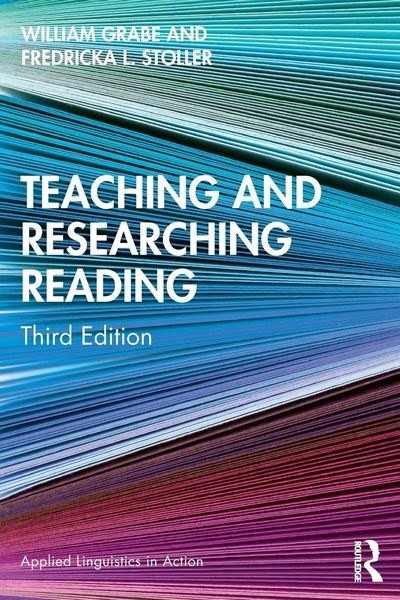
Teaching and Researching Reading

58,99 €

inkl. gesetzl. MwSt., Versandkostenfrei


Beschreibung

Now in its third edition, Teaching and Researching Reading charts the field of reading (first and second language) systematically and coherently for the benefit of language teaching practitioners, students, and researchers. This volume provides background on how reading works and how reading differs...

Beschreibung

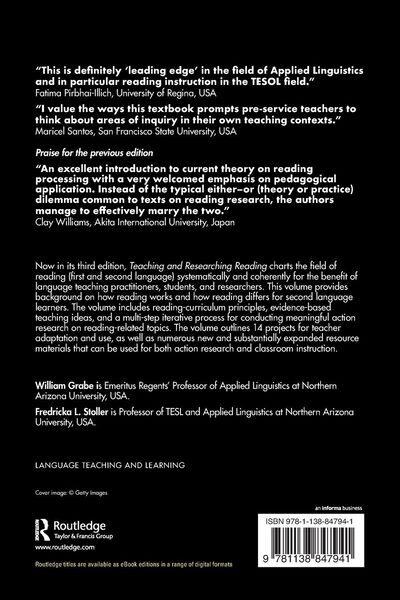
Now in its third edition, Teaching and Researching Reading charts the field of reading (first and second language) systematically and coherently for the benefit of language teaching practitioners, students, and researchers. This volume provides background on how reading works and how reading differs for second language learners. The volume includes reading-curriculum principles, evidence-based teaching ideas, and a multi-step iterative process for conducting meaningful action research on reading-related topics. The volume outlines 14 projects for teacher adaptation and use, as well as numerous new and substantially expanded resource materials that can be used for both action research and classroom instruction.

Rezension

"This is definitely 'leading edge' in the field of Applied Linguistics and in particular reading instruction in the TESOL field."

Fatima Pirbhai-Illich, University of Regina, USA.

"I value the ways this textbook prompts pre-service teachers to think about areas of inquiry in their own teaching contexts."

Maricel Santos, San Francisco State University, USA

Praise for the previous edition

"An excellent introduction to current theory on reading processing with a very welcomed emphasis on pedagogical application. Instead of the typical either-or (theory or practice) dilemma common to texts on reading research, the authors manage to effectively marry the two."

Clay Williams, Akita International University, Japan

Produktdetails

Einband

Taschenbuch

Erscheinungsdatum

30.09.2019

Abbildungen

12 SW-Abb., 1 SW-Fotos, 11 SW-Zeichn., 46 Tabellen

Verlag Taylor & Francis

Produktdetails

Einband

Taschenbuch

Erscheinungsdatum

30.09.2019

Abbildungen

12 SW-Abb., 1 SW-Fotos, 11 SW-Zeichn., 46 Tabellen

Verlag Taylor & Francis
Seitenzahl

342

Maße (L/B/H)

22,9/15,2/1,8 cm

Gewicht

496 g

Auflage

3. Auflage

Sprache

Englisch

ISBN

978-1-138-84794-1

Herstelleradresse

Libri GmbH
Europaallee 1
36244 Bad Hersfeld
DE

Email: gpsr@libri.de

Noch keine Bewertungen vorhanden

Verfassen Sie die erste Bewertung zu diesem Artikel

Helfen Sie anderen Kundinnen und Kunden durch Ihre Meinung.

Kundinnen und Kunden meinen

Bewertungen (0)

Die Leseprobe wird geladen.
  • Produktbild: Teaching and Researching Reading
  • Produktbild: Teaching and Researching Reading
  • Contents

    General Editors' Preface ix

    Authors' Acknowledgements and Dedication xi

    Publisher's Acknowledgements xi

    Introduction 1

    Section I: Understanding L2 reading X

    1 The nature of reading abilities X

    1.1 A description of the miracle of reading (part I) X

    1.2 An initial definition of reading X

    1.3 Purposes for reading

    1.4 Defining fluent reading comprehension

    1.5 Describing how reading works: Components of reading abilities X

    1.6 A description of the miracle of reading (part II)

    1.7 Three models and an approach X

    1.8 Conclusion

    Appendix 1-A Factors to take into account when considering the complex nature of reading

    2 Comparing L1 and L2 reading X

    2.1 Linguistic and processing differences between L1 and L2 readers X

    2.2 Individual and experiential differences between L1 and L2 readers X

    2.3 Socio-cultural and institutional differences influencing L1 and L2 reading development

    2.4 Similarities between L1 and L2 reading

    2.5 Conclusion X

    Section II: Exploring research in reading X

    3 Key studies in L1 reading X

    3.1 Research studies as stories: An extended example X

    3.2 Ten more key research studies

    3.3 Research on underlying cognitive skills and the impact of extensive reading

    3.4 Research on specific component skills in reading comprehension

    3.5 Conclusion

    Appendix 3-A Visual example of a SEM pathway analysis

    4 Key studies in L2 reading X

    4.1 Topics to explore in L2 reading research X

    4.2 Ten good stories from L2 reading research

    4.3 Implications for L2 instruction

    4.4 Conclusion

    Appendix 4-A Discourse structure graphic organizer (DSGO), complete version

    Appendix 4-B Discourse structure graphic organizer (DSGO), instructional version

    Section III: L2 reading curricula and instruction X

    5 Principles for L2 reading-curriculum design

    5.1 Core reading-curriculum principles

    5.2 Reading-skills development principles

    5.3 Instructional-design principles

    5.4 Conclusion

    Appendix 5-A Common signals and transition words

    Appendix 5-B Common reading strategies

    Appendix 5-C Principles that should permeate curricula committed to reading-skills development

    6 Teaching L2 reading using evidence-based practices

    6.1 Core reading-curriculum principles translated into practice

    6.2 Reading-skills development principles translated into practice

    6.3 Instructional-design principles translated into practice

    6.4 Conclusion

    Appendix 6-A Student worksheet: Discourse structure graphic organizers

    Appendix 6-B Answer key to DSGO in Appendix 6-A

    Appendix 6-C Sample reading guide

    Section IV: Investigating reading through action research X

    7 Reading teachers as action researchers X

    7.1 Teachers investigating their own classrooms: 'How to' guidelines X

    7.2 Conclusion X

    Appendix 7-A Explicit vocabulary teaching techniques: Sample tally sheet

    Appendix 7-B Sample record-keeping sheet to document in-class silent reading time

    8 Action research projects: Set I