KI-Beratung Beta

Gutscheinbedingungen

**Gültig am 27.11.2026 auf Spielzeug, Schreibwaren, Filme, Geschenke & Trends, Musik, tolino eReader & Zubehör, Hörbücher und Hörbuch-Downloads, nicht preisgebundene Bücher und Kalender online auf thalia.at und in der Thalia App. Einzelne Artikel können ausgeschlossen sein. Aufgrund der Buchpreisbindung sind deutschsprachige Bücher und eBooks ausgenommen. Zusätzlich ausgenommen sind Abos & Flatrates, Games, Geschenkkarten/-boxen, Shelfies, Software, Zeitschriften sowie einzelne Artikel von tonies®. Pro Einkauf einmal einlösbar. Click & Collect nur bei Onlinevorabzahlung möglich. Keine Barauszahlung. Nicht kombinierbar mit anderen Aktionen und Gutscheinen. Gutschein wird auf max. 500€ Bestellwert angerechnet. Nicht gültig für Versandkosten und Services.

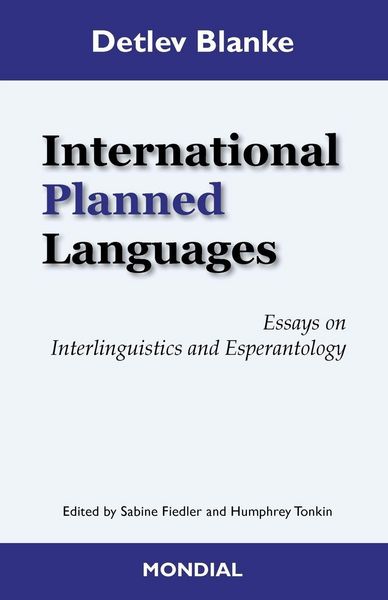
Produktbild: International Planned Languages. Essays on Interlinguistics and Esperantology

International Planned Languages. Essays on Interlinguistics and Esperantology

39,99 €

inkl. gesetzl. MwSt., Versandkostenfrei


Beschreibung

The author of this book, the German interlinguist and Esperanto researcher Detlev Blanke (1941-2016), has influenced the study of planned languages like no one else. It is to a large extent due to his lifelong scholarly devotion to this area of research that Interlinguistics and Esperanto Studies (Esperantology)...

Beschreibung

The author of this book, the German interlinguist and Esperanto researcher Detlev Blanke (1941-2016), has influenced the study of planned languages like no one else. It is to a large extent due to his lifelong scholarly devotion to this area of research that Interlinguistics and Esperanto Studies (Esperantology) have become serious subjects of study in the academic world. In his publications, Blanke gives an overview of the history of language creation. He describes the most important planned language systems and presents various systems of classification. A special focus is put on Esperanto initiated by L.L. Zamenhof in 1887. (Sabine Fiedler) For Blanke, a planned language was essentially a tool: if it worked it was worthy of study and use; if it failed to work, he was interested in why, though at the same time careful to avoid value judgments. Blanke himself spoke a planned language, namely Esperanto, and recognised this language and language projects like it as arising out of a coherent theoretical base and addressing a recognisable problem. Essentially independently of the sociolinguistic school in the west, Blanke had reached a similar conclusion: if a language phenomenon exists, it is worthy of scholarly examination in itself. Blanke was particularly interested in how planned languages related to ethnic languages, how the ‘artificiality’ of, say, Esperanto extended to, indeed was synonymous with, the ‘artfulness’ of ethnic language, and how planned language could solve taxonomic and terminological problems. Humphrey Tonkin)

Produktdetails

Einband

Taschenbuch

Erscheinungsdatum

27.06.2018

Herausgeber Sabine Fiedler + weitere
Verlag Mondial

Produktdetails

Einband

Taschenbuch

Erscheinungsdatum

27.06.2018

Herausgeber
Verlag Mondial
Seitenzahl

228

Maße (L/B/H)

21,6/14/1,4 cm

Gewicht

328 g

Sprache

Englisch

ISBN

978-1-59569-377-8

Herstelleradresse

Produktsicherheitsverantwortliche/r
Europaallee 1
36244 Bad Hersfeld
DE

Email: gpsr@libri.de

Noch keine Bewertungen vorhanden

Verfassen Sie die erste Bewertung zu diesem Artikel

Helfen Sie anderen Kundinnen und Kunden durch Ihre Meinung.

Kundinnen und Kunden meinen

Bewertungen (0)

  • Produktbild: International Planned Languages. Essays on Interlinguistics and Esperantology