KI-Beratung Beta

Produktbild: Compositional Data Analysis
Band 187

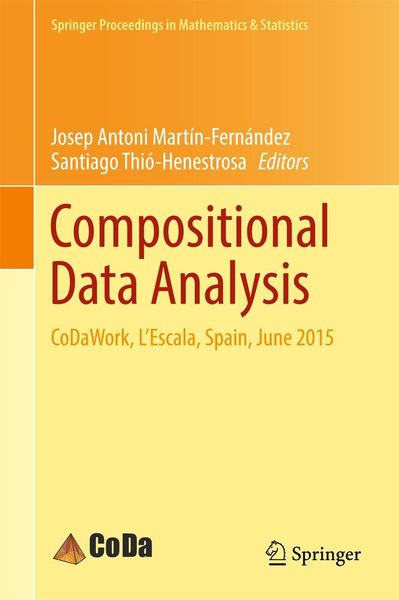
Compositional Data Analysis CoDaWork, L'Escala, Spain, June 2015

153,99 €

inkl. gesetzl. MwSt.

Beschreibung

The authoritative contributions gathered in this volume reflect the state of the art in compositional data analysis (CoDa). The respective chapters cover all aspects of CoDa, ranging from mathematical theory, statistical methods and techniques to its broad range of applications in geochemistry, the life...

Beschreibung

The authoritative contributions gathered in this volume reflect the state of the art in compositional data analysis (CoDa). The respective chapters cover all aspects of CoDa, ranging from mathematical theory, statistical methods and techniques to its broad range of applications in geochemistry, the life sciences and other disciplines. The selected and peer-reviewed papers were originally presented at the 6th International Workshop on Compositional Data Analysis, CoDaWork 2015, held in L'Escala (Girona), Spain.

Compositional data is defined as vectors of positive components and constant sum, and, more generally, all those vectors representing parts of a whole which only carry relative information. Examples of compositional data can be found in many different fields such as geology, chemistry, economics, medicine, ecology and sociology. As most of the classical statistical techniques are incoherent on compositions, in the 1980s John Aitchison proposed the log-ratio approachto CoDa. This became the foundation of modern CoDa, which is now based on a specific geometric structure for the simplex, an appropriate representation of the sample space of compositional data.

The International Workshops on Compositional Data Analysis offer a vital discussion forum for researchers and practitioners concerned with the statistical treatment and modelling of compositional data or other constrained data sets and the interpretation of models and their applications. The goal of the workshops is to summarize and share recent developments, and to identify important lines of future research.

Produktdetails

Format

PDF

Kopierschutz

Nein

Family Sharing

Nein

Text-to-Speech

Nein

Produktdetails

Format

PDF

Format

eBooks im PDF-Format haben eine festgelegte Seitengröße und eignen sich daher nur bedingt zum Lesen auf einem tolino eReader oder Smartphone. Für den vollen Lesegenuss empfehlen wir Ihnen bei PDF-eBooks die Verwendung eines Tablets oder Computers.

Kopierschutz

Nein

Kopierschutz

Dieses eBook können Sie uneingeschränkt auf allen Geräten der tolino Familie, allen sonstigen eReadern und am PC lesen. Das eBook ist nicht kopiergeschützt und kann ein personalisiertes Wasserzeichen enthalten. Weitere Hinweise zum Lesen von eBooks mit einem personalisierten Wasserzeichen finden Sie unter Hilfe/Downloads.

Family Sharing

Nein

Family Sharing

Mit Family Sharing können Sie eBooks innerhalb Ihrer Familie (max. sechs Mitglieder im gleichen Haushalt) teilen. Sie entscheiden selbst, welches Buch Sie mit welchem Familienmitglied teilen möchten. Auch das parallele Lesen durch verschiedene Familienmitglieder ist durch Family Sharing möglich. Um eBooks zu teilen oder geteilt zu bekommen, muss jedes Familienmitglied ein Konto bei Thalia oder einem anderen tolino-Buchhändler haben. Weitere Informationen finden Sie unter Hilfe/Family-Sharing.

Text-to-Speech

Nein

Text-to-Speech

Bedeutet Ihnen Stimme mehr als Text? Mit der Funktion Text-to-Speech können Sie sich im tolino webReader und in der aktuellen Thalia – Lesen & Hören App das eBook vorlesen lassen. Weitere Informationen finden Sie unter Hilfe/Text-to-Speech.

Erscheinungsdatum

19.11.2016

Herausgeber
Verlag Springer
Seitenzahl

209 (Printausgabe)

Dateigröße

10804 KB

Auflage

1st ed. 2016

Sprache

Englisch

EAN

9783319448114

Barrierefreiheit
  • keine Information zur Barrierefreiheit bekannt

Noch keine Bewertungen vorhanden

Verfassen Sie die erste Bewertung zu diesem Artikel

Helfen Sie anderen Kundinnen und Kunden durch Ihre Meinung.

Kundinnen und Kunden meinen

Bewertungen (0)

Weitere Artikel finden Sie in

  • Produktbild: Compositional Data Analysis