Gutscheinbedingungen

**Gültig bis 17.08.2026 auf Schreibwaren & Office-Artikel online auf thalia.at, in der Thalia App und in teilnehmenden Thalia Buchhandlungen in Österreich mit Schulsortiment. In den Buchhandlungen nur gültig auf lagernde Ware. Einzelne Artikel können ausgeschlossen sein. Ausgenommen sind preisgebundene Artikel. Pro Einkauf einmal einlösbar. Nur gültig gegen Vorlage oder im Onlineshop hinterlegter Bonuscard. Infos zur Einlösung in der Buchhandlung sind auf der Bonuscard-Vorteilspreisseite zu finden. Click & Collect nur bei Onlinevorabzahlung möglich. Keine Einlösung bei Scan & Go-Bezahlung. Keine Barauszahlung. Nicht kombinierbar mit anderen Aktionen und Gutscheinen. Gutschein wird auf max. 500€ Bestellwert angerechnet. Nicht gültig für Geschenkkarten, Versandkosten und Services.

  • Produktbild: Natural Computing for Unsupervised Learning
  • Produktbild: Natural Computing for Unsupervised Learning

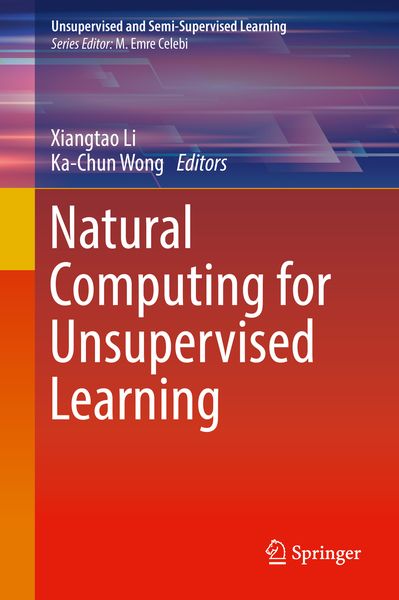
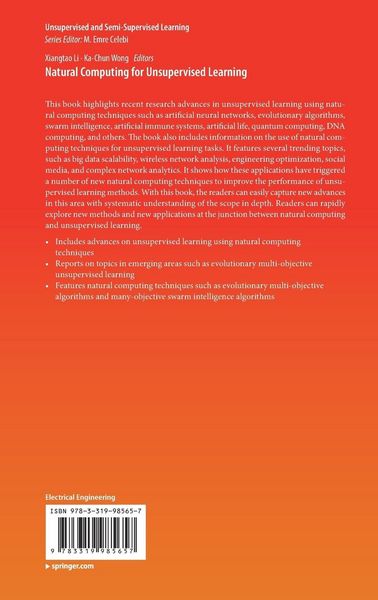
Natural Computing for Unsupervised Learning

99,99 €

inkl. gesetzl. MwSt., Versandkostenfrei


Beschreibung

Produktdetails

Einband

Gebundene Ausgabe

Erscheinungsdatum

12.11.2018

Abbildungen

VI, 121 illus., 79 illus. in color., schwarz-weiss Illustrationen, farbige Illustrationen

Herausgeber

Xiangtao Li + weitere

Verlag

Springer

Seitenzahl

273

Maße (L/B/H)

24,1/16/2,1 cm

Gewicht

588 g

Auflage

1st ed. 2019

Sprache

Englisch

ISBN

978-3-319-98565-7

Beschreibung

Portrait

Xiangtao Li received the B.Eng. Degree, the M.Eng. and Ph.D. degrees in computer science from Northeast Normal University, Changchun, China in 2009, 2012, 2015, respectively. Now He is an associate professor in the Department of Computer science and information technology, Northeast Normal University. He has published more than 50 research papers. His research interests include intelligent computation, evolutionary data mining, constrained optimization, bioinformatics, computational biology and interdisciplinary research.

Ka-Chun Wong received the BEng degree in computer engineering from United College, Chinese University of Hong Kong, in 2008. He received the MPhil degree from the same university in 2010 and the PhD degree from the Department of Computer Science, University of Toronto in 2014. He assumed his duty as an assistant professor at City University of Hong Kong in 2015. His research interests include bioinformatics, computational biology, evolutionary computation, data mining, machine learning, and interdisciplinary research. He is merited as the associate editor of BioData Mining in 2016. In addition, he is on the editorial board of Applied Soft Computing since 2016. He has solely edited 2 books published by Springer and CRC Press, attracting 30 peer-reviewed book chapters around the world.

Produktdetails

Einband

Gebundene Ausgabe

Erscheinungsdatum

12.11.2018

Abbildungen

VI, 121 illus., 79 illus. in color., schwarz-weiss Illustrationen, farbige Illustrationen

Herausgeber

Verlag

Springer

Seitenzahl

273

Maße (L/B/H)

24,1/16/2,1 cm

Gewicht

588 g

Auflage

1st ed. 2019

Sprache

Englisch

ISBN

978-3-319-98565-7

Herstelleradresse

Springer-Verlag KG
Sachsenplatz 4-6
1201 Wien
AT

Email: GPSR Kontakt

Noch keine Bewertungen vorhanden

Verfassen Sie die erste Bewertung zu diesem Artikel

Helfen Sie anderen Kundinnen und Kunden durch Ihre Meinung.

Kundinnen und Kunden meinen

Bewertungen (0)

  • Produktbild: Natural Computing for Unsupervised Learning
  • Produktbild: Natural Computing for Unsupervised Learning
  • Introduction.- Part I – Basic Natural Computing Techniques for Unsupervised Learning.- Hard Clustering using Evolutionary Algorithms.- Soft Clustering using Evolutionary Algorithms.- Fuzzy / Rough Set Systems for Unsupervised Learning.- Unsupervised Feature Selection using Evolutionary Algorithms.- Unsupervised Feature Selection using Artificial Neural Networks.- Part II – Advanced Natural Computing Techniques for Unsupervised Learning.- Hybrid Genetic Algorithms for Feature Subset Selection in Model-Based Clustering.- Nature-Inspired Optimization Approaches for Unsupervised Feature Selection.- Co-Evolutionary Approaches for Unsupervised Learning.- Mining Evolving Patterns using Natural Computing Techniques.- Multi-objective Optimization for Unsupervised Learning.- Many-objective Optimization for Unsupervised Learning.- Part III –  Applications.- Unsupervised Identification of DNA-binding Proteins using Natural Computing Techniques.- Parallel Solution-based Natural Clustering Techniques on Railway Engineering data.- Natural Computing Techniques for Community Detection on Online Social Networks.- Big Data Challenges and Scalability in Natural Computing for Unsupervised Learning.- Conclusion.