KI-Beratung Beta

Gutscheinbedingungen

**Gültig am 27.11.2026 auf Spielzeug, Schreibwaren, Filme, Geschenke & Trends, Musik, tolino eReader & Zubehör, Hörbücher und Hörbuch-Downloads, nicht preisgebundene Bücher und Kalender online auf thalia.at und in der Thalia App. Einzelne Artikel können ausgeschlossen sein. Aufgrund der Buchpreisbindung sind deutschsprachige Bücher und eBooks ausgenommen. Zusätzlich ausgenommen sind Abos & Flatrates, Games, Geschenkkarten/-boxen, Shelfies, Software, Zeitschriften sowie einzelne Artikel von tonies®. Pro Einkauf einmal einlösbar. Click & Collect nur bei Onlinevorabzahlung möglich. Keine Barauszahlung. Nicht kombinierbar mit anderen Aktionen und Gutscheinen. Gutschein wird auf max. 500€ Bestellwert angerechnet. Nicht gültig für Versandkosten und Services.

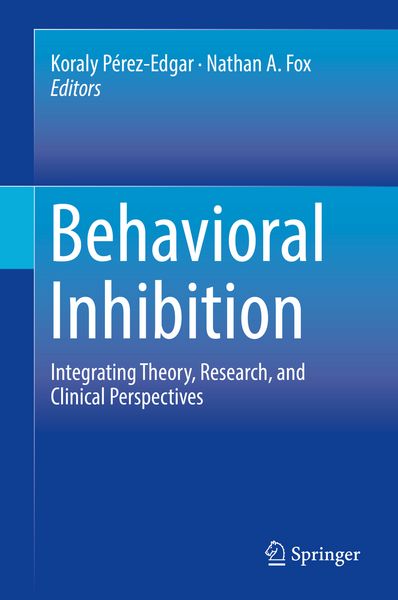
  • Produktbild: Behavioral Inhibition
  • Produktbild: Behavioral Inhibition
- 21%

Behavioral Inhibition Integrating Theory, Research, and Clinical Perspectives

21% sparen

129,99 € UVP 164,99 €

inkl. gesetzl. MwSt., Versandkostenfrei


Beschreibung

This book examines three decades of research on behavioral inhibition (BI), addressing its underlying biological, psychological, and social markers of development and functioning. It offers a theory-to-practice overview of behavioral inhibition and explores its cognitive component as well as its relationship...

Beschreibung

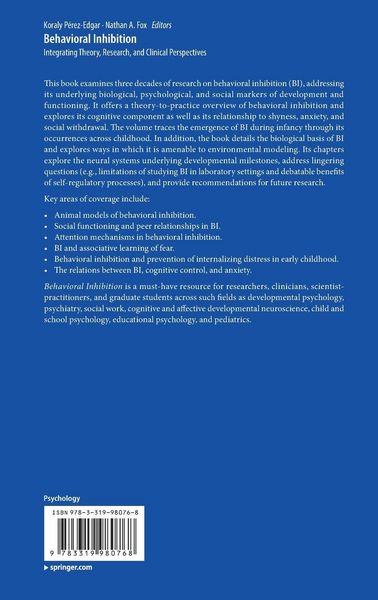
This book examines three decades of research on behavioral inhibition (BI), addressing its underlying biological, psychological, and social markers of development and functioning. It offers a theory-to-practice overview of behavioral inhibition and explores its cognitive component as well as its relationship to shyness, anxiety, and social withdrawal. The volume traces the emergence of BI during infancy through its occurrences across childhood. In addition, the book details the biological basis of BI and explores ways in which it is amenable to environmental modeling. Its chapters explore the neural systems underlying developmental milestones, address lingering questions (e.g., limitations of studying BI in laboratory settings and debatable benefits of self-regulatory processes), and provide recommendations for future research.
Key areas of coverage include:


  • Animal models of behavioral inhibition.


  • Social functioning and peer relationships in BI.


  • Attention mechanisms in behavioral inhibition.


  • BI and associative learning of fear.


  • Behavioral inhibition and prevention of internalizing distress in early childhood. 

  • The relations between BI, cognitive control, and anxiety.


Behavioral Inhibition
is a must-have resource for researchers, clinicians, scientist-practitioners, and graduate students across such fields as developmental psychology, psychiatry, social work, cognitive and affective developmental neuroscience, child and school psychology, educational psychology, and pediatrics.

Portrait


Koraly Pérez-Edgar, Ph.D.,
is the McCourtney Professor of Child Studies and a Professor of Psychology at The Pennsylvania State University. She received her A.B. from Dartmouth College and Ph.D. from Harvard University. Dr. Pérez-Edgar’s research focuses on the relations between temperament and psychopathology. In particular, she examines how individual differences in attention can work to ameliorate or exacerbate risks associated with early temperament traits. Dr. Pérez-Edgar is a fellow of the Association for Psychological Science.


Nathan A. Fox, Ph.D.,
is a Distinguished University Professor of Human Development at the University of Maryland. He received his B.A. from Williams College and Ph.D. from Harvard University. Dr. Fox is a world-recognized leader in the study of early behavioral inhibition, the impact of early life events on development, and the biological underpinning of development. Dr. Fox is a Fellow of the American Association for the Advancement of Science, the Association for Psychological Science, and the American Academy of Arts and Sciences.


Produktdetails

Einband

Gebundene Ausgabe

Erscheinungsdatum

01.10.2018

Abbildungen

XV, 380 p. 13 illus., 9 illus. in color.

Herausgeber Koraly Pérez-Edgar + weitere

Produktdetails

Einband

Gebundene Ausgabe

Erscheinungsdatum

01.10.2018

Abbildungen

XV, 380 p. 13 illus., 9 illus. in color.

Herausgeber
Verlag Springer
Seitenzahl

380

Maße (L/B/H)

24,1/16/2,7 cm

Gewicht

706 g

Sprache

Englisch

ISBN

978-3-319-98076-8

Herstelleradresse

Springer-Verlag KG
Sachsenplatz 4-6
1201 Wien
AT

Email: ProductSafety@springernature.com

Noch keine Bewertungen vorhanden

Verfassen Sie die erste Bewertung zu diesem Artikel

Helfen Sie anderen Kundinnen und Kunden durch Ihre Meinung.

Kundinnen und Kunden meinen

Bewertungen (0)

  • Produktbild: Behavioral Inhibition
  • Produktbild: Behavioral Inhibition

  • Chapter 1. The History and Theory of Behavioral Inhibition.- Chapter 2. Behavioral Inhibition in Nonhuman Primates: The Elephant in the Room.- Chapter 3. Behavioral Inhibition in Rodents: A Model to Study Causes and Health Consequences of Temperament.- Chapter 4. The Neural Mechanisms of Behavioral Inhibition.- Chapter 5. Psychobiological Processes in the Development of Behavioral Inhibition.- Chapter 6. The Neurobiology of Behavioral Inhibition as a Developmental Mechanism.- Chapter 7. The Social World of Behaviorally Inhibited Children: A Transactional Account.- Chapter 8. Peer Relations and the Behaviorally Inhibited Child.- Chapter 9. The Temperamentally Shy Child as the Social Adult: An Exemplar of Multifinality.- Chapter 10. Relations Between Behavioral Inhibition, Cognitive Control and Anxiety: Novel Insights Provided by Parsing Subdomains of Cognitive Control.- Chapter 11. Attention Mechanisms in Behavioral Inhibition: Exploring, and Exploiting, the Environment.- Chapter 12. Behavioral Inhibition and the Associative Learning of Fear.- Chapter 13. Behavioral Inhibition as a Precursor to Psychopathology.- Chapter 14. The Biological Bridge Between Behavioral Inhibition and Psychopathology.- Chapter 15. Behavioural Inhibition and the Prevention of Internalising Distress in Early Childhood.- Chapter 16. Next Steps: Behavioral Inhibition as a Model System.