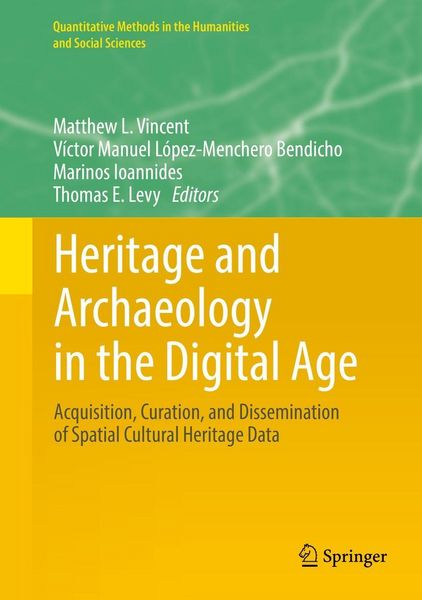
Heritage and Archaeology in the Digital Age Acquisition, Curation, and Dissemination of Spatial Cultural Heritage Data
-
- Hardcover
- Taschenbuch
- eBook ausgewählt
-
Form:Einzelkauf Download
-
Sprache:Englisch
131,99 €
inkl. gesetzl. MwSt.Beschreibung
Produktdetails
Format
Kopierschutz
Nein
Family Sharing
Nein
Text-to-Speech
Nein
Erscheinungsdatum
10.11.2017
Herausgeber
Matthew L. Vincent + weitereVerlag
Springer Nature SwitzerlandSeitenzahl
198 (Printausgabe)
Dateigröße
16572 KB
Sprache
Englisch
EAN
9783319653709
This book examines how computer-based programs can be used to acquire 'big' digital cultural heritage data, curate, and disseminate it over the Internet and in 3D visualization platforms with the ultimate goal of creating long-lasting "digital heritage repositories.' The organization of the book reflects the essence of new technologies applied to cultural heritage and archaeology. Each of these stages bring their own challenges and considerations that need to be dealt with. The authors in each section present case studies and overviews of how each of these aspects might be dealt with. While technology is rapidly changing, the principles laid out in these chapters should serve as a guide for many years to come. The influence of the digital world on archaeology and cultural heritage will continue to shape these disciplines as advances in these technologies facilitate new lines of research.
>The book is divided into three sections covering acquisition, curation, and dissemination (the major life cycles of cultural heritage data). Acquisition is one of the fundamental challenges for practitioners in heritage and archaeology, and the chapters in this section provide a template that highlights the principles for present and future work that will provide sustainable models for digital documentation. Following acquisition, the next section highlights how equally important curation is as the future of digital documentation depends on it. Preservation of digital data requires preservation that can guarantee a future for generations to come. The final section focuses on dissemination as it is what pushes the data beyond the shelves of storage and allows the public to experience the past through these new technologies, but also opens new lines of investigation by giving access to these data to researchers around the globe. Digital technology promises significant changes in how we approach social sciences, cultural heritage, and archaeology. However, researchersmust consider not only the acquisition and curation, but also the dissemination of these data to their colleagues and the public.
Throughout the book, many of the authors have highlighted the usefulness of Structure from Motion (SfM) work for cultural heritage documentation; others the utility and excitement of crowdsourcing as a 'citizen scientist' tool to engage not only trained students and researchers, but also the public in the cyber-archaeology endeavor. Both innovative tools facilitate the curation of digital cultural heritage and its dissemination. Together with all the chapters in this volume, the authors will help archaeologists, researchers interested in the digital humanities and scholars who focus on digital cultural heritage to assess where the field is and where it is going.
Noch keine Bewertungen vorhanden
Verfassen Sie die erste Bewertung zu diesem Artikel
Helfen Sie anderen Kundinnen und Kunden durch Ihre Meinung.
Kurze Frage zu unserer Seite
Vielen Dank für Ihr Feedback
Wir nutzen Ihr Feedback, um unsere Produktseiten zu verbessern. Bitte haben Sie Verständnis, dass wir Ihnen keine Rückmeldung geben können. Falls Sie Kontakt mit uns aufnehmen möchten, können Sie sich aber gerne an unseren Kund*innenservice wenden.
zum Kundenservice