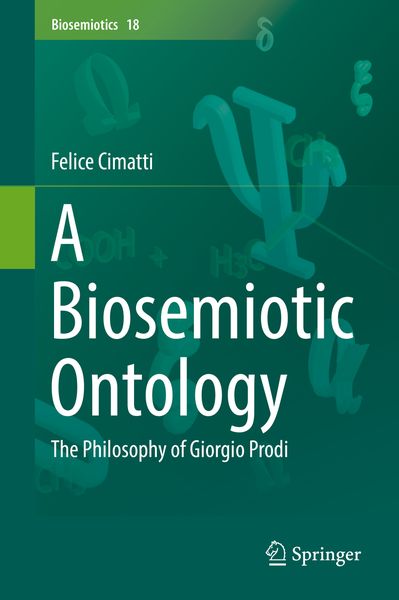
A Biosemiotic Ontology The Philosophy of Giorgio Prodi
89,99 €
inkl. gesetzl. MwSt.,
Beschreibung
Produktdetails
Einband
Gebundene Ausgabe
Erscheinungsdatum
23.11.2018
Abbildungen
V, 20 illus., 6 illus. in color., farbige Illustrationen, schwarz-weiss Illustrationen
Verlag
SpringerSeitenzahl
159
Maße (L/B/H)
24,1/16/1,5 cm
Gewicht
455 g
Auflage
1st ed. 2018
Sprache
Englisch
ISBN
978-3-319-97902-1
Giorgio Prodi (1928-1987) was an important Italian scientist who developed an original philosophy based on two basic assumptions: 1. life is mainly a semiotic phenomenon; 2. matter is somewhat a semiotic phenomenon.
Prodi applies Peirce's cenopythagorean categories to all phenomena of life and matter: Firstness, Secondness, and Thirdness. They are interconnected meaning that the very ontology of the world, according to Prodi, is somewhat semiotic. In fact, when one describes matter as “made of” Firstness and Secondness, this means that matter ‘intrinsically’ implies semiotics (with Thirdness also being present in the world).
At the very heart of Prodi’s theory lies a metaphysical hypothesis which is an ambitious theoretical gesture that places Prodi in an awkward position with respect to the customary philosophical tradition. In fact, his own ontology is neither dualistic nor monistic. Such a conclusion is unusual and weird, but much less unusual in present time than itwas when it was first introduced. The actual resurgence of various “realisms” make Prodi’s semiotic realism much more interesting than when he first proposed his philosophical approach. What is uncommon, in Prodi perspective, is that he never separated semiotics from the materiality of the world. Prodi does not agree with the “standard” structuralist view of semiosis as an artificial and unnatural activity. On the contrary, Prodi believed semiosis (that is, the interconnection between Firstness, Secondness and Thirdness) lies at the very bottom of life. On one hand, Prodi maintains a strong realist stance; on the other, a realism that includes semiosis as ‘natural’ phenomena. This last view is very unusual because all forms, more or less, of realism exclude semiosis from nature but they frequently “reduce” semiosis to non-semiotic elements. According to Prodi, semiosis is a completely natural phenomenon.
Noch keine Bewertungen vorhanden
Verfassen Sie die erste Bewertung zu diesem Artikel
Helfen Sie anderen Kundinnen und Kunden durch Ihre Meinung.
Kurze Frage zu unserer Seite
Vielen Dank für Ihr Feedback
Wir nutzen Ihr Feedback, um unsere Produktseiten zu verbessern. Bitte haben Sie Verständnis, dass wir Ihnen keine Rückmeldung geben können. Falls Sie Kontakt mit uns aufnehmen möchten, können Sie sich aber gerne an unseren Kund*innenservice wenden.
zum Kundenservice