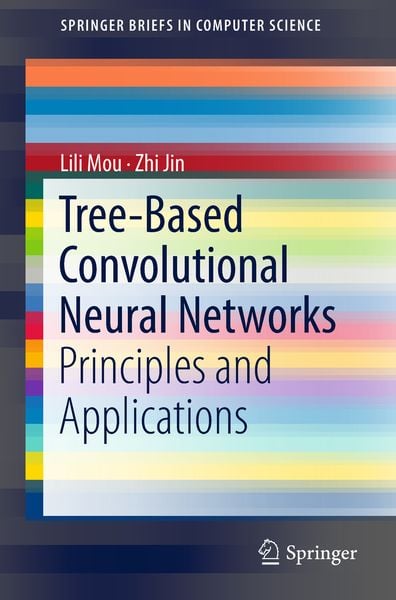
• Produktbild: Tree-Based Convolutional Neural Networks
  • Produktbild: Tree-Based Convolutional Neural Networks

Tree-Based Convolutional Neural Networks Principles and Applications

56,99 €

inkl. gesetzl. MwSt., Versandkostenfrei


Beschreibung

Produktdetails

Einband

Taschenbuch

Erscheinungsdatum

09.10.2018

Abbildungen

XV, 32 illus., schwarz-weiss Illustrationen

Verlag

Springer Singapore

Seitenzahl

96

Maße (L/B/H)

23,5/15,5/0,7 cm

Gewicht

184 g

Auflage

1st ed. 2018

Sprache

Englisch

ISBN

978-981-13-1869-6

Beschreibung

Produktdetails

Einband

Taschenbuch

Erscheinungsdatum

09.10.2018

Abbildungen

XV, 32 illus., schwarz-weiss Illustrationen

Verlag

Springer Singapore

Seitenzahl

96

Maße (L/B/H)

23,5/15,5/0,7 cm

Gewicht

184 g

Auflage

1st ed. 2018

Sprache

Englisch

ISBN

978-981-13-1869-6

Herstelleradresse

Springer-Verlag KG
Sachsenplatz 4-6
1201 Wien
AT

Email: GPSR Kontakt

Noch keine Bewertungen vorhanden

Verfassen Sie die erste Bewertung zu diesem Artikel

Helfen Sie anderen Kundinnen und Kunden durch Ihre Meinung.

Kundinnen und Kunden meinen

Bewertungen (0)

  • Produktbild: Tree-Based Convolutional Neural Networks
  • Produktbild: Tree-Based Convolutional Neural Networks
  • 1         Introduction

    1.1           Deep Learning Background

    1.2           Structure-Sensitive Neural Networks

    1.3           The Proposed Tree-Based Convolutional Neural Networks

    1.4           Overview of the Book

    2         Preliminaries and Related Work

    2.1           General Neural Networks

    2.1.1      Neurons and Multi-Layer Perceptrons

    2.1.2      Training of Neural Networks: Backpropagations

    2.1.3      Pros and Cons of Multi-Layer Perceptrons

    2.1.4      Pretraining of Neural Networks

    2.2           Neural Networks Applied in Natural Language Processing

    2.2.1      The Characteristics of Natural Language

    2.2.2      Language Models

    2.2.3      Word Embeddings

    2.3           Existing Structure-Sensitive Neural Networks

    2.3.1      Convolutional Neural Networks

    2.3.2      Recurrent Neural Networks

    2.3.3      Recursive Neural Networks

    2.4           Summary and Discussions

    3         General Concepts of Tree-Based Convolutional Neural Networks (TBCNNs)

    3.1           Idea and Formulation

    3.2           Applications of TBCNNs

    3.3           Issues in designing TBCNNs

    4         TBCNN for Programs’ Abstract Syntax Trees (ASTs)

    4.1           Background of Program Analysis

    4.2           Proposed Model

    4.2.1      Overview

    4.2.2      Representation Learning of AST nodes

    4.2.3      Encoding Layer

    4.2.4      AST-Based Convolutional Layer

    4.2.5      Dynamic Pooling

    4.2.6      Continuous Binary Tree

    4.3           Experiments

    4.3.1      Unsupervised Representation Learning

    4.3.2      Program Classification

    4.3.3      Detecting Bubble Sort

    4.3.4      Model Analysis

    4.4           Summary and Discussions

    5         TBCNN for Constituency Trees in Natural Language Processing

    5.1           Background of Sentence Modeling and Constituency Trees

    5.2           Proposed Model

    5.2.1      Constituency Trees as Input

    5.2.2      Recursively Representing Intermediate Layers

    5.2.3      Constituency Tree-Based Convolutional Layer

    5.2.4      Dynamic Pooling Layer

    5.3           Experiments

    5.3.1      Sentiment Analysis

    5.3.2      Question Classification

    5.4           Summary and Discussions

    6         TBCNN for Dependency Trees in Natural Language Processing

    6.1           Background of Dependency Trees

    6.2           Proposed Model

    6.2.1      Dependency Trees as Input

    6.2.2      Dependency Tree-Based Convolutional Layer

    6.2.3      Dynamic Pooling Layer

    6.2.4      Dependency TBCNN Applied to Sentence Matching

    6.3           Experiments

    6.3.1      Sentence Classification

    6.3.2      Sentence Matching

    6.3.3      Model Analysis

    6.3.4      Visualization

    6.4           Summary and Discussions

    7         Concluding Remarks

    7.1           More Structure-Sensitive Neural Models

    7.2           Conclusion