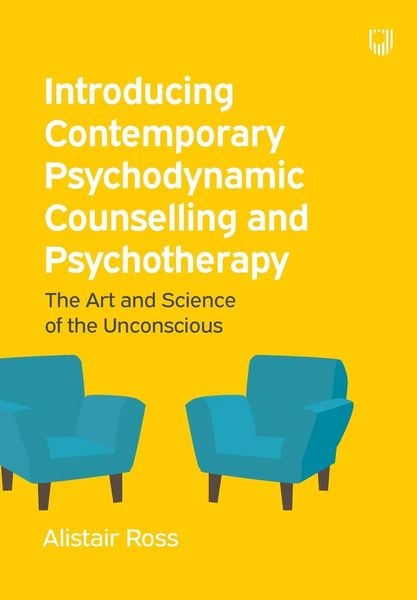
Introducing Contemporary Psychodynamic Counselling and Psychotherapy
-
- Englisch ausgewählt
41,99 €
inkl. gesetzl. MwSt.,
Beschreibung
Produktdetails
Einband
Taschenbuch
Erscheinungsdatum
07.06.2019
Verlag
Open University PressSeitenzahl
242
Maße (L/B/H)
24,4/17/1,3 cm
Gewicht
393 g
Sprache
Englisch
ISBN
978-0-335-22682-5
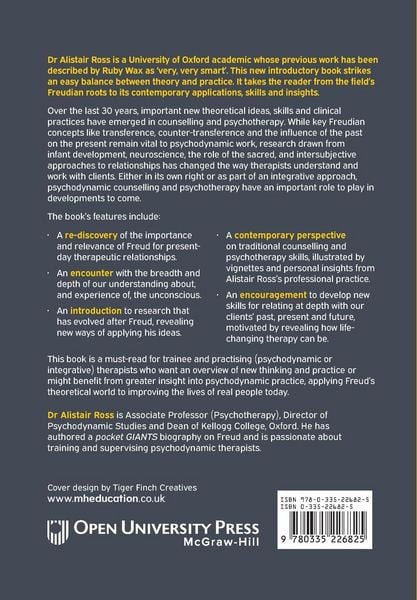
Dr Alistair Ross is a University of Oxford academic whose previous work has been described by Ruby Wax as 'very, very smart'. This new introductory book strikes an easy balance between theory and practice. It takes the reader from the field's Freudian roots to its contemporary applications, skills and insights.
Over the last 30 years, important new theoretical ideas, skills and clinical practices have emerged in counselling and psychotherapy. While key Freudian concepts like transference, counter-transference and the influence of the past on the present remain vital to psychodynamic work, research drawn from infant development, neuroscience, the role of the sacred, and intersubjective approaches to relationships has changed the way therapists understand and work with clients. Either in its own right or as part of an integrative approach, psychodynamic counselling and psychotherapy have an important role to play in developments to come.
The book's features include:
. A re-discovery of the importance and relevance of Freud for present-day therapeutic relationships.
. An encounter with the breadth and depth of our understanding about, and experience of, the unconscious.
. An introduction to research that has evolved after Freud, revealing new ways of applying his ideas.
. A contemporary perspective on traditional counselling and psychotherapy skills, illustrated by vignettes and personal insights from Alistair Ross's professional practice.
. An encouragement to develop new skills for relating at depth with our clients' past, present and future, motivated by revealing how life-changing therapy can be.
This book is a must-read for trainee and practising (psychodynamic or integrative) therapists who want an overview of new thinking and practice or might benefit from greater insight into psychodynamic practice, applying Freud's theoretical world to improving the lives of real people today.
'It is good to see Alistair, a valued student of mine and now an equally valued colleague, taking up the torch for psychodynamic counselling and psychotherapy for a new generation. He has written a book that collates much of the valuable writing to date and at the same time adds new dimensions that should not be overlooked.' Michael Jacobs, Visiting Professor, University of Leeds and Bournemouth University, UK
Noch keine Bewertungen vorhanden
Verfassen Sie die erste Bewertung zu diesem Artikel
Helfen Sie anderen Kundinnen und Kunden durch Ihre Meinung.
Kurze Frage zu unserer Seite
Vielen Dank für Ihr Feedback
Wir nutzen Ihr Feedback, um unsere Produktseiten zu verbessern. Bitte haben Sie Verständnis, dass wir Ihnen keine Rückmeldung geben können. Falls Sie Kontakt mit uns aufnehmen möchten, können Sie sich aber gerne an unseren Kund*innenservice wenden.
zum Kundenservice