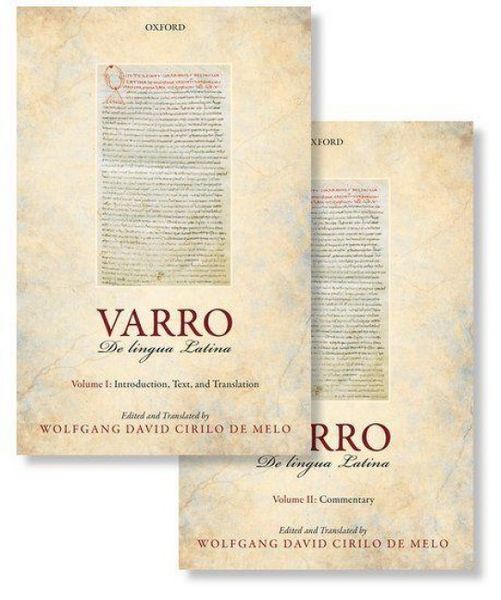
Varro: de Lingua Latina Introduction, Text, Translation, and Commentarytwo-Volume Set
-
- Englisch ausgewählt
481,99 €
inkl. gesetzl. MwSt.,
Beschreibung
Produktdetails
Einband
Gebundene Ausgabe
Erscheinungsdatum
21.05.2019
Verlag
Oxford University PressSeitenzahl
1360
Maße (L/B/H)
24,4/16,6/8,4 cm
Gewicht
2356 g
Sprache
Englisch
ISBN
978-0-19-965973-9
Marcus Terentius Varro (116-27 BC) was the greatest polymath of the Roman republic. During his lifetime he authored several hundred books, and though many of them dealt with linguistic topics, the De lingua Latina ('On the Latin language'), the first large-scale linguistic treatment of Latin, was by far his most significant work. Originally consisting of twenty-five volumes - one introductory, followed by six on etymology, six on morphology, and twelve on syntax - only books 5-10 treating etymology and morphology have come down to us in a more or less complete form, though a fair number of fragments of other volumes have been transmitted in other authors. The present volumes aim to provide a comprehensive treatment of this highly technical text in a new critical edition accompanied by a clear, accurate translation and full commentary. In Volume I, an introductory study outlines Varro's life and works, analysing his own linguistic usage and setting his insights about language in their historical and intellectual context. His etymology and morphology are contrasted with our own modern methods, yielding important and sometimes surprising insights into how an educated Roman looked at the history of his own language: although his etymology is, by current standards, pre-scientific, it is actually quite often in agreement with modern etymology, while his morphology also has much in common with a modern approach, focusing on the question of how regular language is and providing arguments against and in favour of regularity. Detailed discussions of these and other of Varro's linguistic ideas are brought to the fore in the exhaustive commentary in Volume II, which also sheds much needed light on the work's textual problems, cultural background, and distinctive Varronian style, and will be indispensible to scholars and students of both classics and linguistics.
Noch keine Bewertungen vorhanden
Verfassen Sie die erste Bewertung zu diesem Artikel
Helfen Sie anderen Kundinnen und Kunden durch Ihre Meinung.
Kurze Frage zu unserer Seite
Vielen Dank für Ihr Feedback
Wir nutzen Ihr Feedback, um unsere Produktseiten zu verbessern. Bitte haben Sie Verständnis, dass wir Ihnen keine Rückmeldung geben können. Falls Sie Kontakt mit uns aufnehmen möchten, können Sie sich aber gerne an unseren Kund*innenservice wenden.
zum Kundenservice