Gutscheinbedingungen

**Gültig bis 17.08.2026 auf Schreibwaren & Office-Artikel online auf thalia.at, in der Thalia App und in teilnehmenden Thalia Buchhandlungen in Österreich mit Schulsortiment. In den Buchhandlungen nur gültig auf lagernde Ware. Einzelne Artikel können ausgeschlossen sein. Ausgenommen sind preisgebundene Artikel. Pro Einkauf einmal einlösbar. Nur gültig gegen Vorlage oder im Onlineshop hinterlegter Bonuscard. Infos zur Einlösung in der Buchhandlung sind auf der Bonuscard-Vorteilspreisseite zu finden. Click & Collect nur bei Onlinevorabzahlung möglich. Keine Einlösung bei Scan & Go-Bezahlung. Keine Barauszahlung. Nicht kombinierbar mit anderen Aktionen und Gutscheinen. Gutschein wird auf max. 500€ Bestellwert angerechnet. Nicht gültig für Geschenkkarten, Versandkosten und Services.

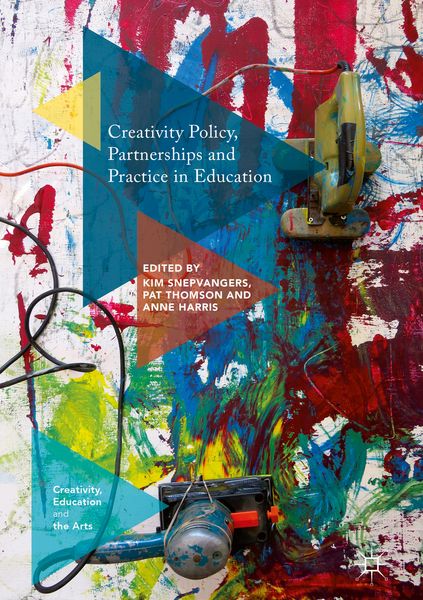
  • Produktbild: Creativity Policy, Partnerships and Practice in Education
  • Produktbild: Creativity Policy, Partnerships and Practice in Education
- 21%

Creativity Policy, Partnerships and Practice in Education

21% sparen

129,99 € UVP 164,99 €

inkl. gesetzl. MwSt., Versandkostenfrei


Beschreibung

Produktdetails

Einband

Gebundene Ausgabe

Erscheinungsdatum

12.11.2018

Abbildungen

XXIII, 11 illus., schwarz-weiss Illustrationen

Herausgeber

Kim Snepvangers + weitere

Verlag

Springer

Seitenzahl

365

Maße (L/B/H)

21,6/15,3/2,6 cm

Gewicht

618 g

Auflage

1st ed. 2018

Sprache

Englisch

ISBN

978-3-319-96724-0

Beschreibung

Portrait

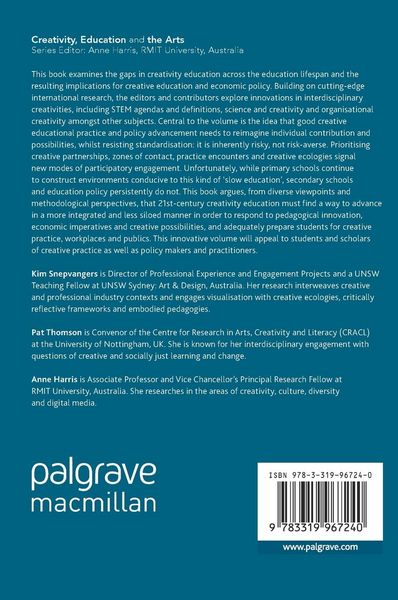
Kim Snepvangers is Director: Professional Experience and Engagement Projects and a UNSW Teaching Fellow at UNSW Sydney: Art & Design, Australia. Her research interweaves creative and professional industry contexts and engages visualisation with creative ecologies, critically reflective frameworks and embodied pedagogies.  

Pat Thomson is Convenor of the Centre for Research in Arts, Creativity and Literacy (CRACL) at the University of Nottingham, UK. She is known for her interdisciplinary engagement with questions of creative and socially just learning and change.   Anne Harris is Associate Professor and Vice Chancellor's Principal Research Fellow at RMIT University, Australia. She researches in the areas of creativity, culture, diversity and digital media.

Produktdetails

Einband

Gebundene Ausgabe

Erscheinungsdatum

12.11.2018

Abbildungen

XXIII, 11 illus., schwarz-weiss Illustrationen

Herausgeber

Verlag

Springer

Seitenzahl

365

Maße (L/B/H)

21,6/15,3/2,6 cm

Gewicht

618 g

Auflage

1st ed. 2018

Sprache

Englisch

ISBN

978-3-319-96724-0

Herstelleradresse

Springer-Verlag GmbH
Tiergartenstr. 17
69121 Heidelberg
DE

Email: ProductSafety@springernature.com

Noch keine Bewertungen vorhanden

Verfassen Sie die erste Bewertung zu diesem Artikel

Helfen Sie anderen Kundinnen und Kunden durch Ihre Meinung.

Kundinnen und Kunden meinen

Bewertungen (0)

Weitere Artikel finden Sie in

  • Produktbild: Creativity Policy, Partnerships and Practice in Education
  • Produktbild: Creativity Policy, Partnerships and Practice in Education
  • Chapter 1. Evolving ecologies: Creative policy, partnerships and practice in education; Anne Harris, Pat Thomson and Kim Snepvangers.SECTION I. POLICY.Chapter 2. What did Creative Partnerships achieve? A review of the Creative Partnerships (CP) research archive; Patricia Thomson, Rebecca Coles and Maddy Hallewell.Chapter 3. Transforming creative classroom contradictions through activity theory analysis; Victoria Kinsella.Chapter 4. Creative Agency / creative ecologies; Anne M. Harris.Chapter 5. Value-adding in higher education: Complementary contexts for learning creativities; Jonathan Purdy, Vinesh Chandra and Kelli McGraw. SECTION II. PARTNERSHIPS. Chapter 6. Creative partnerships: Exploring encounters in the contact zone; Donna Mathewson Mitchell. Chapter 7. Creative industry encounters: Digital ecologies in art, design and media; Kim Snepvangers. Chapter 8. Organisational change for creativity in education; Leon de Bruin. Chapter 9. Creative ecologies in education: teaching relationships within sustained school-based artist-in-residence projects; Christine Hatton and Mary Mooney. SECTION III. PRACTICE. Chapter 10. The antecedents and outcomes of creative cognition; Sarah Asquith, Xu Wang and Anna Abraham. Chapter 11. Assessing Creativity: Four Critical Issues; Rachel Jacobs. Chapter 12. Tearing it down: Using problematisation to encourage artistic creativity; Shelley Hannigan and Katherine Barrand.Chapter 13. From Wise Humanising Creativity to (posthumanising) creativity; Kerry Chappell.Chapter 14. An ecology of care: Relationships and responsibility through the constitutive and creative acts of oral history theatre making in local communities shouldering global crises; Kathleen Gallagher, Nancy Cardwell and Dirk Rodricks. Chapter 15. Flexibility, constraints and creativity - cultivating creativity in teacher education; Susan Davis. Chapter 16. Propositions for policy, partnership and practice in educational creative futures; Kim Snepvangers, Anne Harris and Pat Thomson.