KI-Beratung Beta

Gutscheinbedingungen

**Gültig am 25.11.2026 auf fremdsprachige Bücher online auf thalia.at und in der Thalia App. Einzelne Artikel können ausgeschlossen sein. Ausgenommen sind preisgebundene Artikel & eBooks. Pro Einkauf einmal einlösbar. Click & Collect nur bei Onlinevorabzahlung möglich. Keine Barauszahlung. Nicht kombinierbar mit anderen Aktionen und Gutscheinen. Gutschein wird auf max. 500€ Bestellwert angerechnet. Nicht gültig für Geschenkkarten, Versandkosten und Services.

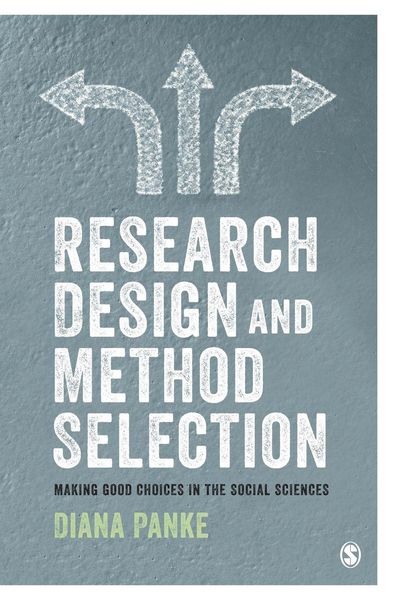
  • Produktbild: Research Design & Method Selection
  • Produktbild: Research Design & Method Selection

Research Design & Method Selection Making Good Choices in the Social Sciences

154,99 €

inkl. gesetzl. MwSt., Versandkostenfrei


Beschreibung

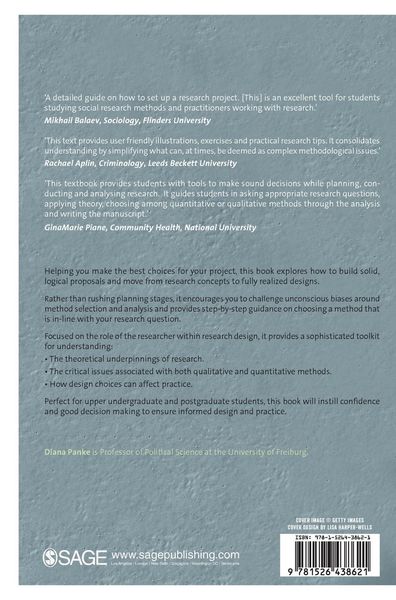
Heavily grounded in helping students make the best choices for their projects, this book explores how to develop and work with theory, research questions, and method selection to build solid, logical proposals and move from research concepts to fully realized designs.

Rather than rushing initial planning...

Beschreibung

Heavily grounded in helping students make the best choices for their projects, this book explores how to develop and work with theory, research questions, and method selection to build solid, logical proposals and move from research concepts to fully realized designs.

Rather than rushing initial planning stages or reverse engineering questions from preferred methods, it encourages students to challenge unconscious biases around method selection and analysis and provides step-by-step guidance on choosing a method that is in-line with the question being explored. Focused on the role of the researcher within research design, it stresses the need to consider the theoretical underpinnings of research and not just practical issues when designing a project.

It provides a sophisticated toolkit to understand:

- The critical issues associated with both qualitative and quantitative methods

- The approach that works best for specific research questions

- How design choices can affect practice.

Perfect for upper undergraduate and postgraduate students, this book will instil confidence and good decision making to ensure constructively informed design and practice.


Rezension

This text provides user friendly illustrations, exercises and practical research tips. It consolidates understanding by simplifying what can, at times, be deemed as complex methodological issues. 

Rachael Aplin 20171130

Produktdetails

Einband

Gebundene Ausgabe

Erscheinungsdatum

29.09.2018

Verlag SAGE Publications
Seitenzahl

368

Produktdetails

Einband

Gebundene Ausgabe

Erscheinungsdatum

29.09.2018

Verlag SAGE Publications
Seitenzahl

368

Maße (L/B/H)

25/17,5/2,4 cm

Gewicht

757 g

Sprache

Englisch

ISBN

978-1-5264-3862-1

EU-Ansprechpartner

Kolibri 360 GmbH
Ettore-Bugatti-Straße 6-14
51149 Köln
DE
produktsicherheit@kolibri360.de

Herstelleradresse

SAGE Publications
1 Oliver's Yard 55 City Road
EC1Y 1SP London
GB
orders@sagepub.co.uk

Noch keine Bewertungen vorhanden

Verfassen Sie die erste Bewertung zu diesem Artikel

Helfen Sie anderen Kundinnen und Kunden durch Ihre Meinung.

Kundinnen und Kunden meinen

Bewertungen (0)

Die Leseprobe wird geladen.
  • Produktbild: Research Design & Method Selection
  • Produktbild: Research Design & Method Selection
  • Chapter 1: Introduction: the Basics of Social Science Research Designs
    Deductive and inductive research
    Explanatory and interpretative research designs
    Deductive, explanatory research designs and their core components
    Research design choices: x-centered and y-centered projects
    Quality criteria for social science research
    Chapter 2: Detecting Puzzles and Selecting Good Research Questions
    Research questions' essentials
    How to find empirical puzzles and select a good explanatory research question
    Feasibility
    How to make choices: selecting good research questions
    Chapter 3: Working with Theories
    Why do we need theories for explanatory social science projects?
    Selecting theories: how many and which ones do we need?
    Working with theories: how to develop and select hypotheses?
    Making choices: which and how many theories and hypotheses to use?
    Chapter 4: Qualitative, Quantitative, and Mixed-Method Projects-How to Make the Choice
    Advantages and disadvantages of quantitative and qualitative projects
    Mixed-method combinations: Advantages and challenges
    Qualitative, quantitative and mixed-method projects - How to make a choice?
    Chapter 5: How to Select Cases
    What is a case?
    Case selection: An essential task for comparative research
    How many and which cases should be selected?
    Making choices: How to select cases?
    Chapter 6: Making Choices between Methods of Data Collection
    The measurement of variables
    Overview of data sources and methods of data collection
    Databases and compendiums
    Primary Sources: Documents
    Interviews
    Surveys and questionnaires
    Focus groups
    Participant observation
    The importance of triangulation
    The importance of data management
    Summary - Choices on data collection
    Chapter 7: Making Choices between Qualitative Methods of Data Analysis
    Types of Comparisons in Qualitative Case Studies
    Process-tracing
    Summary: Choosing between methods of qualitative analysis
    Chapter 8: Making Choices between Quantitative Methods of Data Analysis
    Detecting variable types and describing variables
    Choosing between linear and logistic regression analysis
    Choosing between advanced methods of quantitative data analysis
    Chapter 9: Making Choices in Writing and Sharing Research
    Writing techniques
    Disseminating research outputs