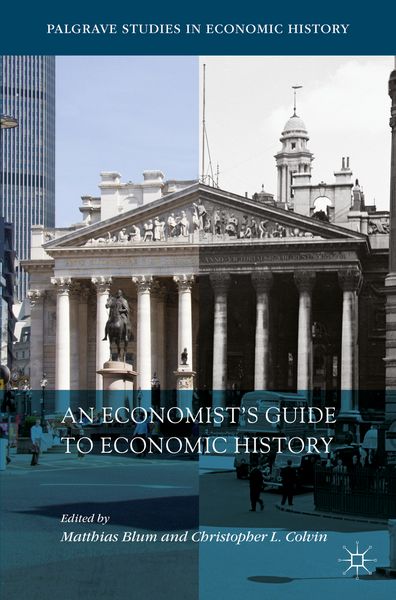
An Economist’s Guide to Economic History
-
- Taschenbuch ausgewählt
- eBook
-
Sprache:Englisch
52,99 €
UVP
60,49 €
inkl. gesetzl. MwSt.,
Beschreibung
Produktdetails
Einband
Taschenbuch
Erscheinungsdatum
18.12.2018
Abbildungen
XXVII, 18 illus., schwarz-weiss Illustrationen
Herausgeber
Matthias Blum + weitereVerlag
SpringerSeitenzahl
479
Maße (L/B/H)
23,5/15,5/2,8 cm
Gewicht
771 g
Auflage
1st ed. 2018
Sprache
Englisch
ISBN
978-3-319-96567-3
Without economic history, economics runs the risk of being too abstract or parochial, of failing to notice precedents, trends and cycles, of overlooking the long-run and thus misunderstanding ‘how we got here’. Recent financial and economic crises illustrate spectacularly how the economics profession has not learnt from its past.
This important and unique book addresses this problem by demonstrating the power of historical thinking in economic research. Concise chapters guide economics lecturers and their students through the field of economic history, demonstrating the use of historical thinking in economic research, and advising them on how they can actively engage with economic history in their teaching and learning.
Blum and Colvin bring together important voices in the field to show readers how they can use their existing economics training to explore different facets of economic history. Each chapter introduces a question or topic, historical context or research method and explores how they can be used in economics scholarship and pedagogy. In a century characterised to date by economic uncertainty, bubbles and crashes, An Economist’s Guide to Economic History is essential reading.
Matthias Blum and Christopher L. Colvin are economic historians based at Queen’s University Belfast, UK. Blum has research interests in measurement, health and wellbeing, and economic development in the long-run. Colvin works on historical banking crises, corporate governance and the economics of religion. Besides teaching and supervising students in economic history, they always make a point of incorporating historical thinking into the other field courses they teach, including econometrics, development economics, industrial organisation and managerial economics.
Noch keine Bewertungen vorhanden
Verfassen Sie die erste Bewertung zu diesem Artikel
Helfen Sie anderen Kundinnen und Kunden durch Ihre Meinung.
Kurze Frage zu unserer Seite
Vielen Dank für Ihr Feedback
Wir nutzen Ihr Feedback, um unsere Produktseiten zu verbessern. Bitte haben Sie Verständnis, dass wir Ihnen keine Rückmeldung geben können. Falls Sie Kontakt mit uns aufnehmen möchten, können Sie sich aber gerne an unseren Kund*innenservice wenden.
zum Kundenservice