Gutscheinbedingungen

**Gültig bis 15.06.2026 auf Spiele & Spielzeug online auf thalia.at, in der Thalia App ab einem Mindestbestellwert von 30€ und in allen Thalia Buchhandlungen in Österreich. In den Buchhandlungen nur gültig auf lagernde Ware. Einzelne Artikel können ausgeschlossen sein. Ausgenommen sind preisgebundene Artikel sowie online auf thalia.at und in der Thalia App einzelne Artikel von tonies®. Pro Einkauf einmal einlösbar. Nur gültig gegen Vorlage oder im Onlineshop hinterlegter Bonuscard. Infos zur Einlösung in der Buchhandlung sind auf der Bonuscard-Vorteilspreisseite zu finden. Click & Collect nur bei Onlinevorabzahlung möglich. Keine Einlösung bei Scan & Go-Bezahlung. Keine Barauszahlung. Nicht kombinierbar mit anderen Aktionen und Gutscheinen. Gutschein wird auf max. 500€ Bestellwert angerechnet. Nicht gültig für Geschenkkarten, Versandkosten und Services.

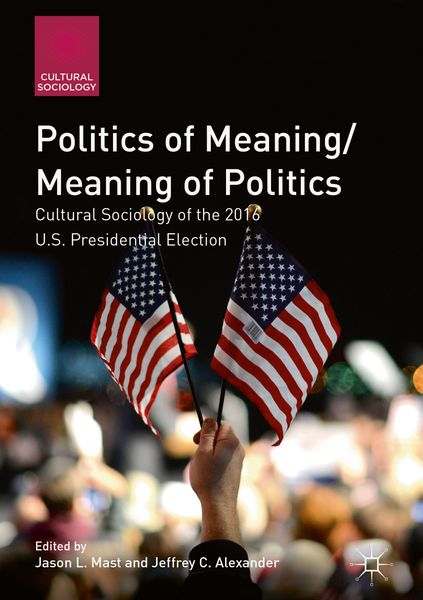
Produktbild: Politics of Meaning/Meaning of Politics
- 24%

Politics of Meaning/Meaning of Politics Cultural Sociology of the 2016 U.S. Presidential Election

Aus der Reihe Cultural Sociology
24% sparen

99,99 € UVP 131,99 €

inkl. gesetzl. MwSt., Versandkostenfrei


Beschreibung

Produktdetails

Einband

Gebundene Ausgabe

Erscheinungsdatum

23.11.2018

Abbildungen

XVII, 5 illus., 3 illus. in color., schwarz-weiss Illustrationen, farbige Illustrationen

Herausgeber

Jason L. Mast + weitere

Verlag

Springer

Seitenzahl

292

Maße (L/B/H)

21,6/15,3/2,2 cm

Gewicht

518 g

Auflage

1st ed. 2019

Sprache

Englisch

ISBN

978-3-319-95944-3

Beschreibung

Portrait

Jason L. Mast is a Research Fellow at the Normative Orders Excellence Cluster at Goethe-University Frankfurt am Main, Germany. He is the author of The Performative Presidency: Crisis and Resurrection During the Clinton Years .  

Jeffrey C. Alexander is Lillian Chavenson Saden Professor of Sociology at Yale University, and a Director of the Center for Cultural Sociology. He is the author of The Performance of Politics: Obama’s Victory and the Democratic Struggle for Power and co-author of Obama Power .


Produktdetails

Einband

Gebundene Ausgabe

Erscheinungsdatum

23.11.2018

Abbildungen

XVII, 5 illus., 3 illus. in color., schwarz-weiss Illustrationen, farbige Illustrationen

Herausgeber

Verlag

Springer

Seitenzahl

292

Maße (L/B/H)

21,6/15,3/2,2 cm

Gewicht

518 g

Auflage

1st ed. 2019

Sprache

Englisch

ISBN

978-3-319-95944-3

Herstelleradresse

Springer-Verlag GmbH
Tiergartenstr. 17
69121 Heidelberg
DE

Email: ProductSafety@springernature.com

Kundinnen und Kunden meinen

0 Bewertungen

Informationen zu Bewertungen

Zur Abgabe einer Bewertung ist eine Anmeldung im Konto notwendig. Die Authentizität der Bewertungen wird von uns nicht überprüft. Wir behalten uns vor, Bewertungstexte, die unseren Richtlinien widersprechen, entsprechend zu kürzen oder zu löschen.

Die Bewertungen sind nach Format, Anzahl Sterne und Datum sortiert.

Verfassen Sie die erste Bewertung zu diesem Artikel

Helfen Sie anderen Kund*innen durch Ihre Meinung

Kundinnen und Kunden meinen

0 Bewertungen filtern

  • Produktbild: Politics of Meaning/Meaning of Politics
  • Introduction

    Jason Mast, Normative Orders Cluster of Excellence, Goethe University Frankfurt, Germany


    Section 1: Election 2016: Differences and Reiterations


    Chapter 1: Politics as a Vacation

    Robin Wagner-Pacific, Department of Sociology, The New School for Social Research, USA

    Iddo Tavory, Department of Sociology, New York University, USA


    Chapter 2: When Voters Are Voting, What Are They Doing?: Symbolic Selection and the 2016 U.S. Presidential Election

    Matt Norton, Department of Sociology, University of Oregon, USA


    Section 2: Media and News Journalism: Narrative and Fake News 


    Chapter 3: Deep Stories, Nostalgia Narratives, and Fake News: Storytelling in the Trump Era

    Francesca Polletta, Department of Sociology, University of California, Irvine, USA

    Jessica Callahan, Department of Sociology, University of California, Irvine, USA


    Chapter 4: Journalism after Trump

    Ronald N. Jacobs, Department of Sociology, University at Albany, USA


    Section 3: The Meanings of Donald Trump and Steve Bannon


    Chapter 5: On the Construction Sites of History: Where Did Donald Trump Come From?

    Mabel Berezin, Department of Sociology, Cornell University, USA


    Chapter 6: Donald’s Dick: A Man Against the Institutions

    Roger Friedland, Department of Sociology, University of California, Santa Barbara, USA


    Chapter 7: A Period of “wild and fierce fanaticism”: Populism, Theo-Political Militarism, and the Crisis

    of US Hegemony

    Julia Hell, Department of Germanic Languages and Literatures, University of Michigan, USA

    George Steinmentz, Department of Sociology, University of Michigan, USA


    Section 4: The American Right and Trump-Bannonism


    Chapter 8: Raging Against the Enlightenment: Steven Bannon’s Anti-Democratic Ideology

    Jeffrey C Alexander, Department of Sociology, Yale University, USA


    Chapter 9: The Flight 93-ization of American Politics

    Alexander Riley, Department of Sociology and Anthropology, Bucknell University, USA


    Section 5: Religion: The Fates of White Christian Evangelicals and Muslims


    Chapter 10: Why Evangelicals Voted for Trump: A Critical Cultural Sociology

    Philip Gorski, Department of Sociology, Yale University, USA


    Chapter 11: Muslims as Outsiders, Enemies, and Others: The 2016 Presidential Election and the Politics

    of Religious Exclusion

    Ruth Braunstein, Department of Sociology, University of Connecticut, USA


    Section 6: Political Legitimacy and the Civil Sphere


    Chapter 12: Populism’s Efforts to De-legitimize the Vital Center and the Implications for Liberal Democracy

    Peter Kivisto, Department of Sociology, Augustana College, USA


    Chapter 13: The Fragmenting of the Civil Sphere: How Partisan Identity Shapes the Moral Evaluations of Candidates and Epistemology

    Daniel Kreiss, School of Media and Journalism, University of North Carolina, USA


    Chapter 14: Legitimacy Troubles and the Performance of Power in the 2016 US Presidential Election

    Jason L. Mast, Normative Orders Exzellenzcluster, Goethe University Frankfurt, Germany


    Afterword

    Lyn Spillman, Department of Sociology, Notre Dame, USA