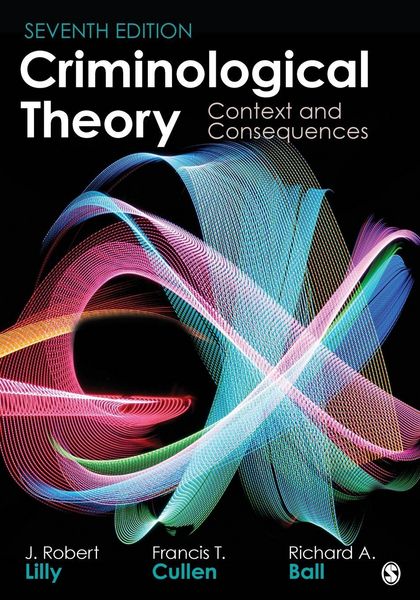
Produktbild: Criminological Theory

Criminological Theory Context and Consequences

141,99 €

inkl. gesetzl. MwSt., Versandkostenfrei


Beschreibung

Produktdetails

Einband

Taschenbuch

Erscheinungsdatum

29.11.2018

Verlag

Sage Publications

Seitenzahl

592

Maße (L/B/H)

25,4/17,8/3,2 cm

Gewicht

1101 g

Auflage

7th edition

Sprache

Englisch

ISBN

978-1-5063-8730-7

Beschreibung

Produktdetails

Einband

Taschenbuch

Erscheinungsdatum

29.11.2018

Verlag

Sage Publications

Seitenzahl

592

Maße (L/B/H)

25,4/17,8/3,2 cm

Gewicht

1101 g

Auflage

7th edition

Sprache

Englisch

ISBN

978-1-5063-8730-7

Herstelleradresse

Libri GmbH
Europaallee 1
36244 Bad Hersfeld
DE

Email: GPSR Kontakt

Noch keine Bewertungen vorhanden

Verfassen Sie die erste Bewertung zu diesem Artikel

Helfen Sie anderen Kundinnen und Kunden durch Ihre Meinung.

Kundinnen und Kunden meinen

Bewertungen (0)

  • Produktbild: Criminological Theory
  • Preface
    Acknowledgments
    CHAPTER 1. The Context and Consequences of Theory
    Theory in Social Context
    Theory and Policy: Ideas Have Consequences
    Context, Theory, and Policy: Plan of the Book
    Conclusion
    Further Readings
    CHAPTER 2. The Search for the "Criminal Man"
    Spiritualism
    The Classical School: Criminal as Calculator
    The Positivist School: Criminal as Determined
    The Consequence of Theory: Policy Implications
    Conclusion
    Further Readings
    CHAPTER 3. Rejecting Individualism: The Chicago School
    The Chicago School of Criminology: Theory in Context
    Shaw and McKay's Theory of Juvenile Delinquency
    Sutherland's Theory of Differential Association
    The Chicago School's Criminological Legacy
    Control and Culture in the Community
    Akers's Social Learning Theory
    The Consequences of Theory: Policy Implications
    Conclusion
    Further Readings
    CHAPTER 4. Crime in American Society: Anomie and Strain Theories
    Merton's Strain Theory
    Status Discontent and Delinquency
    The Criminological Legacy of "Classic" Strain Theory
    Agnew's General Strain Theory
    A Theory of African American Offending
    Crime and the American Dream: Institutional-Anomie Theory
    The Market Economy and Crime
    The Future of Strain Theory
    The Consequences of Theory: Policy Implications
    Conclusion
    Further Readings
    CHAPTER 5. Society as Insulation: The Origins of Control Theory
    Forerunners of Control Theory
    Early Control Theories
    Reckless's Containment Theory
    Sykes and Matza: Neutralization and Drift Theory
    Control Theory in Context
    Further Readings
    CHAPTER 6. The Complexity of Control: Hirschi's Two Theories and Beyond
    Hirschi's First Theory: Social Bonds and Delinquency
    Hirschi's Second Theory: Self-Control and Crime
    The Complexity of Control
    The Consequences of Theory: Policy Implications
    Conclusion
    Further Readings
    CHAPTER 7. The Irony of State Intervention: Labeling Theory
    The Social Construction of Crime
    Labeling as Criminogenic: Creating Career Criminals
    The Consequences of Theory: Policy Implications
    Extending Labeling Theory
    Conclusion
    Further Readings
    CHAPTER 8. Social Power and the Construction of Crime: Conflict Theory
    Forerunners of Conflict Theory
    Theory in Context: The Turmoil of the 1960s
    Advancing Conflict Theory: Turk, Chambliss, and Quinney
    Conflict Theory and the Causes of Crime
    Consequences of Conflict Theory
    Conclusion
    Further Readings
    CHAPTER 9. The Variety of Critical Theory
    Looking Back at Early British and European Influences
    Early Left Realism
    The New Criminology Revisited: A Shift in Context
    Left Realism Today
    Changing Social Context: 2015-2018
    Early Cultural Criminology
    Cultural Criminology Today
    Green/Cultural Criminology
    Convict/Cultural Criminology
    New Directions in Criminological Theory: Death and the Birth of New Ideas
    European Criminology
    Conclusion
    Further Readings
    CHAPTER 10. The Gendering of Criminology: Feminist Theory
    Background
    Prefeminist Pioneers and Themes
    The Emergence of New Questions: Bringing Women In
    The Second Wave: From Women's Emancipation to Patriarchy
    Varieties of Feminist Thought
    The Intersection of Race, Class, and Gender
    Masculinities and Crime
    Gendering Criminology
    Postmodernist Feminism and the Third Wave Revisited
    Consequences of Feminist Theory: Policy Implications
    Conclusion
    Further Readings
    CHAPTER 11. Crimes of the Powerful: Theories of White-Collar Crime
    The Discovery of White-Collar Crime: Edwin H. Sutherland
    Organizational Culture
    Organizational Strain and Opportunity
    Deciding to Offend
    State-Corporate Crime
    Consequences of White-Collar Crime Theory: Policy Implications
    Conclusion
    Further Readings
    CHAPTER 12. Bringing Punishment Back In: Conservative Criminology
    Context: The United States of the 1980s and Early 1990s
    A New Context in Four Parts: 2008 to 2019
    Other Recent Changes in Context
    Varieties of Conservative Theory
    Crime and Human Nature: Wilson and Herrnstein
    Crime and The Bell Curve: Herrnstein and Murray
    The Criminal Mind
    Choosing to Be Criminal: Crime Pays
    Crime and Moral Poverty
    Broken Windows: The Tolerance of Public Disorganization
    Consequences of Conservative Theory: Policy Implications
    Conclusion
    Further Readings
    CHAPTER 13. Choosing Crime in Everyday Life: Routine Activity and Rational Choice Theories
    Routine Activity Theory: Opportunities and Crime
    Rational Choice Theory
    Perceptual Deterrence Theory
    Situational Action Theory
    Conclusion
    Further Readings
    CHAPTER 14. The Search for the "Criminal Man" Revisited: Biosocial Theories
    Evolutionary Psychology: Darwin Revisited
    Social Concern Theory: Evolutionary Psychology Revisited
    Neuroscience: Neurological and Biochemical Theories
    Genetics
    Conclusion
    Further Readings
    CHAPTER 15. New Directions in Biosocial Theory: Perspectives and Policies
    Biosocial Risk and Protective Factors
    Environmental Toxins
    The Consequences of Theory: Policy Implications
    Conclusion
    Further Readings
    CHAPTER 16. The Development of Criminals: Life-Course Theories
    Integrated Theories of Crime
    Life-Course Criminology: Continuity and Change
    Criminology in Crisis: Gottfredson and Hirschi Revisited
    Patterson's Social-Interactional Developmental Model
    Moffitt's Life-Course-Persistent/Adolescence-Limited Theory
    Sampson and Laub: Social Bond Theory Revisited
    Rethinking Crime: Cognitive Theories of Desistance
    The Consequences of Theory: Policy Implications
    Conclusion
    Further Readings
    References
    Author Index
    Subject Index
    About the Authors