
Territories of Human Reason Science and Theology in an Age of Multiple Rationalities
35,99 €
inkl. gesetzl. MwSt.,
Beschreibung
Produktdetails
Einband
Gebundene Ausgabe
Erscheinungsdatum
03.03.2019
Verlag
Oxford University PressSeitenzahl
300
Maße (L/B/H)
22,2/14,5/2 cm
Gewicht
511 g
Sprache
Englisch
ISBN
978-0-19-881310-1
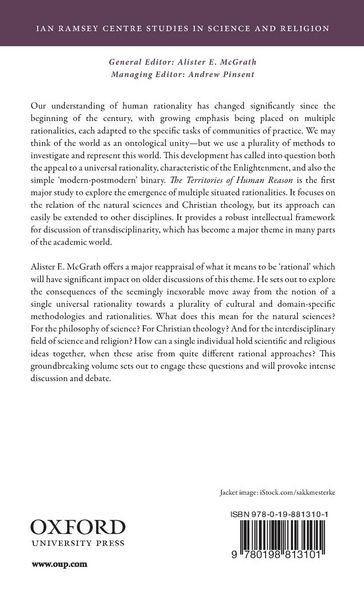
Our understanding of human rationality has changed significantly since the beginning of the century, with growing emphasis being placed on multiple rationalities, each adapted to the specific tasks of communities of practice. We may think of the world as an ontological unity-but we use a plurality of methods to investigate and represent this world. This development has called into question both the appeal to a universal rationality, characteristic of the Enlightenment, and also the simple 'modern-postmodern' binary. The Territories of Human Reason is the first major study to explore the emergence of multiple situated rationalities. It focuses on the relation of the natural sciences and Christian theology, but its approach can easily be extended to other disciplines. It provides a robust intellectual framework for discussion of transdisciplinarity, which has become a major theme in many parts of the academic world. Alister E. McGrath offers a major reappraisal of what it means to be 'rational' which will have significant impact on older discussions of this theme. He sets out to explore the consequences of the seemingly inexorable move away from the notion of a single universal rationality towards a plurality of cultural and domain-specific methodologies and rationalities. What does this mean for the natural sciences? For the philosophy of science? For Christian theology? And for the interdisciplinary field of science and religion? How can a single individual hold together scientific and religious ideas, when these arise from quite different rational approaches? This ground-breaking volume sets out to engage these questions and will provoke intense discussion and debate.
Noch keine Bewertungen vorhanden
Verfassen Sie die erste Bewertung zu diesem Artikel
Helfen Sie anderen Kundinnen und Kunden durch Ihre Meinung.
Kurze Frage zu unserer Seite
Vielen Dank für Ihr Feedback
Wir nutzen Ihr Feedback, um unsere Produktseiten zu verbessern. Bitte haben Sie Verständnis, dass wir Ihnen keine Rückmeldung geben können. Falls Sie Kontakt mit uns aufnehmen möchten, können Sie sich aber gerne an unseren Kund*innenservice wenden.
zum Kundenservice