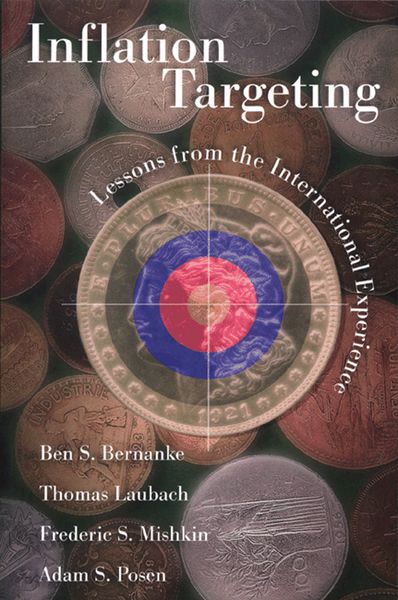
Inflation Targeting Lessons from the International Experience
-
- Taschenbuch
- eBook ausgewählt
-
Form:Einzelkauf Download
-
Sprache:Englisch
58,30 €
inkl. gesetzl. MwSt.Beschreibung
Produktdetails
Format
Kopierschutz
Nein
Family Sharing
Nein
Text-to-Speech
Nein
Erscheinungsdatum
05.06.2018
Verlag
Princeton University PressSeitenzahl
392 (Printausgabe)
Dateigröße
58394 KB
Sprache
Englisch
EAN
9780691187396
How should governments and central banks use monetary policy to create a healthy economy? Traditionally, policymakers have used such strategies as controlling the growth of the money supply or pegging the exchange rate to a stable currency. In recent years a promising new approach has emerged: publicly announcing and pursuing specific targets for the rate of inflation. This book is the first in-depth study of inflation targeting. Combining penetrating theoretical analysis with detailed empirical studies of countries where inflation targeting has been adopted, the authors show that the strategy has clear advantages over traditional policies. They argue that the U.S. Federal Reserve and the European Central Bank should adopt this strategy, and they make specific proposals for doing so.
The book begins by explaining the unique features and advantages of inflation targeting. The authors argue that the simplicity and openness of inflation targeting make it far easier for the public to understand the intent and effects of monetary policy. This strategy also increases policymakers' accountability for inflation performance and can accommodate flexible, even "discretionary," monetary policy actions without sacrificing central banks' credibility. The authors examine how well variants of this approach have worked in nine countries: Germany and Switzerland (which employ a money-focused form of inflation targeting), New Zealand, Canada, the United Kingdom, Sweden, Israel, Spain, and Australia. They show that these countries have typically seen lower inflation, lower inflation expectations, and lower nominal interest rates, and have found that one-time shocks to the price level have less of a "pass-through" effect on inflation. These effects, in turn, are improving the climate for economic growth. The authors warn, however, that the success of inflation targeting depends on operational details, such as how the targets are defined and when they are announced. They also show that inflation targeting is not a panacea that can make inflation perfectly predictable or reduce it without economic costs.
Clear, balanced, and authoritative, Inflation Targeting is a groundbreaking study that will have a major impact on the debate over the right monetary strategy for the coming decades. As a unique comparative study of what central banks actually do in different countries around the world, this book will also be invaluable to anyone interested in how economic policy is made.
Noch keine Bewertungen vorhanden
Verfassen Sie die erste Bewertung zu diesem Artikel
Helfen Sie anderen Kundinnen und Kunden durch Ihre Meinung.
Kurze Frage zu unserer Seite
Vielen Dank für Ihr Feedback
Wir nutzen Ihr Feedback, um unsere Produktseiten zu verbessern. Bitte haben Sie Verständnis, dass wir Ihnen keine Rückmeldung geben können. Falls Sie Kontakt mit uns aufnehmen möchten, können Sie sich aber gerne an unseren Kund*innenservice wenden.
zum Kundenservice