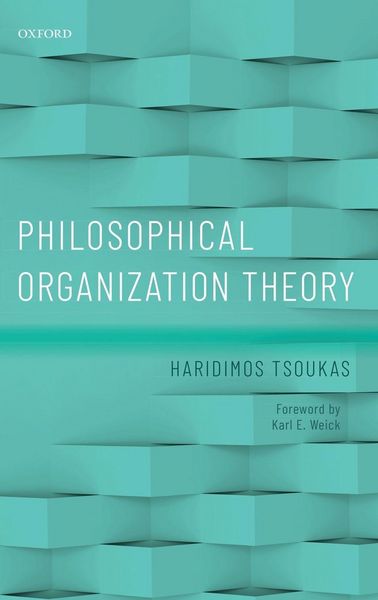
• Produktbild: Philosophical Organization Theory
  • Produktbild: Philosophical Organization Theory

Philosophical Organization Theory

99,99 €

inkl. gesetzl. MwSt., Versandkostenfrei


Beschreibung

Produktdetails

Einband

Gebundene Ausgabe

Erscheinungsdatum

13.02.2019

Verlag

Oxford University Press

Seitenzahl

488

Maße (L/B/H)

24/16,1/3,1 cm

Gewicht

892 g

Sprache

Englisch

ISBN

978-0-19-879454-7

Beschreibung

Rezension

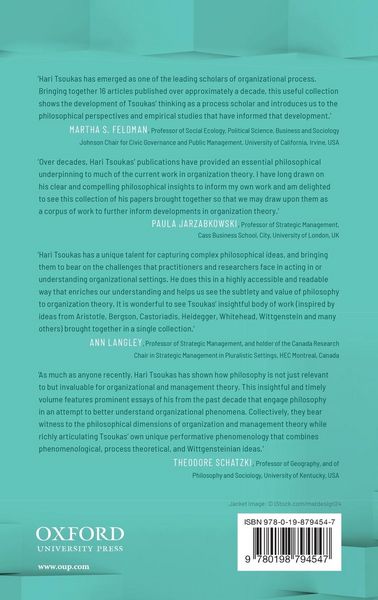
Hari Tsoukas has emerged as one of the leading scholars of organizational process. Bringing together 16 articles published over approximately a decade, this useful collection shows the development of Tsoukas' thinking as a process scholar and introduces us to the philosophical perspectives and empirical studies that have informed that development. Martha S. Feldman, Professor of Social Ecology, Political Science, Business and Sociology Johnson Chair for Civic Governance and Public Management, University of California, Irvine, USA

Produktdetails

Einband

Gebundene Ausgabe

Erscheinungsdatum

13.02.2019

Verlag

Oxford University Press

Seitenzahl

488

Maße (L/B/H)

24/16,1/3,1 cm

Gewicht

892 g

Sprache

Englisch

ISBN

978-0-19-879454-7

Noch keine Bewertungen vorhanden

Verfassen Sie die erste Bewertung zu diesem Artikel

Helfen Sie anderen Kundinnen und Kunden durch Ihre Meinung.

Kundinnen und Kunden meinen

Bewertungen (0)

Die Leseprobe wird geladen.
  • Produktbild: Philosophical Organization Theory
  • Produktbild: Philosophical Organization Theory
    • Introduction: What is Philosophical Organization Theory and Why Does it Matter?

    • I: Organization and Strategy

    • 1: Organization as chaosmos: Insights from Cornelius Castoriadis

    • 2: Understanding the Creation and Recreation of Routines From Within: A Symbolic Interactionist Perspective

    • 3: Complex Thought, Simple Talk: An Ecological Approach to Language-Based Change In Organizations

    • 4: Making Strategy: Meta-Theoretical Insights From Heideggerian Phenomenology

    • 5: Strategic Decision Making and Knowledge: A Heideggerian Approach

    • II: Knowledge and Reflective Judgment

    • 6: A Dialogical Approach to the Creation of New Knowledge in Organizations

    • 7: What is Reflection-in-Action? A Phenomenological Account

    • 8: In Search Of Phronesis: Leadership and the Art of Judgment

    • 9: Performing Phronesis: On The Way to Engaged Judgment

    • 10: The "Metaphor" Metaphor: Educating Practitioners For Reflective Judgment

    • III: Theorizing

    • 11: Theory As Therapy: Wittgensteinian Reminders For Reflective Theorizing In Organization And Management Theory

    • 12: Grasping The Logic Of Practice: Theorizing Through Practical Rationality

    • 13: Practice Theory: What It Is, Its Philosophical Base, And What It Offers Organization Studies

    • 14: Craving For Generality And Small-N Studies: A Wittgensteinian Approach Towards The Epistemology of The Particular in Organization and Management Theory

    • 15: The Power Of The Particular: Towards An Organization Science Of Singularities

    • 16: Don't Simplify, Complexify: From Disjunctive To Conjunctive Theorizing In Organization And Management Studies